The tradition & historical record
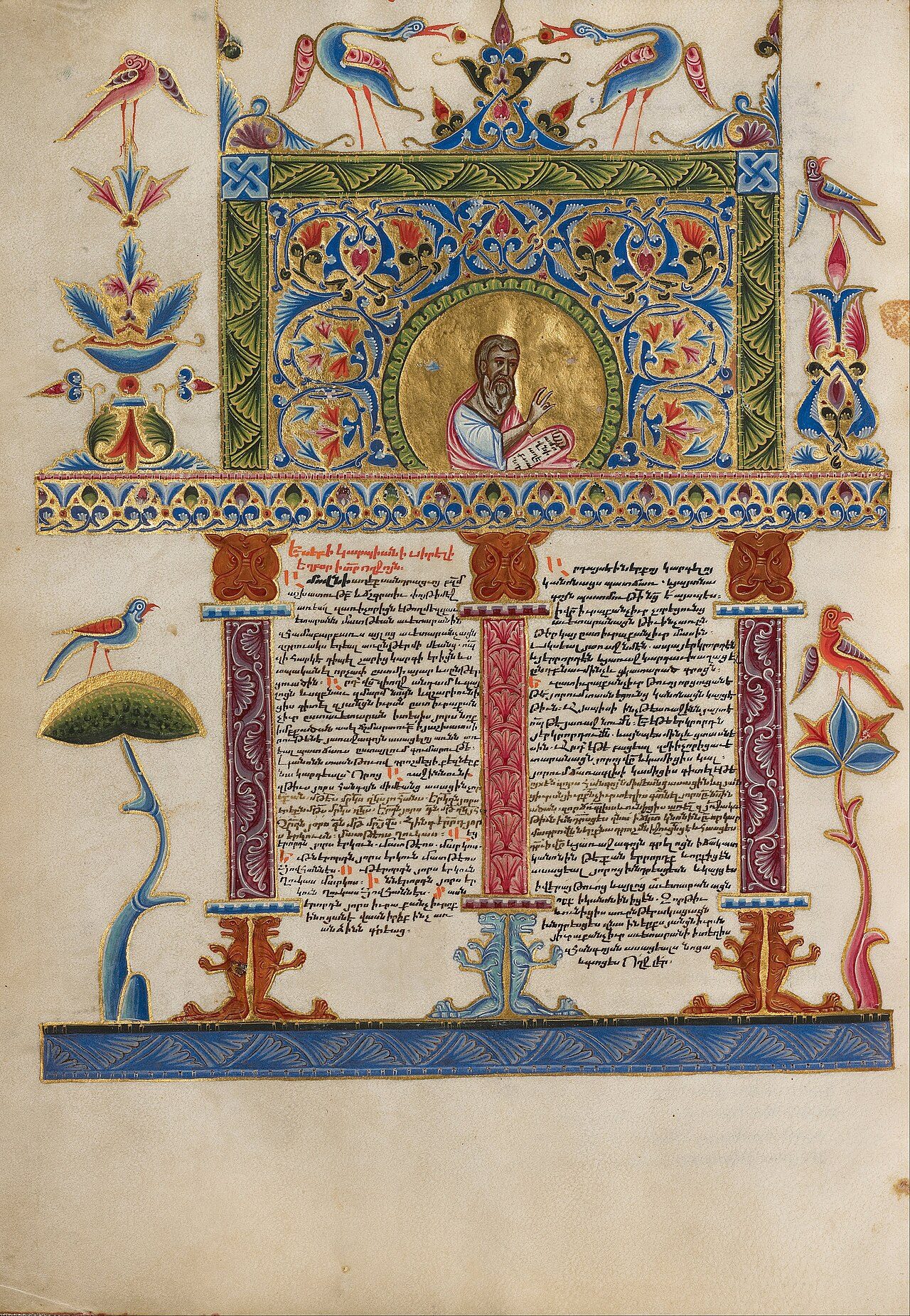
6 min read · 2 sourcesArmenian illuminated manuscripts (Armenian: Հայկական մանրանկարչություն, romanized: Haykakan manrankarch'owt'yown), form an Armenian tradition of formally prepared documents where the text is often supplemented with flourishes such as borders and miniature illustrations. They are related to other forms of Medieval Armenian art, Persian miniatures, and to Byzantine illuminated manuscripts. The earliest surviving examples date after the Golden Age of Armenian art and literature in the 6th century. Armenian illuminated manuscripts embody Armenian culture; they illustrate its spiritual and cultural values. The most famous Armenian miniaturist, Toros Roslin, lived in the 13th century. The art form flourished in Greater Armenia, Lesser Armenia and the Armenian Diaspora. Its appearance dates back to the creation of the Armenian alphabet in Armenia, in the year 405 AD. Very few fragments of illuminated manuscripts from the 6th and 7th centuries have survived. The oldest fully preserved manuscript dates from the 9th century. Art experienced a golden age in the 13th and 14th centuries when the main schools and centers started to pop up (1,500 centers of writing and illumination). The most striking are those of Syunik, Vaspurakan and Cilicia. Many Armenian illuminated manuscripts outside the country of Armenia have also survived the centuries. 1
Emergence
The Armenian form of miniatures and illuminations probably originated with the creation of the first Armenian books at the beginning of the 5th century, but a hiatus of four centuries separated the emergence of the art from the oldest preserved illuminated manuscripts (with the exception of the 'Final Four Miniatures' of the Echmiadzin Gospels); the latter, however, is probably inspired by earlier manuscripts. At its beginnings, the art of the illuminator was done by the same scribe who wrote the manuscript, the ornamentations like the text, only simple copies of earlier models, but in the 9th and 10th centuries, it became more refined and sophisticated until it separated from the work of the scribe to form a unique role in the making of manuscripts. The first surviving manuscripts are the tetra-gospels (including, in addition to the four gospels, the Letter of Eusebius and the Eusebian canons and the "mystical allegory of the economy of salvation") which already demonstrate the diversity in genre, style and technique of the illustrations. The art got influenced by Byzantine art, with its monumental appearance (see for example the Gospel of Trebizond, 11th century, San Lazzaro degli Armeni, Ms. 1400), and by oriental art, with its taste for heavily ornamented pages (illustrated in the Mughni gospel, 11th century, Matenadaran, Ms. 7736), the two influences were sometimes found in one manuscript (such as the Gospel of King Gagik of Kars, 11th century, Armenian Patriarchate of Jerusalem, Ms. 1
Apotheosis
The political and cultural life in Greater Armenia experienced a brief development at the end of the twelfth and the beginning of the thirteenth century, with the support of neighboring Georgia. The Armenians then managed to fight off the Seljuk invasions and experienced a certain boom called the “Zakarid renaissance”. As a result, they formed an independent principality governed by the Zakarids in which a brief period of relative peace reigned before the coming of the Mongol invasions of Transcaucasia between 1220 and 1240. Construction projects of palaces and churches grew in number in the first half of the 13th century. In parallel, the activity of the schools of miniaturists and scriptoria was in full expansion; grammar, language, rhetoric, theology, philosophy, music, painting and calligraphy were all taught there, notably in the universities (hamalsaran) of Tatev and Gladzor, often called as the “second Athens”. This last university, "almost contemporary with one of the main centers of European thought, the University of Paris, could compete with the latter as much in terms of cultural training as by the richness of its library and the diversity of the subjects taught. ”. Only a few ruins of the University of Gladzor remain today, a result of the Mongol and Timurid invasions. As if to compensate for the catastrophic losses by these invasions, the Armenian kingdom of Cilicia flourished from the eleventh century to the end of the fourteenth century. 1
Upper Armenia
The surviving manuscripts of upper Armenian origins, a northwestern region of historic Armenia, crossing several roads of transit axis in the 13th century, are "always decorated with rich vegetal motifs, curved leaves with the sharpness of a sickle and scrolls with palmettes”. At first, treated "in a fairly realistic manner", these motifs gradually experienced an "increasingly pronounced stylization", to end up spreading to the art of Transcaucasia, the Near East and the Middle East. In the largest of the known Armenian manuscripts, the Homiliary of Mush (monastery of the Holy Apostles, 1200-1202, Matenadaran, Ms. 7729), written in erkataghir (Armenian uncials), the pages are filled with vignettes and marginal motifs of Armenian pagan origin. This is largely due to the pagan and Zoroastrian sanctuaries getting consecrated as temples dedicated to Christianity, a result of the Christianization of the country in 301 AD with the conversion of the king of Armenia, Tiridates III from paganism to Christianity. Subsequently, elements inherited from ancient paganism mixed with Christian art, but they carried new meanings. This homily symbolizes with its ornamentation a search for the renovation of already existing shapes and an effort to create new motifs. It seems to be the work of three artists of whom only the name of the author of the title page has been preserved: Stepanos. A second miniaturist executed an important series of more vivid miniatures. With a more fiery temperament, he painted in the margins of the manuscript vegetal ornaments of various shapes, in which birds as well as real and fantastic animals are also found. From a stylistic point of view, warm color combinations are based on the principle of contrasts. 1
Ani
Still protected during the early period of the 13th century by the Zakarid dynasty, the capital of the kingdom of Ani was full of activities involving numerous economic occupations such as craftsmen, artisans and traders of diverse languages and cultural backgrounds. Cultural life was maintained there amidst numerous difficulties. Lydia Durnovo writes in her essay: “this middle class of the population, in constant expansion, naturally made its culture prevail over those of the aristocracy and the working classes. It didn't aspire to pomp and did not intend to spend large sums on the production of lavish manuscripts, but the laconic simplicity of folk art did not satisfy it either. This class had widened its horizon and its field of knowledge. It needed texts in the form of detailed narratives sprinkled with digressions and explanations. 1
Syunik
Syunik, a province in the southeast of Lake Sevan, is home to t… 1
The text above is adapted from the Wikipedia article “Armenian illuminated manuscripts”, available under the Creative Commons Attribution-ShareAlike 4.0 licence. 1
Armenian illuminated manuscript is decorated manuscript in Armenian, according to the structured record cited below. This entry was generated automatically from that record and has not yet been reviewed by a person familiar with the tradition. 2
The source record links this tradition to 1 external register, which can be verified through the citation. 2