The tradition & historical record
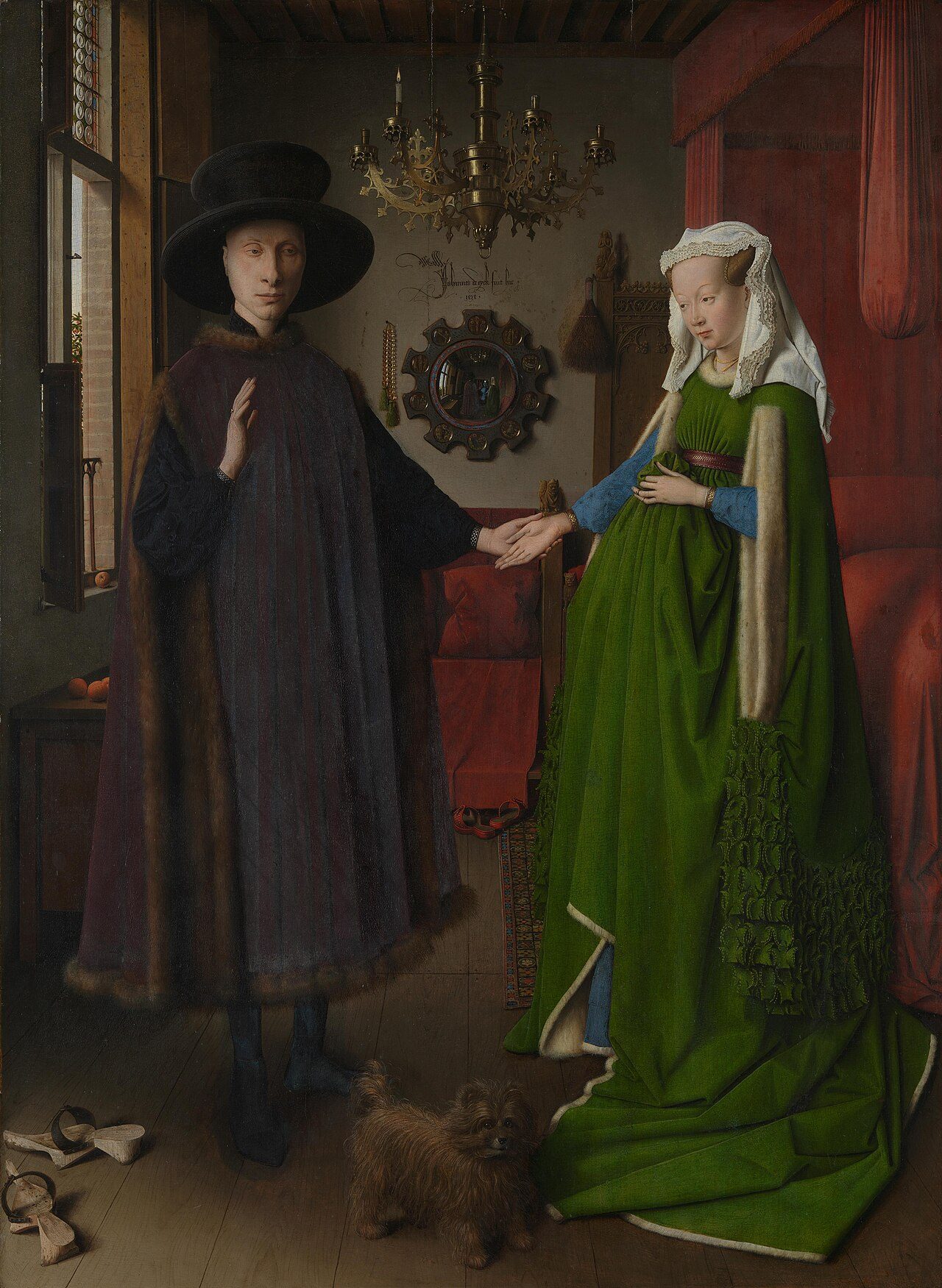
7 min read · 2 sourcesThe Arnolfini Portrait (or The Arnolfini Wedding, The Arnolfini Marriage, the Portrait of Giovanni Arnolfini and his Wife, or other titles) is an oil painting on oak panel by the Early Netherlandish painter Jan van Eyck, dated 1434 and now in the National Gallery, London. It is a full-length double portrait, believed to depict the Italian merchant Giovanni di Nicolao Arnolfini and his wife, presumably in their residence at the Flemish city of Bruges. It is considered one of the most original and complex paintings in Western art, because of its beauty, complex iconography, geometric orthogonal perspective, and expansion of the picture space with the use of a mirror. According to Ernst Gombrich: 1
In its own way it was as new and revolutionary as Donatello's or Masaccio's work in Italy. A simple corner of the real world had suddenly been fixed on to a panel as if by magic [...] For the first time in history the artist became the perfect eye-witness in the truest sense of the term. 1
The portrait has been considered by Erwin Panofsky and some other art historians as a unique form of marriage contract, recorded as a painting. Signed and dated by van Eyck in 1434, it is, with the Ghent Altarpiece by the same artist and his brother Hubert, the oldest very famous panel painting to have been executed in oils rather than in tempera. 1
Description
Jan van Eyck's characteristic Early Netherlandish style depicts the scene with a high level of detail. The painting is generally in very good condition, though with small losses of original paint and damage, which have mostly been retouched. Infrared reflectograms of the painting show many small alterations, or pentimenti, in the underdrawing: to both faces, to the mirror, and to other elements. The couple is shown in an upstairs room with a chest and a bed in it during early summer as indicated by the fruits on the cherry tree outside the window. The room probably functioned as a reception room, as was the fashion in France and Burgundy where beds in reception rooms were used for seating, except, for example, when a mother with a new baby received visitors. The window has six interior wooden shutters, but only the top opening has glass, with clear bulls-eye pieces set in blue, red and green stained glass. The two figures are very richly dressed; despite the season both their outer garments, his tabard and her houppelande, are trimmed and fully lined with fur. The furs may be the especially expensive sable for him and ermine or miniver for her. He wears a hat of plaited straw dyed black, as was often worn in summer at this time. His tabard was more purple than it appears now (as the pigments have faded over time) and may be intended to be silk velvet (another very expensive item). Underneath he wears a doublet of patterned material, probably silk damask. The woman holds her long, full skirts up, revealing a blue underdress also trimmed with white fur. Her robe has elaborate dagging (cloth folded and sewn together, then cut and frayed decoratively) on the sleeves, and a long train. 1
Identity of subjects
In their book published in 1857, Crowe and Cavalcaselle were the first to link the double portrait with the early 16th century inventories of Margaret of Austria. They suggested that the painting shows portraits of Giovanni [di Arrigo] Arnolfini and his wife. Four years later James Weale published a book in which he agreed with this analysis and identified Giovanni's wife as Jeanne (or Giovanna) Cenami. For the next century most art historians accepted that the painting was a double portrait of Giovanni di Arrigo Arnolfini and his wife Jeanne Cenami, but a chance discovery published in 1997 established that they were married in 1447, thirteen years after the date on the painting and six years after van Eyck's death. It is now believed that the subject is either Giovanni di Arrigo or his cousin, Giovanni di Nicolao Arnolfini, and a wife of either one of them. This is either an undocumented first wife of Giovanni di Arrigo or a second wife of Giovanni di Nicolao, or, according to a recent proposal, Giovanni di Nicolao's first wife Costanza Trenta, who had died perhaps in childbirth by February 1433. In the latter case, this would make the painting partly an unusual memorial portrait, showing one living and one dead person. Details such as the snuffed-out candle above the woman, the scenes after Christ's death on her side of the background roundel, and the black garb of the man, support this view. Both Giovanni di Arrigo and Giovanni di Nicolao Arnolfini were Italian merchants, originally from Lucca, but resident in Bruges since at least 1419. The man in this painting is the subject of a further portrait by van Eyck in the Gemäldegalerie, Berlin, leading to speculation he was a friend of the artist. 1
Scholarly debate
In 1934, Erwin Panofsky published an article entitled Jan van Eyck's 'Arnolfini' Portrait in the Burlington Magazine, arguing that the elaborate signature on the back wall, and other factors, shows that it was painted as a legal record of the occasion of the marriage of the couple, complete with witnesses and a witness signature. Panofsky also argues that the many details of domestic items in the painting each have a disguised symbolism attached to their appearance. While Panofsky's claim that the painting formed a kind of certificate of marriage is not accepted by all art historians, his analysis of the symbolic function of the details is broadly agreed, and has been applied to many other Early Netherlandish paintings, especially a number of depictions of the Annunciation set in richly detailed interiors, a tradition for which the Arnolfini Portrait and the Mérode Altarpiece by Robert Campin represent the start (in terms of surviving works at least). Since then, there has been considerable scholarly argument among art historians on the occasion represented. Edwin Hall considers that the painting depicts a betrothal, not a marriage. Margaret D. Carroll argues that the painting is a portrait of a married couple that alludes also to the husband's grant of legal authority to his wife. Carroll also proposes that the portrait was meant to affirm Giovanni Arnolfini's good character as a merchant and aspiring member of the Burgundian court. She argues that the painting depicts a couple, already married, now formalizing a subsequent legal arrangement, a mandate, by which the husband "hands over" to his wife the legal authority to conduct business on her own or his behalf (similar to a power of attorney). 1
Figures and marriage
It is thought that the couple are already married because of the woman's headdress. A non-married woman would have her hair down, according to Margaret Carroll. 1
Mirror
The small medallions set into the frame of the convex mirror at the back of the room show tiny scenes from the Passion of Christ and may represent God's promise of salvation for the figures reflected on the mirror's convex surface. 1
The text above is adapted from the Wikipedia article “Arnolfini Portrait”, available under the Creative Commons Attribution-ShareAlike 4.0 licence. 1
Arnolfini Portrait is 1434 painting by Jan van Eyck, according to the structured record cited below. This entry was generated automatically from that record and has not yet been reviewed by a person familiar with the tradition. 2
The source record links this tradition to 17 external registers, which can be verified through the citation. 2