The tradition & historical record
6 min read · 2 sourcesByzantine illuminated manuscripts were produced across the Byzantine Empire, some in monasteries but others in imperial or commercial workshops. Religious images or icons were made in Byzantine art in many different media: mosaics, paintings, small statues and illuminated manuscripts. Monasteries produced many of the illuminated manuscripts devoted to religious works using the illustrations to highlight specific parts of text, a saints' martyrdom for example, while others were used for devotional purposes similar to icons. These religious manuscripts were most commissioned by patrons and were used for private worship but also gifted to churches to be used in services. Not all Byzantine illuminated manuscripts were religious texts, secular subjects are represented in chronicles (e.g. Madrid Skylitzes), medical texts such as the Vienna Dioscurides, and some manuscripts of the Greek version of the Alexander Romance. In addition to the majority of manuscripts, in Greek, there are also manuscripts from the Syriac Church, such as the Rabbula Gospels, and Armenian illuminated manuscripts which are heavily influenced by the Byzantine tradition. "Luxury" heavily-illuminated manuscripts are less of a feature in the Byzantine world than in Western Christianity, perhaps because the Greek elite could always read their texts, which was often not the case with Latin books in the West, and so the style never became common. 1
Origins
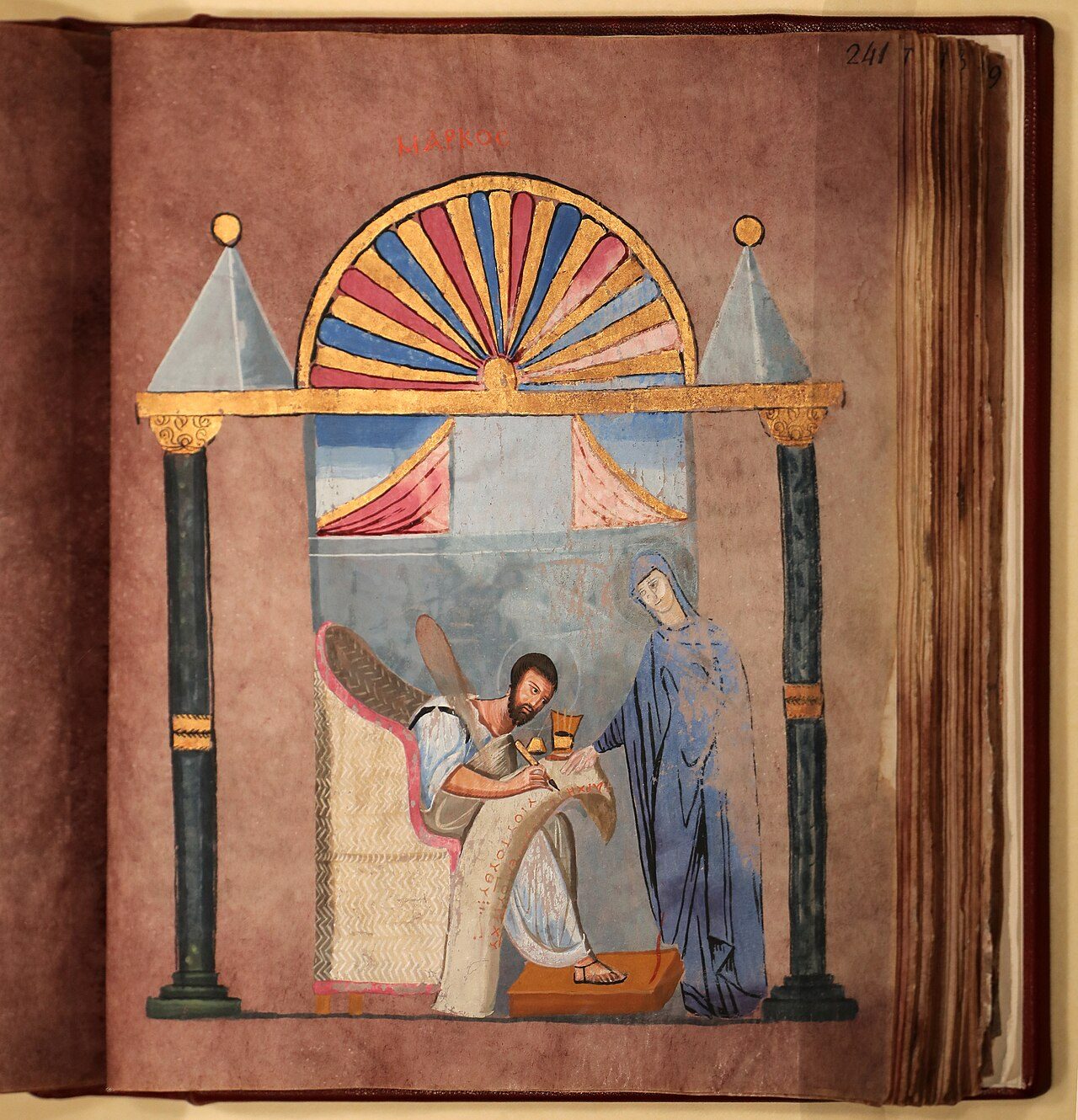
Due to the lack of early Byzantine manuscripts, it is difficult to know about the situation of illumination during the first centuries of the Eastern Roman Empire. Constantine I installed a scriptorium in his palace, and it is likely that it had a presence of illuminators and miniaturists, but none of its manuscripts have been preserved. There are still some fragments of illuminated papyri found in Egypt which prove that there was an early byzantine tradition of illuminating manuscripts. The earliest manuscripts date back to the 6th century. These manuscripts show clear influences of ancient stylistic traditions. This is the case in the oldest of these codices, the Vienna Dioscorides, commissioned by Princess Anicia Juliana in Constantinople at the beginning of this century, but also in somewhat later manuscripts such as the Vienna Genesis, the Codex Sinopensis and the Codex Purpureus Rossanensis (which comes from the south of Byzantine Italy) or even the Cotton Genesis, which most likely comes from Egypt. The artistic trend leans more towards hieratic and more abstract figures than in the previous period. The Rabbula Gospels, which come from Mesopotamia and is dated to 586, move further away from this style, with more contrasting colors and more geometric shapes. 1
Iconoclastic period
While a certain number of works of art and in particular manuscripts were destroyed, some manuscripts were nevertheless produced during this period from the seventh to the mid-ninth century, particularly in the peripheral areas of the empire, such as in Palestine, or in Italy. It is probably in the latter that a copy of the Sacra Parallela (BNF, Greek 923) was produced, which contains more than 1600 illustrations located in the margins of the manuscript. The style is very distant from the models of the late antiquity, it is notable in its use thick black brush strokes and its use of the gold ground technique. But it was in Constantinople, in a monastic scriptorium, that the Chludov Psalter was painted in the middle of the ninth century, it contains numerous figurative decorations in the margins, including a representation of a scene of the destruction of an icon. 1
Renaissance
Illumination flourished starting from the late 9th century to the 12th century. Several hundred manuscripts are preserved from this period, they are most often parchment codices, which take precedence over scrolls, although the latter did not completely disappear as shown in the Joshua Roll (Vatican Apostolic Library, Palat.Grec 431). However, they are very often poorly preserved. As the techniques implemented for the coloring recommended either the production of a very thin layer of paint which does not allow them to set correctly on the parchment, or on the contrary the application of a very thick layer which has tendency to flake off. Moreover, it is often difficult to be able to date them and locate their production due to the frequent absence of a colophon. Illumination from this period most often consists of miniatures either full-page or on part of the page such as margin decorations and less frequently initials of simple ornamental of vegetal or zoomorphic decoration. The psalters are the most frequent illuminated texts. They are of two types: the monastic psalters, of modest dimensions, whose decorations are found in the margins of almost all pages. This is the case of the Chludov psalter and the Theodore Psalter dated 1066 (BL, Add.19352). The aristocratic psalters are, on the contrary, large in size, and decorated with sumptuous full-page miniatures but in a reduced number, most often depicting biblical royal figures. The Paris Psalter is the most famous example, perhaps made for Constantine VII. Among the other manuscripts, there are octateuchs as well as evangeliaries, which are decorated with portraits of evangelists, scenes from the life of Christ and Eusebian Canons. 1
Latin interlude
During the period of the occupation of Constantinople by the Crusaders, between 1204 and 1261, following its sacking, Byzantine art experienced an interval during which it was no longer a priority, the new rulers showing little interest to the art. Only a small group of Byzantine manuscripts are dated to this period, with most of them mixing Latin and Byzantine elements. One of them, a bilingual Latin-Greek gospel book, is still kept at the National Library of France; the Greek-Latin tetra-gospel (Gr.54), which was probably intended for a high Latin dignitary, religious or layman. It was never completed. 1
Palaeologian era
The field of illumination remained more in permanence during the time of the Palaiologos than in innovation. The manuscripts of this period take up the models developed in previous periods, drawing inspiration from or even directly imitating the manuscripts of Macedonian or Komnenian art. The works were getting increasingly made on paper and no longer on parchment, the production declined with what remained of the empire. Some works show an influence of Western illumination of the time, such as a Book of Job written by a scribe from Mistra named Manuel Tzykandyles around 1362 (BNF, Gr.132). Nevertheless, some manuscripts took advantage of the revival of monumental painting during the fourteenth century, with much more expressive and virtuoso representations, particularly in portraits. These are found in a manuscript of theological works of Emperor John VI Kantakouzenos (BNF, Gr.1242) in which are painted in addition to a Transfiguration, the portraits of the owner as an emperor and as a monk. 1
The text above is adapted from the Wikipedia article “Byzantine illuminated manuscripts”, available under the Creative Commons Attribution-ShareAlike 4.0 licence. 1
art of Byzantine illumination is illumination of manuscripts across the Byzantine Empire, according to the structured record cited below. This entry was generated automatically from that record and has not yet been reviewed by a person familiar with the tradition. 2
The source record links this tradition to 8 external registers, which can be verified through the citation. 2