The tradition & historical record
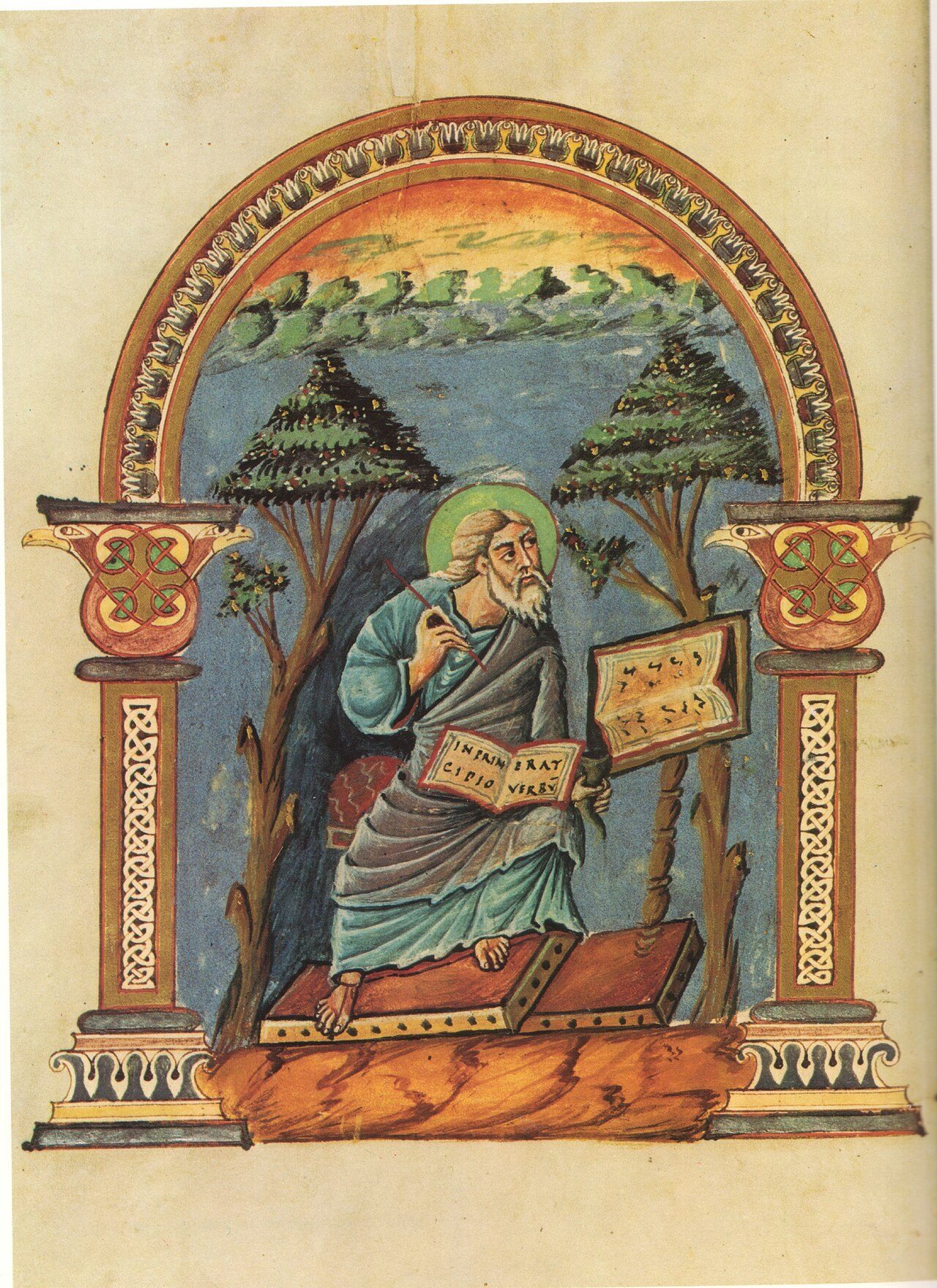
6 min read · 2 sourcesCarolingian illumination refers to the illuminated manuscripts produced in the Frankish Empire from the late 8th to the late 9th century. While the preceding Merovingian illumination was purely monastic in character, Carolingian illumination originated from the courts of the Frankish kings and the residences of prominent bishops. The starting point was the court school of Charlemagne at the Aachen Palace, to which the manuscripts of the Ada group are assigned. At the same time, and probably in the same location, there existed the palace school, whose artists were influenced by Byzantine illumination. The codices of this school are also known, after their leading manuscript, as the group of the Vienna Coronation Gospels. Despite all stylistic differences, both painting schools share a direct engagement with the formal language of late antique illumination and an effort toward a clarity of page design unprecedented until then. After Charlemagne's death, the center of illumination shifted to Reims, Tours, and Metz. While the court school dominated during Charlemagne's time, the works of the palace school were more strongly received in the later centers of book art. The heyday of Carolingian illumination ended in the late 9th century. In the late Carolingian period, a Franco-Saxon school developed, which again increasingly adopted forms of the older Insular illumination, before a new era began with Ottonian illumination from the end of the 10th century. 1
Temporal and geographical framework
The classification of Carolingian art into an era is inconsistent: sometimes it is considered a distinct art epoch, more often it is summarized with other styles from the 5th to 11th centuries as early medieval art or with Ottonian art as Pre-Romanesque, and occasionally already included in the Romanesque era as early Romanesque. Carolingian art was strongly tied to the respective ruling house and limited to the domain of the Carolingians, thus to the Frankish Empire. Art regions outside this area are not counted as Carolingian art. An exception is the Lombard Kingdom, which Charlemagne was able to conquer in 773/774, but which continued its own cultural traditions that strongly influenced Carolingian art. Conversely, the impulses of the Carolingian Renaissance also affected Italy, especially Rome. The election of Pepin the Short in 751 as king of the Franks marks the beginning of the Carolingian royal dynasty, but an independent Carolingian art only began under Charlemagne, who was sole ruler of the Frankish Empire from 771 and was crowned emperor in 800. The first luxury manuscript commissioned by Charlemagne between 781 and 783 was the Godescalc Evangelistary. After the death of Louis the Pious, Charlemagne's successor, the empire was divided in 843 by the Treaty of Verdun into the three parts of West, East Francia, and Lotharingia. Lotharingia experienced several further divisions in the following decades, in which some areas fell to West and East Francia, while others became independent kingdoms and duchies in Lorraine, Burgundy, and Italy. With the death of Louis the Child in 911, the line of the East Frankish Carolingians died out. The new king was Conrad the Younger from the Conradine family. 1
Artists and patrons
In Merovingian times, only monasteries were responsible for book production, but the Carolingian Renaissance originated from Charlemagne's court. The Godescalc Evangelistary, the Dagulf Psalter, and a plain manuscript attest to Charlemagne as patron in dedication poems and colophons. Under Charlemagne's successors, short-lived workshops were also tied to the courts of the Carolingian emperors and kings or to prominent bishops closely connected to the royal court. Only the monastery of Tours remained productive for decades until its destruction in 853. Most liturgical books were intended for the royal court. Some of the most precious codices served as gifts of honor; thus, the Dagulf Psalter was planned as a gift from Charlemagne to Pope Hadrian I, although it did not come to a handover due to Hadrian's death. A third group of manuscripts was produced for the empire's most important monasteries to carry the religious and cultural impulses emanating from the imperial court into the empire. Thus, the Saint-Riquier Gospels was intended for Charlemagne's son-in-law Angilbert, the lay abbot of Saint-Riquier, and in 827, Louis the Pious donated a gospel book (Soissons Gospels) from Charlemagne's court school to the church of Saint-Médard in Soissons. Conversely, the Touronian monastery under Abbot Vivian gave Charles the Bald the Vivian Bible in 846, which he probably donated to Metz Cathedral in 869/870. Few early medieval illuminators are known by name. In an illustrated Terence manuscript, perhaps from Aachen, one of the three painters, Adelricus, hid his name in the gable ornament of a miniature. 1
The book in Carolingian times and its transmission
The books, produced in a labor-intensive process with expensive materials, were an extremely precious luxury item. All Carolingian manuscripts are written on parchment; the cheaper paper only reached Europe in the course of the 13th century. Particularly representative luxury manuscripts, such as the Godescalc Evangelistary, the Soissons Gospels, the Coronation Gospels, the Lorsch Gospels, and the Bible of St. Paul were written with gold and silver ink on purple-dyed parchment. Their book covers were decorated with ivory carving panels framed by goldsmith works studded with gems. In the miniatures, gouache painting dominated; rarer was the – usually colored – pen drawing. 1
Around 8000 manuscripts from the 8th and 9th centuries survive. How great the book losses are due to Viking invasions, wars, iconoclastic storms, fires, and other violent causes, due to disregard or reuse of parchment as raw material, is hardly estimable. Surviving library catalogs provide information on the extent of some of the largest libraries. Thus, the book stock of St. Gallen Monastery rose in Carolingian times from 284 to 428, Lorsch Abbey owned 590 in the 9th century, and the monastery library in Murbach 335 manuscripts. Wills provide an idea of the extent of private libraries. The 200 codices that Angilbert bequeathed to his monastery Saint-Riquier and among which was also the Saint-Riquier Gospels, was probably one of the largest libraries. Eccard of Mâcon bequeathed about twenty books to his heirs. How large Charlemagne's library was, which was sold after his death according to his testamentary provisions, is unknown. 1
Merovingian illumination
The Carolingian Renaissance formed in a pronounced “cultural vacuum”, its center became Charlemagne's residence Aachen. Merovingian illumination, named after the Merovingian ruling dynasty preceding the Carolingians in the Frankish Empire, remained purely ornamental. The initials constructed with ruler and compass, as well as title pages with arcades and inserted cross, are almost the only form of illustration. 1
Insular illumination
Until the Carolingian Renaissance, the British Isles were the refuge of Roman-early Christian tradition, which, however, through mixing with … 1
The text above is adapted from the Wikipedia article “Carolingian illumination”, available under the Creative Commons Attribution-ShareAlike 4.0 licence. 1
art of Carolingian illumination is decoration of manuscripts in the Carolingian period, according to the structured record cited below. This entry was generated automatically from that record and has not yet been reviewed by a person familiar with the tradition. 2
The source record links this tradition to 7 external registers, which can be verified through the citation. 2