The tradition & historical record
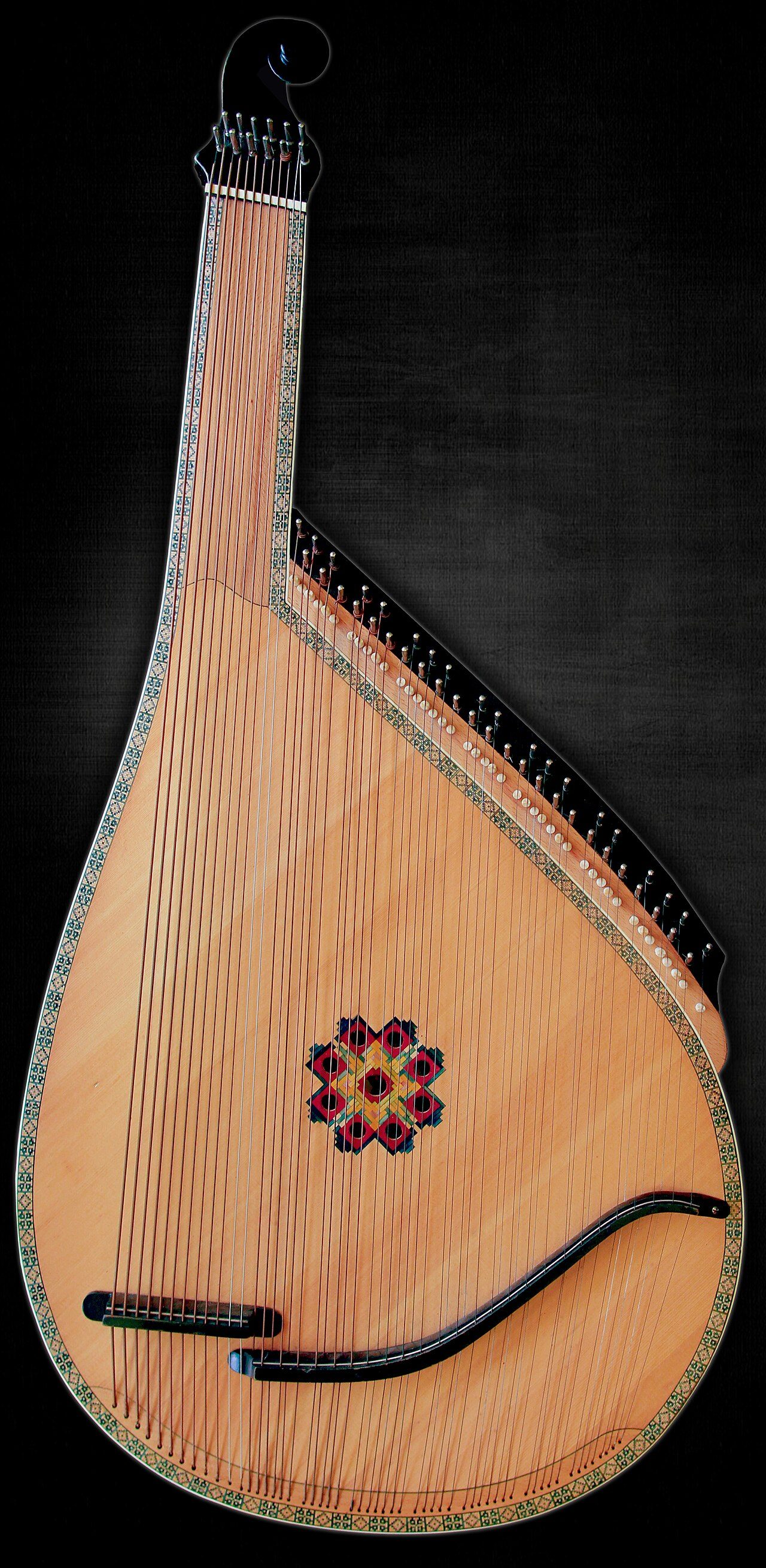
6 min read · 2 sourcesA bandura (Ukrainian: бандура [bɐnˈdurɐ] ) is a Ukrainian plucked-string folk-instrument. It combines elements of the zither and lute and, up until the 1940s, was also often called a kobza. Early instruments (c. 1700) had 5 to 12 strings and resembled lutes. In the 20th century, the number of strings increased initially to 31 strings (1926), then to 56 strings – 68 strings on modern "concert" instruments (1954). Musicians who play the bandura are referred to as bandurists. In the 19th and early 20th centuries traditional bandura players, often blind, were called kobzars. It is suggested that the instrument developed as a hybrid of gusli (Eastern-European psaltery) and kobza (Eastern-European lute). Some also consider the kobza as a type or an instrument resembling the bandura. The term bandura occurs in Polish chronicles from 1441. The hybridization, however, occurred in the late-18th or early-19th centuries. 1
Etymology and terminology
Banduras are first recorded in a Polish chronicle of 1441, which mentioned that Sigismund III, king of Poland, employed the Ruthenian Taraszko at court to play the bandura and be his chess companion. Medieval Polish manuscripts recorded other court bandurists of Ukrainian descent. The term bandura is generally thought to have entered the Ukrainian language via Polish, either from Latin or from the Greek pandora or pandura; some scholars believe the term was introduced directly from Greek. The use of the term bandore (or bandora) stems from a now discredited assumption, initially made by Russian musicologist A. Famintsyn, that the word was borrowed directly from England. The word appeared in early 20th century Soviet Ukrainian-English and Russian-English dictionaries. Eastern European string instruments such as the hurdy-gurdy are occasionally referred to as banduras, and the five-string guitar as a bandurka. 1
History
The use of lute-like stringed instruments by Ukrainians dates back to 591. In that year, Byzantine Greek chronicles mention Bulgar warriors who travelled with lute-like instruments they called kitharas. There are iconographic depictions of lute-like instruments in the 11th-century frescoes of Saint Sophia's Cathedral, the capital of the Kievan Rus'. It is not known by what specific term these instruments were referred to in those early times, although it has been surmised that the lute-like instrument was referred to by the generic medieval Slavic term for a string instrument—"husli". 1
Early years
Up until the mid 18th century, the instrument known as the bandura had frets and was played in a manner similar to the lute or guitar. The instrument was similar to the German bandore with usually 5 single courses strung along the neck. In the mid 18th century additional strings known as "prystrunky" began to appear. Gradually the zither–like bandura replaced the lute–like bandura by the middle of the 19th century. The invention of an instrument combining organological elements of lute and psaltery is sometimes credited to Francesco Landini, an Italian lutenist-composer during the trecento. Filippo Villani wrote in his Liber de civitatis Florentiae, "[Landini] invented a new sort of instrument, a cross between lute and psaltery, which he called the serena serenarum, an instrument that produces an exquisite sound when its strings are struck." Rare iconographic evidence (by artists such as Alessandro Magnasco) reveals that such instruments were still in use in Italy c. 1700. In the Hetman state in left-bank Ukraine, the bandura underwent significant transformations with the development of a professional class of itinerant blind musicians called kobzars. The first mentions of an institution for the study of bandura playing date back to 1738, to a music academy in Hlukhiv where the bandura and violin were taught to be played from sheet music. This was the first music school in Eastern Europe and prepared musicians and singers for the Tsarist Court in St Petersburg. The construction and playing technique were adapted to accommodate its primary role as accompaniment to the solo singing voice. 1
Court years
Up until the 20th century, the bandura repertoire was an oral tradition based primarily on vocal works sung to the accompaniment of the bandura. These included folk songs, chants, psalms, and epics known as dumy. Some folk dance tunes were also part of the repertoire. The instrument became popular in the courts of the nobility in Eastern Europe. There are numerous citations mentioning the existence of Ukrainian bandurists in both Russia and Poland. Empress Elisabeth of Russia (the daughter of Peter the Great) had a long-standing relationship and maybe a morganatic marriage with her Ukrainian court bandurist, Olexii Rozumovsky. In 1908, the Mykola Lysenko Institute of Music and Drama in Kyiv began offering classes in bandura playing, instructed by kobzar Ivan Kuchuhura Kucherenko. Kucherenko taught briefly until 1911, and attempts were made to reopen the classes in 1912 with Hnat Khotkevych; however, the death of Mykola Lysenko and Khotkevych's subsequent exile in 1912 prevented this from happening. Khotkevych published the first primer for the bandura in Lviv in 1909. It was followed by a number of other primers specifically written for the instrument, most notably those by Mykhailo Domontovych, Vasyl Shevchenko and Vasyl Ovchynnikov, published in 1913–14. In 1910, the first composition for the bandura was published in Kyiv by Khotkevych. It was a dance piece entitled "Odarochka" for the folk bandura played in the Kharkiv style. Khotkevych prepared a book of pieces in 1912 but, because of the arrest of the publisher, it was never printed. Despite numerous compositions being written for the instrument in the late 1920s and early 30s, and the preparation of these works for publication, little music for the instrument was published in Ukraine. 1
Tsarist sanctions
The persecution of Kobzars started in 1876 under Imperial Russia with the publication of the Ems Ukaz: stage performances by kobzars and bandurists were officially banned. Paragraph 4 of the decree was specifically aimed at preventing all music, including ethnographic performances in Ukrainian. As a result, blind professional musicians such as the kobzars turned to the street for their sustenance. In the major Russian speaking cities, they were often treated like common street beggars by the non-Ukrainian population, being arrested and having their instruments destroyed. The restrictions and brutal persecution were only halted in 1902 after a special delegation was sent to the Ministry of Internal Affairs from the Imperial Archaeological Society. Sanctions introduced by the Russian government in 1876 (Ems ukaz) that severely restricted the use of Ukrainian language and in point 4, also restricted the use of the bandura on the concert stage since all of the repertoire was sung in Ukrainian. Many bandurists and kobzars were systematically persecuted by the authorities controlling Ukraine at various times. 1
The text above is adapted from the Wikipedia article “Bandura”, available under the Creative Commons Attribution-ShareAlike 4.0 licence. 1
bandura is plucked string instrument from Ukraine, according to the structured record cited below. This entry was generated automatically from that record and has not yet been reviewed by a person familiar with the tradition. 2
The source record links this tradition to 21 external registers, which can be verified through the citation. 2