The tradition & historical record
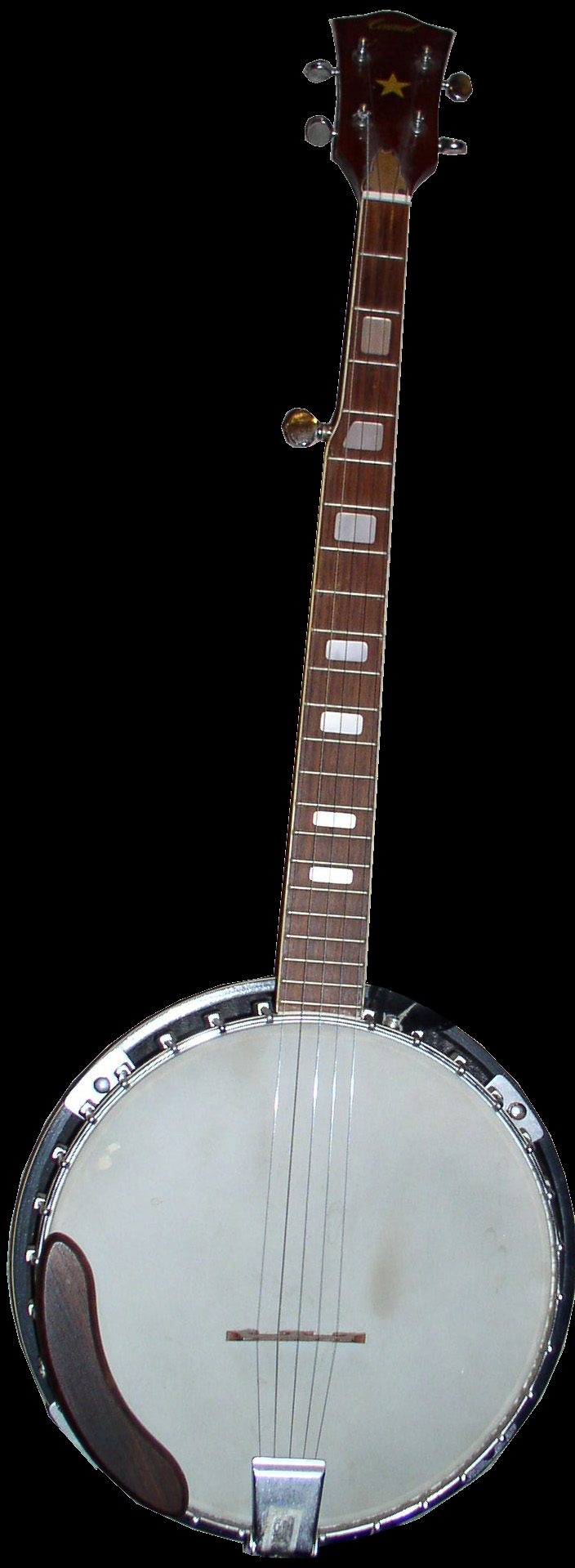
6 min read · 2 sourcesThe banjo is a stringed musical instrument with a thin membrane stretched over a frame or cavity to form a resonator. The membrane is typically circular, and in modern forms is usually made of mylar (BOPET), whereas earlier examples of banjos had membranes made of goat skin. Early forms of the instrument were fashioned by the "African diaspora" and had African antecedents. In the 19th century, interest in the instrument was piqued across the United Kingdom and United States by traveling members of highly popular traveling blackface minstrel shows, followed by mass production and mail-order sales, including instructional books. The inexpensive or home-made banjo remained part of rural folk culture, but five-string and four-string banjos also became popular for home parlour music entertainment, college music clubs, and early 20th century jazz bands. By the early 20th century, the banjo was most frequently associated with the folk, blues, cowboy, and country music genres. By mid-century, the banjo had come to be strongly associated with bluegrass. Eventually it began to be employed occasionally and sporadically in other kinds of popular music. Some famous American bluegrass players of the banjo are Ralph Stanley and Earl Scruggs. Historically, the banjo occupied a central place in black American traditional music and rural folk culture before entering the mainstream via the minstrel shows of the 19th century. 1
Etymology
The term banjo has several possible etymological origins. One theory links the word "banjo" to the West African Mandinka language (a possible association with Banjul, capital of The Gambia). Another claim is a connection to the West African folk lute akonting: it is made with a long bamboo neck called a bangoe. The material for the neck, called ban julo in the Mandinka language, again gives banjul. In this interpretation, banjul became a sort of eponym for the akonting as it crossed the Atlantic. The instrument's name might also derive from the Kimbundu word mbanza, which is a loan word to the Portuguese language resulting in the term banza, which was used by early French travelers in the Americas. Its earliest recorded use was in 1678 by the Sovereign Council of Martinique which reinstated a 1654 decree that placed prohibitions and restrictions on "dances and assemblies of negroes" deemed to be kalenda, which was defined as the gathering of enslaved Africans who danced to the sound of a drum and an instrument called the banza. The OED claims that the term banjo comes from a dialectal pronunciation of Portuguese bandore or from an early anglicisation of Spanish bandurria. Contrary evidence shows that the terms bandore and bandurria were used when Europeans encountered the instrument or its kin varieties in use by people of African descent, who used names for the instrument such as banza, as it was called in places such as Haiti, varieties that were built around a gourd body with a wooden plank for the neck. 1
Early origins
The modern banjo was tethered directly from West African lute instruments that have been recorded in use for almost a millennia. These instruments were crafted from split gourds with animal skins stretched across them. Strings, from gut or vegetable fibers, were attached to a wooden neck. The earliest European written indication of an instrument akin to the banjo is in the 17th century: Richard Jobson (1621) in describing The Gambia, wrote about an instrument which some consider to be similar to the banjo. 1
They have little varietie of instruments, that which is most common in use, is made of a great gourd, and a necke thereunto fastned, resembling, in some sort, our Bandora; but they have no manner of fret, and the strings they are either such as the place yeeldes or their invention can attaine to make, being very unapt to yeeld a sweete and musicall sound, notwithstanding with pinnes they winde and bring to agree in tunable notes, having not above sixe strings upon their greatest instrument.The earliest surviving physical banjo-style instrument from the New World is the " Creole Bania", crafted by an enslaved person in Suriname and dated to the 1770s. This instrument was collected by Scottish-Dutch mercenary John Gabriel Stedman during his time in Suriname and is now archived in the Nationaal Museum van Wereldculturen in the Netherlands. 1
Minstrel era, 1830s–1870s
In the antebellum South, many enslaved Africans played the banjo, spreading it to the rest of the population. In his memoir With Sabre and Scalpel: The Autobiography of a Soldier and Surgeon, the Confederate veteran and surgeon John Allan Wyeth recalls learning to play the banjo as a child from an enslaved person on his family plantation. Another man who learned to play from African-Americans, probably in the 1820s, was Joel Walker Sweeney, a minstrel performer from Appomattox Court House, Virginia. Sweeney has been credited with adding a string to the four-string African-American banjo, and popularizing the five-string banjo. Although Robert McAlpin Williamson is the first documented white banjoist, in the 1830s Sweeney became the first white performer to play the banjo on stage. Sweeney's musical performances occurred at the beginning of the minstrel era, as banjos shifted away from being exclusively homemade folk instruments to instruments of a more modern style. Sweeney participated in this transition by encouraging drum maker William Boucher of Baltimore to make banjos commercially for him to sell. 1
In 1949, Arthur Woodward credited Sweeney with replacing the gourd with a wooden sound box covered in skin, and adding a short fifth string around 1831. However, modern scholar Gene Bluestein pointed out in 1964 that Sweeney may not have originated either the 5th string or sound box. This new banjo was at first tuned d'Gdf♯a, though by the 1890s, this had been transposed up to g'cgbd'. Banjos were introduced in Britain by Sweeney's group, the American Virginia Minstrels, in the 1840s, and became very popular in music halls. The instrument grew in popularity during the 1840s after Sweeney began his traveling minstrel show. 1
Classic era, 1880s–1910s
The term classic banjo is used today to talk about a bare-finger "guitar style" that was widely in use among banjo players of the late 19th to early 20th century. It is still used by banjoists today. The term also differentiates that style of playing from the fingerpicking bluegrass banjo styles, such as the Scruggs style and Keith style. The Briggs Banjo Method, considered to be the first banjo method and which taught the stroke style of playing, also mentioned the existence of another way of playing, the guitar style. Alternatively known as "finger style", the new way of playing the banjo displaced the stroke method, until by 1870 it was the dominant style. Although mentioned by Briggs, it wasn't taught. The first banjo method to teach the technique was Frank B. 1
Ragtime era (1895–1919) and Jazz Age era (1910s–1930s)
In the early 1900s, new banjos began to spread, four-string models, played with a plectrum rather than with the minstrel-banjo clawhammer stroke or the clas… 1
The text above is adapted from the Wikipedia article “Banjo”, available under the Creative Commons Attribution-ShareAlike 4.0 licence. 1
banjo is stringed musical instrument, according to the structured record cited below. This entry was generated automatically from that record and has not yet been reviewed by a person familiar with the tradition. 2
The source record links this tradition to 59 external registers, which can be verified through the citation. 2