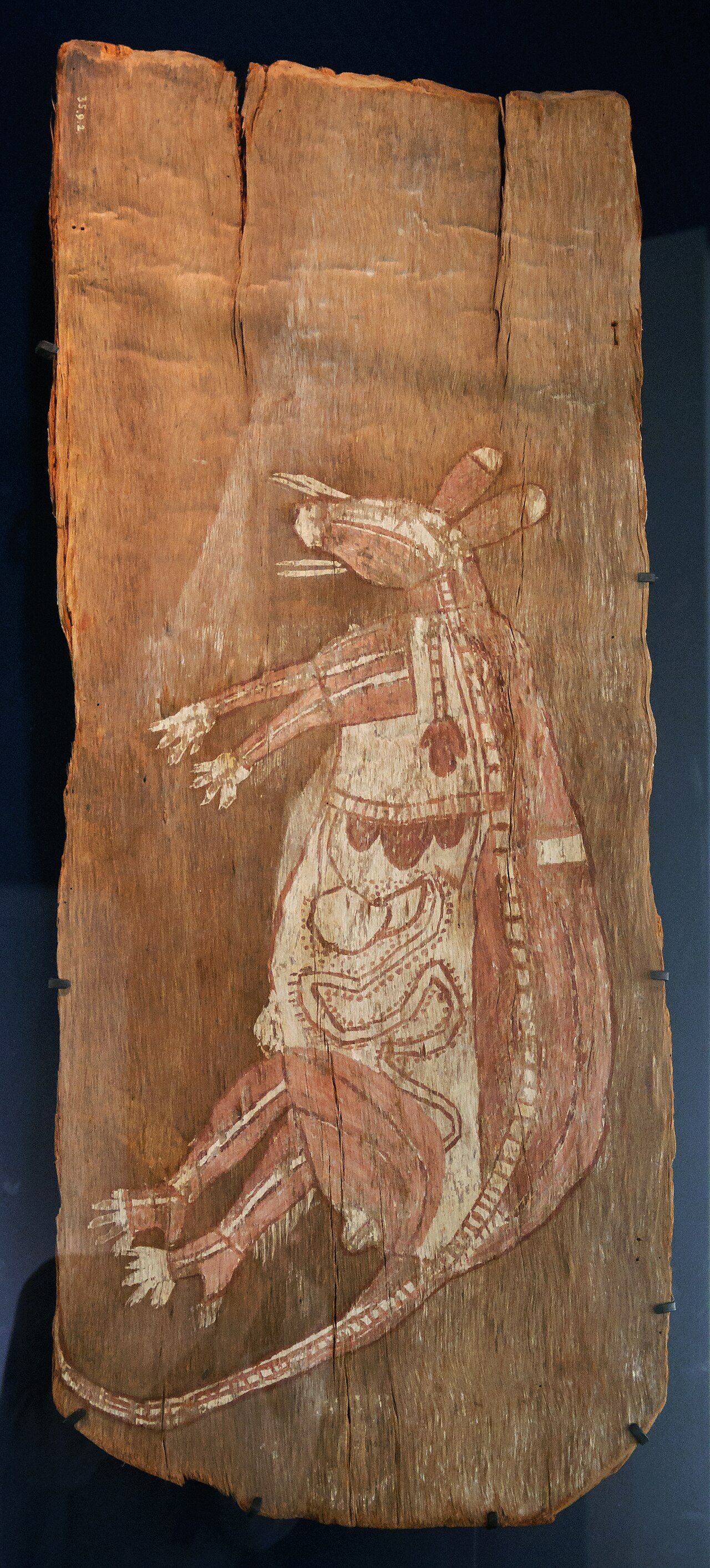
The tradition & historical record
4 min read · 2 sourcesBark painting is an Australian Aboriginal art form, involving painting on the interior of a strip of tree bark. While examples of painted bark shelters were found in the south-eastern states (then colonies) of Tasmania, Victoria, and New South Wales in the 19th century, as well as later on bark shelters in northern Australia, it is now typically only found as a continuing form of artistic expression in Arnhem Land and other regions in the Top End of Australia, including parts of the Kimberley region of Western Australia. Bark paintings were traditionally produced (especially among the Yolngu peoples) for instructional and ceremonial purposes and were transient objects. Today, they are keenly sought after by collectors and public arts institutions. 1
History
Painting on the dried bark stripped off trees, using ochres, is an old tradition. The earliest European find was in a bark shelter over a grave in Tasmania around 1800, recorded by French artist Nicolas-Martin Petit, who travelled with Nicolas Baudin to Tasmania between 1800 and 1804. Other painted bark shelters were later found in Victoria and New South Wales. These were drawn with charcoal, and then painted or scratched onto bark which had been blackened by smoke. The earliest surviving bark paintings date from the 19th century, an example of which is a bark etching of a kangaroo hunt now in the British Museum, which was collected near Boort in northern Victoria by the British explorer John Hunter Kerr. Another example, painted before 1876, is held by the Museum of Victoria. In the Kimberley and Arnhem Land, the paintings on bark shelters were similar in style to those done in rock shelters, which illustrated various stories told to young people when people were confined to the shelters for long periods during the wet season. Bark coffins and belts were painted in northeast Arnhem Land, and painted bark baskets were also used in death rituals on the Tiwi Islands. The modern form of bark paintings began when works were commissioned from Yolngu artists. In 1912 Baldwin Spencer commissioned bark paintings at Gunbalanya (Oenpelli), and soon collectors were wanting to purchase more like these. Spencer looked for paintings on the basis of artistic and aesthetic merit, and provided examples to the Museum of Victoria. 1
Description and interpretation
Bark paintings are based on sacred designs that include abstract patterns and designs (such as cross-hatching in particular colours) that identify a clan, and also often contain elements of the eternal Dreamtime. Sometimes the elements of a story are obvious—such as men or animals—but sometimes the elements are symbolic. What appears to the tourist as a series of wavy lines punctuated by dots may actually be telling a complex Dreaming story describing the path of a creator spirit and events that happened along the way. An uninitiated man or woman is only allowed to paint "outside" stories, the sort of story that might be told to a child. An initiated man can paint an "inside" story, which is restricted knowledge. Thus, a painting may be displayed in an exhibition, or put up for sale, but the artist, although having the right to paint the story, does not have the right to tell the story to another person. Alternatively, the story behind the painting may be one that may not be told to an uninitiated person. Non-Indigenous people who, like Howard Morphy, have spent years studying the subject, still have an outsider's view and rely on analogies. The Yolngu language and culture has words and concepts that are unfamiliar to non-indigenous cultures, which makes understanding the art form difficult. The following explanation only describes the physical aspects. 1
Components
A bark painting consists of several components, not all of which may be present in an individual painting, and that are generally applied in the following order: 1
Ground Border Dividing lines Feature blocks Figurative designs Geometric designs Clan designs Cross-hatching 1
Ground
In all cases, the bark is first covered with a layer of ochre, which is usually red or white, occasionally yellow or black. 1
Borders, dividing lines, and feature blocks
The border, if present, is usually yellow (which originated from a Yirrkala clan design). The paintings are sometimes divided into sections known as feature blocks, which feature either separate stories, or scenes in a story. 1
The text above is adapted from the Wikipedia article “Bark painting”, available under the Creative Commons Attribution-ShareAlike 4.0 licence. 1
bark painting is Australian aboriginal art form, according to the structured record cited below. This entry was generated automatically from that record and has not yet been reviewed by a person familiar with the tradition. 2
The source record links this tradition to 5 external registers, which can be verified through the citation. 2