The tradition & historical record
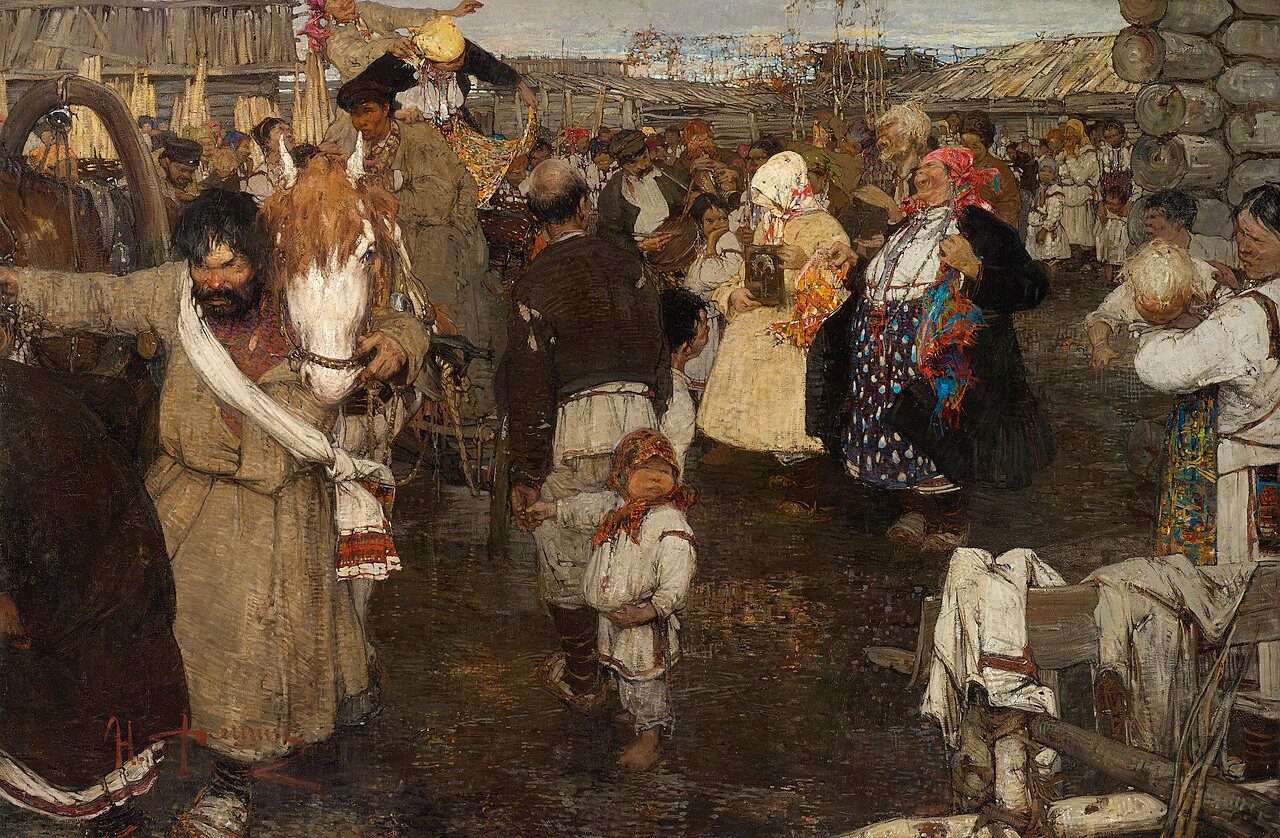
7 min read · 2 sourcesBearing Away the Bride (Russian: Черемисская свадьба; also known by other titles, not officially established in art history bibliography: Cheremis Wedding, Seeing the Bride Away, Abduction of the Bride, Mari Wedding, Chuvash Wedding) is a painting by Russian artist Nicolai Fechin. It was painted in Kazan in 1908. Fechin collected the material for the canvas during a trip through Mari villages. Candidate of Art History Galina Tuluzakova called it a stage of Fechin's work, where he "for the first time and fully" manifested the peculiarities of the artist's compositional thinking, characterized by his principles of genre painting and color. Nicolai Fechin repeated and developed the innovations he found while working on Bearing Away the Bride in his later paintings Pouring and Slaughterhouse. It was exhibited at major national (St. Petersburg, Kazan) and international art exhibitions (Munich, Pittsburgh, New York, Chicago) many times. There is a significant scientific and popular research literature dedicated to the painting, its fate has been closely followed by the media for decades. In 2011, the painting returned to the Russian Federation from the United States, where it had been for a century, but it is part of a private collection and is currently unavailable to a wide audience of art amateurs. 1
Representation
It is an oil on canvas painting of 111x282 cm. It is signed by the artist in the lower left corner: N. Fechin. Nicolai Fechin depicted an episode of the wedding ceremony of the Mari (pre-revolutionary name — Cheremis) — the taking away of the bride from her parents' house. This event takes place in front of the whole village. In the background of the scene there are wooden buildings of village houses and fragile birches. The artist painted the scene from above, showing the viewer a wide expanse of land and leaving only a thin strip of sky above. This technique was considered characteristic of all of Fechin's genre compositions by art historian Dmitri Seryakov. Art historian Marina Yashina suggested that the event depicted by the artist takes place in autumn, as weddings were usually held after the completion of agricultural work. In the center of the composition there is a bride dressed in white holding an icon in her hands. Her face is covered. To her right is a fat matchmaker. The embroidery on her costume is on the collar, the cleavage, and the hem. Marina Yashina explained this by the old Mari belief that the holes and edges of the clothes should be protected from the evil eye. The red color of the scarf on the matchmaker's head symbolizes life and is fundamental to Mari embroidery. Closer to the viewer, the artist placed the image of a Cheremisk woman with a child cut off by the frame. Behind her are relatives, musicians and onlookers. The bride is preparing to be placed on a cart standing to her left. The groom sits on the seat of the cart, one of the horses harnessed to it being held by a bearded man in the foreground who seems to be stepping out of the picture — toward the viewer. 1
Mari wedding rituals in ethnographers' and art historians' work
Galina Tuluzakova, a candidate of art history, wrote that the subject attracted the artist "by the colorfulness of the action itself. Even the Mari people, who adopted Christianity, continued to follow pagan marriage rites. Matchmakers were usually sent to find a girl, but in some cases bride kidnapping was practiced. In the late 19th and early 20th centuries, this happened when the marriage was opposed by relatives or, more often, with the permission of the parents, because the wedding was expensive for both the groom and the bride. Once the bride price and dowry were agreed upon, the wedding date was set. The bridegroom's brother or father appointed from among his relatives. All of them were drunk with oatmeal salma, beer and wine. After that, the festive procession followed the bride with music and singing, visiting the groom's relatives along the way. A feast was arranged at each of them. Only after passing all of them did the procession reach the bride's house. Participants of the trip pretended to be drunk and fooling around, pretended to be ready to fall off the horse, swayed on it, shouted, sang to the uneven sounds of music. At the house, the procession stopped in the street without entering the gate. The bridegroom informed the bride's father of her arrival, and then the procession entered the yard, left the horses, and approached the porch with songs and dances. Already inside the house, new rites were performed, then a feast with music and dancing began in the house. After that, the participants of the wedding procession left the house with a lot of noise. The matchmaker took the bride by the hands and handed her to the groom, saying: "Take this girl into your family. The groom took her to the yard to his relatives and put her in a cart or a sleigh. 1
The artist's work
Bearing Away the Bride (1908), as well as another genre painting Fechin Kapustnitsa (1909), was created during his studies at the Imperial Academy of Arts. Galina Tuluzakova believes that in Bearing Away the Bride the artist defined the theme that fascinated him at that time — "customs, rituals, holidays of the Russian and foreign village". The choice of the theme was influenced by Nicolai Fechin's life experience. From the age of 12, he accompanied his father on trips to the villages of Kazan province to fulfill church orders for the production of wooden iconostases for altars. Fechin and his father often stayed with relatives in the village of Kushnya. "The primitive life of the people here, with their ancient pagan deities and mysterious mystical sacrifices made during rites held in the remote forests, naturally developed in me a love for everything that belongs to nature," the artist later recalled. Nicolai Fechin said that in the summer of 1908, "...I went to the Cheremiss village of Lipsha, not to rest, but to work. After gathering the necessary material, I returned to Kazan. I settled in an empty house that belonged to my uncle and began to work on my first large composition, thee Abduction of a Young Woman, which was based on the marriage customs of the Mari people. My large painting only fit diagonally into the room. The light from the low windows was so weak that more than half of the painting was in darkness. In order to see the result of my work, I was forced to lie directly on the floor under the painting and look up". Galina Tuluzakova describes these events differently in her 1998 dissertation. 1
Sketches and studies
The Russian Soviet "peasant poet" and artist, the last chairman of the Peredvizhniki Society and the first chairman of the Association of Artists of Revolutionary Russia, Pavel Radimov, recalled that in the early years of his acquaintance with Nicolai Fechin, the latter showed him a set of sketches of twelve of his works. Among them was Bearing Away the Bride). Radimov wrote that the artist later created his paintings on the basis of these sketches. 1
From Russia to the United States
Bearing Away the Bride was presented at the spring exhibition of the Imperial Academy o… 1
The text above is adapted from the Wikipedia article “Bearing Away the Bride”, available under the Creative Commons Attribution-ShareAlike 4.0 licence. 1
Bearing Away the Bride is painting by artist Nikolai Feshin (1908), according to the structured record cited below. This entry was generated automatically from that record and has not yet been reviewed by a person familiar with the tradition. 2
The source record links this tradition to 1 external register, which can be verified through the citation. 2