The tradition & historical record
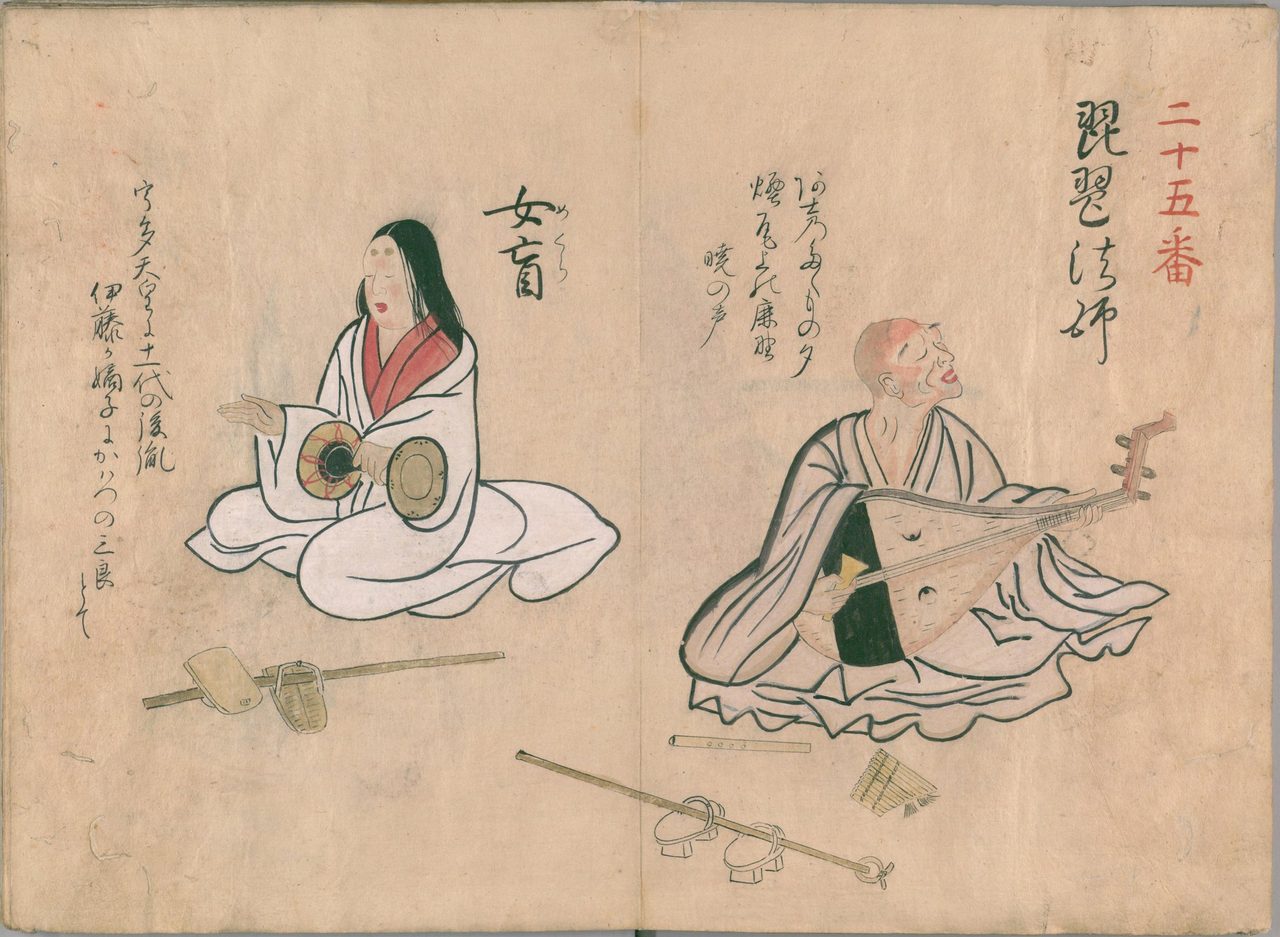
6 min read · 2 sourcesBiwa hōshi (琵琶法師), also known as "lute priests", were travelling performers in the era of Japanese history preceding the Meiji period. They earned their income by reciting vocal literature to the accompaniment of biwa music. Biwa hōshi were mostly blind, and adopted the shaved heads and robes common to Buddhist monks. The occupation likely had its origin in China and India, where blind Buddhist lay-priest performers were once common. The musical style of the biwa hōshi is referred to as heikyoku (平曲), which literally means "heike music". Although these performers existed well before the events of the Genpei War, they eventually became famous for narrating tales about this war. Before biwa hōshi sang heikyoku, they were entertainers and ritual performers. They took on a broad range of roles, including poetry and song, plague prevention, and spiritual purification; it was probably because of their ritualistic duties that they became the caretakers of The Tale of the Heike (平家物語, Heike Monogatari). The biwa hōshi are considered the first performers of the Tale of the Heike, which is one of Japan's most famous epics. It details battles between two powerful clans, the Minamoto and the Taira around the 12th century. The Taira (or Heike) were eventually annihilated by the Minamoto (sometimes called the Genji), who systematically killed every male descendant of the Taira. 1
Etymology
Biwa hōshi (琵琶法師) literally means "lute priest". Hōshi (法師) is derived from buppō no kyōshi (仏法の教師), which translates as a teacher who explains Buddhist precepts. The two characters hō (法) and shi (師) mean "Buddhist doctrine" and "teacher" respectively. Hōshi referred to blind priests who played the heike-biwa to accompany their songs about legends, wars, histories, and mythologies. Eventually, hōshi referred to non-blind and blind performers and was also used as a suffix to a series of other types of people, such as dancing musicians (田楽法師, dengaku hōshi), Chinese-style entertainers (散楽法師, sarugaku hōshi), outcast artists (絵取り法師, edori hōshi), and men from Sanjō or men from temporary quarters (三条法師, Sanjō hōshi). Biwa hōshi are referred to in Japanese iconography that dates back to the late Heian period (794–1185 CE). They are also referred to in the Shinsarugakuki, written by Fujiwara no Akihira (989–1066). 1
Origins and proliferation
Shōbutsu, a Buddhist monk of the Tendai school, was, according to tradition, the first biwa hōshi to sing the Heike Monogatari, around the year 1220. Subsequently, two different factions of biwa hōshi were formed. These were the Ichikata school, founded by Akashi Kyoichi, and the Yasaka School, founded by Yasaka Kigen. Ranks were assigned to biwa hōshi on the basis of skill, the highest being kengyō (検校), followed by kōtō (勾当), bettō (別当) and zatō (座頭). The proliferation of the Yasaka and Ichikata factions heightened with the contributions of Akashi Kakuichi (1300–1371). A noted biwa hōshi, Kakuichi's heikyoku narration is currently accepted as the definitive version of the heike. A documented reason for this is that Kakuichi was largely responsible for forming the Ichikata guild. This preceded the formation of the Tōdō (当道), a self-governing guild of biwa hōshi. The Tōdō received income in two ways: patronage from the Kyoto aristocracy and military, and its monopoly over the teaching and transmission of heikyoku. To be accepted as a disciple, an aspiring student would have to pay a fee, after which the study of each new piece of music required payment. By the 13th and 14th centuries, biwa hōshi performed for the military elite and the aristocracy, including the regional daimyō feudal lords. Public performances were also given during Buddhist temple services. The general population had the further option of attending Kanjin performances, which they were required to pay a fee to see. 1
Sengoku to Edo period
The Ōnin War (1467–1477) proved a trying occurrence for the proliferation of the biwa hōshi. The war instigated the Sengoku period (15th–17th centuries), an era of civil war and political–military conflict that lasted for nearly two centuries. In this time, many heike musicians turned their attention to the jōruri or the shamisen three-stringed lute. Therefore, not only did the conflict cause a loss of performers, but also a decline in the number of listeners of the heikyoku. However, the complete demise of the biwa hōshi was prevented by the daimyō Tokugawa Ieyasu, who favored the art of heike performance. Ieyasu ultimately reunified the country by establishing the Tokugawa shogunate, and became a fervent patron of the heike. During the Edo period (1600–1868), the Tokugawa shogunate provided the Tōdō with special privileges and substantial financing, which the Tōdō then distributed to members according to rank. The Edo period also marks the era in which the shogunate designated heike as one of its official ceremonial forms of music. Accordingly, new schools of heike appeared, many of which were influenced by the newly introduced shamisen and its accompanying styles of music. The two predominant schools that came about during the Edo period were the Maeda-ryū founded by Maeda Kyūichi, and the Hatano-ryū founded by Hatano Kōichi. Both figures were members of the Shidō-ha, which was the most active branch of the older Ichikata school. Collaborations were formed between amateur aficionados of the heike who, over the course of the Edo period, made small revisions to the musical notation of the heike score. The ceremonial form of the heike performed for the shogunate became increasingly solemn and refined to meet the standards of the intellectual class. 1
Meiji period to present
In 1868, the Meiji Restoration heralded the collapse of the Tokugawa shogunate. This ultimately contributed to the abolition of the Tōdō, which undermined social privileges for the musicians and reduced the availability of avenues for performance. The Hatano-ryū, in particular, underwent a debilitating decline in popularity, so much so that it struggled to survive in Kyoto until the middle of the 20th century. In addition, the rise in popularity of the shamisen, which accompanied contemporary songs and narratives, made the ancient tales of the Heike appear antiquated. By the end of the Edo period, the koto had replaced the biwa as the most common instrument used among blind musicians. The heike tradition persisted, however, through the Tsugaru lineage (transmitted by sighted performers) and the Nagoya lineage (transmitted by professional blind musicians of the Tōdō tradition), both of which belonged to the Maeda-ryū. The Tsugaru lineage consisted of Kusumi Taisō (1815–1882), who learned the heike of the Edo Maeda-ryū, as well as his sons Tateyama Zennoshin and Tateyama Kōgo, both of whom lamented the decline of heike in the late years of Meiji and sought to foster a number of pupils. 1
Blindness
For most of Japan's recorded history, music and narrative performance were common activities for the blind, whose importance in most other major genres is also unavoidable, save for court and theatre music… 1
The text above is adapted from the Wikipedia article “Biwa hōshi”, available under the Creative Commons Attribution-ShareAlike 4.0 licence. 1
biwa hōshi is pre-Meiji era travelling performers, according to the structured record cited below. This entry was generated automatically from that record and has not yet been reviewed by a person familiar with the tradition. 2
The source record links this tradition to 4 external registers, which can be verified through the citation. 2