The tradition & historical record
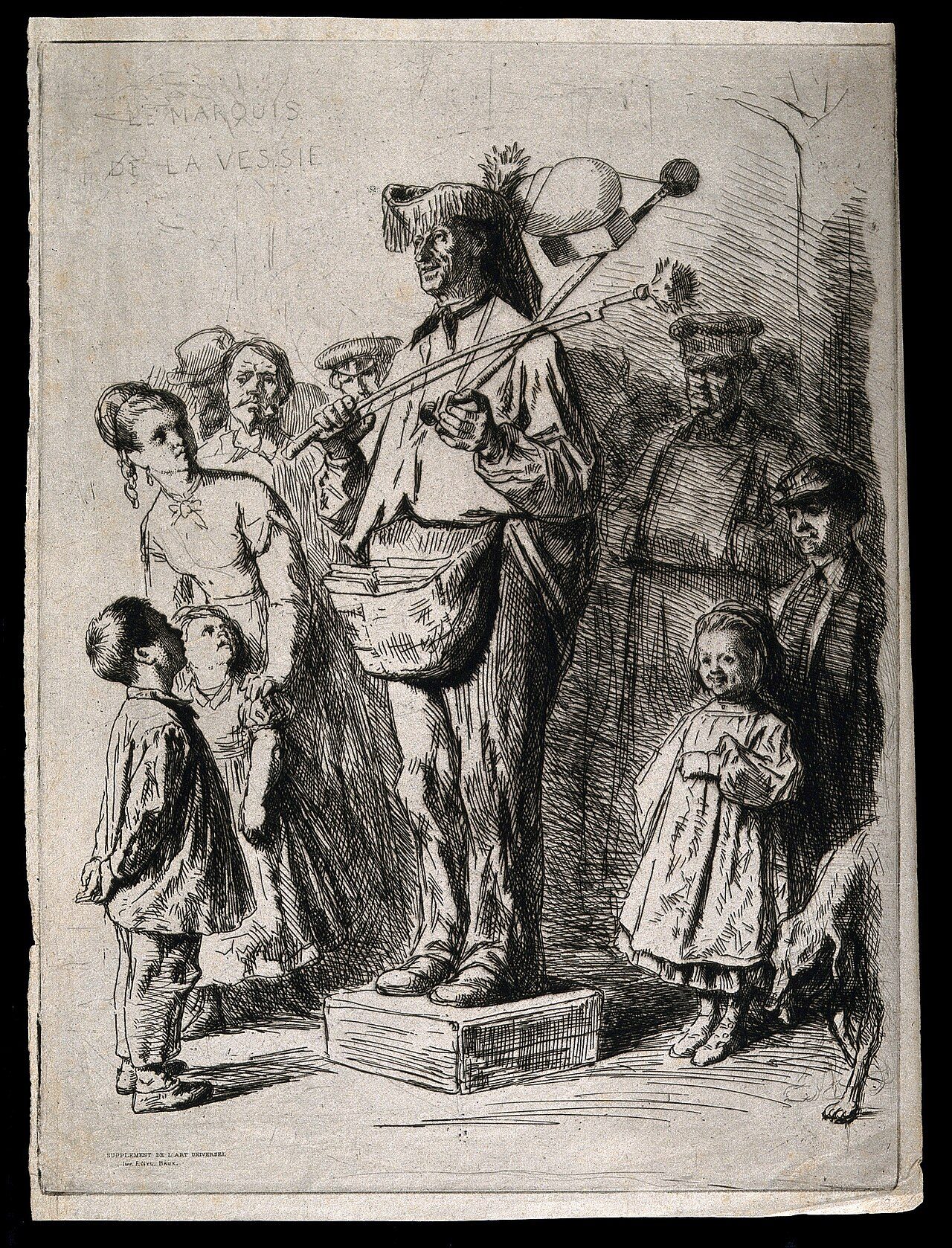
5 min read · 2 sourcesThe bladder fiddle was a folk instrument used throughout Europe and in the Americas. The instrument was originally a simple large stringed fiddle (a musical bow) made with a long stick, one or more thick gut strings, and a pig's-bladder resonator. It was bowed with either a notched stick or a horsehair bow. The folk instrument was historically played by "wandering musicians" and beggars up to the early 19th century. Although it may be used in serious folk music it has also been used for humor. Changes in the instrument have produced two distinct modern variations. The traditional bowed instrument has been preserved into the 21st century in Lithuania as the pusline (and possibly Estonia and Flanders), producing sustained or rhythmic droning notes. The other variation, a percussion instrument, is used in folk music internationally, including Europe, North America and Australia, in which sound may imitate a drum roll and other percussive sounds. 1
Evolution from fiddle to drum set
The instrument was originally a fiddle. It used a flexible stick, a musical bow, as the instrument's body and neck. The resonator, at first an inflated animal bladder, was held between the stick and the bowstring. Versions in Poland, Lithuania and the Netherlands had as many as three strings, but pictures of the Flanders fiddle and the Nocturnal Serenade by Jan Steen show monochords (single-stringed instruments). In this configuration, the fiddle is played by drawing the bow over the string or strings; pressing down on the string changes the note. Having multiple strings allows a fiddler to accompany other instruments with simple patterns using one, two or three notes from open strings. Some variants of the instrument show a flexible stick, making the bowed-instrument a musical bow. Others, such as the Estonian and Lithuanian instruments, have rigid sticks, making the instrument a bar or stick zither. The instrument changed in some places. While the pig-bladder instrument can still be found in Lithuania today, in Holland the pig's bladder had been replaced by 1675 by a drum-like circle, wedged between the stick and a single gutstring, which resonated when the string was bowed. That version, the bumbass, was illustrated in the painting Nocturnal Serendade, by Dutch painter Jan Steen. Immigrants to the United States brought the bumbass with them. In America, it used by the Pennsylvania Dutch culture of eastern Pennsylvania, United States, and still exists today, as the boomba, a percussion instrument. It may also be seen in Texas, at events celebrating local German heritage (such as the Tomball German Heritage Festival). On percussion instruments, the drum has been turned sideways on the instrument and the string runs across it like the sound-table on a spike lute. 1
Other names
It is known under different names; in Germany it was called the bumbass, Teufelsgeige (devil's fiddle) or Bettelgeige (beggar's fiddle). In Germany sometimes a bell or cymbal was added to the top for decoration or additional sound. In Austria it was called the saubass, in Spanish the rabel. In France it is the basse de Flandre (Flanders fiddle), and in England a drone, "drone and string" or bladder fiddle. In England it was used by traveling musicians. In Venezuela, the bladder fiddle is known as "marimba, tarimba, guarumba, guasdua, and carangano". The name in Latvian is pūšļa vijole. In Lithuania, the instrument is the Pūslinė. In Poland there is a variant that started as a costume accessory and has become a devil's violin, called the Diabelskie skrzypce. 1
Slavic instrument
The Slavic peoples have a musical bow (Słowiański łuk muzyczny in Polish) which is pictured as having three strings (trzy struny). 1
Modern bowed instrument
The original pig-bladder instrument is still played with a bow in Lithuania as a traditional folk instrument, called a Pūslinė. Estonia has one as well, called the põispill. The instrument has between 1-3 strings and can be tuned with tuning pegs. 1
Modern percussion instrument
The modern boomba focuses heavily on loud percussion, typically consisting of a variety of percussion instruments attached to a wooden pole. The exact designs of a boomba vary, with much emphasis being put on the personalization of the boomba. Common features typically include a spring-loaded rubber base (much like a pogo stick), with percussion instruments such as bells and wood blocks attached. Boombas often also include a set of cymbals which crash as the boomba is bounced, and a tambourine which can be played with a drumstick or shaken as the boomba is played. The boomba is similar in nature to the "stumpf fiddle", though the stumpf fiddle generally lacks the loud crashing cymbal on top. It is this loud crash when bounced that makes the boomba distinct. An older, German variant of the stumpf fiddle and the boomba is the Teufelsgeige (lit. 'Devil's fiddle'), which is decorated with a Devil's head at the top of the pole. A modern percussion instrument in Friesland is called the Kuttepiel. A similar percussion instrument in Slovakia is the Ozembuch. 1
The text above is adapted from the Wikipedia article “Bladder fiddle”, available under the Creative Commons Attribution-ShareAlike 4.0 licence. 1
bladder fiddle is musical instrument, according to the structured record cited below. This entry was generated automatically from that record and has not yet been reviewed by a person familiar with the tradition. 2
The source record links this tradition to 6 external registers, which can be verified through the citation. 2