The tradition & historical record
6 min read · 2 sourcesBonampak (known anciently as Ake or, in its immediate area as Usiij Witz, 'Vulture Hill') is an ancient Maya archaeological site in the Mexican state of Chiapas. The site is approximately 30 km (19 mi) south of the larger site of Yaxchilan, under which Bonampak was a dependency, and the border with Guatemala. While the site is not overly spatial or abundant in architectural size, it is well known for the murals located within the three-roomed Structure 1 (The Temple of the Murals). The construction of the site's structures dates to the Late Classic period (c. AD 580 to 800). The Bonampak murals are noteworthy for being among the best-preserved Maya murals. The site, lying close to a tributary of the Usumacinta River, was seen by non-Maya in 1946. Precisely who was first of the non-Maya to see it is a matter of speculation, but it was either two American travelers, Herman Charles (Carlos) Frey and John Bourne, or photographer/explorer Giles Healey. The Americans were led to the ruins by the local Lacandon Maya who still visited the site to pray in the ancient temples. Giles Healey was the first to be shown the huge paintings covering the walls of one of the structure's three rooms. The paintings show the story of a single battle and its victorious outcome. 1
History of the polity
Bird Jaguar in the early 5th century fought against K'inich Tatb'u Skull I in Yaxchilan, and lost his freedom. Other nobles were captured in a later war against Knot-eye Jaguar I. In 514, Knot-eye Jaguar I was himself taken captive (by Ruler C of Piedras Negras), giving Bonampak some respite; but after 526, his successor K'inich Tatb'u Skull II attacked Bonampak again and captured more lords. Bonampak by 600 CE had become a satellite of Yaxchilan. In that time, the ajaw of Yaxchilan installed Yajaw Chan Muwaan I as lord in Bonampak. Subsequent ajawob reconstructed the site to orient toward the metropolis. C. 790 CE, Yaxchilan's king Shield Jaguar III oversaw the installation of Chan Muwaan II, and hired Yaxchilano artisans to commemorate it in "Structure I"'s murals. Bonampak collapsed with Yaxchilan in the 9th century. 1
Temple of the Murals
Structure 1: Structure 1 at Bonampak, built at the end of the eighth century A.D. measures 16 meters long, four meters deep, and seven meters tall, and is constructed atop a T-shaped platform. Although there is no evidence to support the claim, some speculate that it may have also had a roofcomb, such as can be seen on Structure 33 at nearby Yaxchilan. Structurally symmetrical, balanced and stable, it is composed of three separate rooms, which contain murals that narrate the events surrounding the accession to the throne by Chooj, son of Bonampak ruler Yajaw Chaan Muwan, and grandson of Aj Sak Teles. Although there has been some disagreement as to the temporal sequence of events, it is generally agreed that the narrative should be viewed in chronological order, beginning in Room 1 (scene of tribute, dressing, dance, mummery and musical performance); then on to Room 2 (scene of violent conflict, and a display in which a human cull is presented, tortured and killed in the company of the highest members of court and upper echelons of the victorious force); and, finally, to Room 3 (scene of a dance, with observers, and ritual bloodletting). In total, there are some 281 human figures represented within the three rooms, many with captions (approximately 1/3 of the figures are named, while another 10 percent of the figures have blank captions, and slightly more than half have no caption at all). A few theories as to why some captions were left blank include deaths or political realignment, an interruption of the murals related to the ostensible Lowland Maya collapse during the period of Structure 1's creation, and the possibility that it became politically impolite to name certain figures. 1
Stele 1
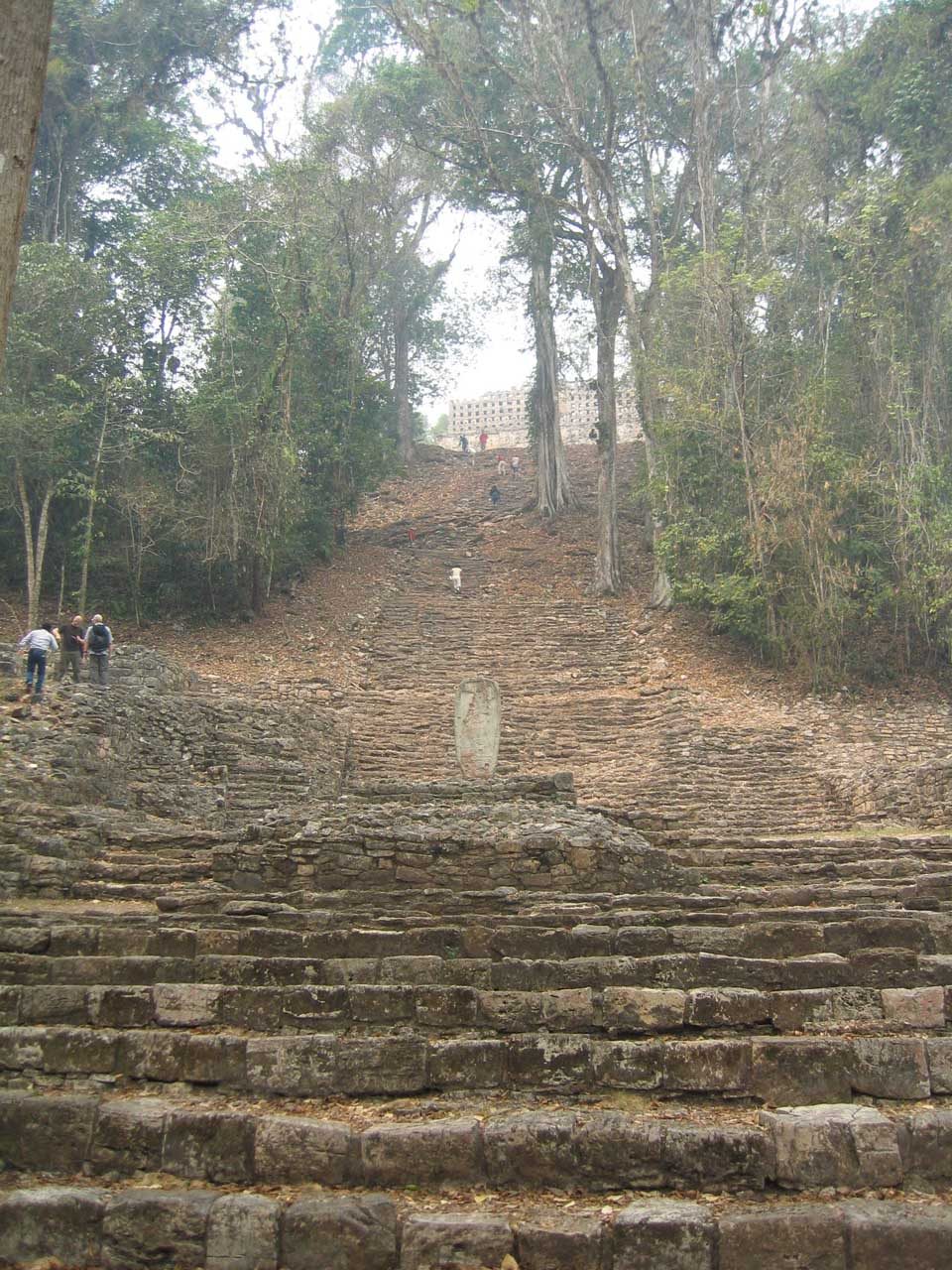
It is located in the central part of the Great Plaza, it represents the moment of the height of Chan Muwan II, the importance of the character is reflected in the way it is represented and in the difficulty to elaborate the monument, that is, in a huge slab of stone of little thickness without suffering any fracture. With its almost 6 meters high it is one of the highest in the Mayan world. Chan Muwan II is standing and carrying a ceremonial cane, the styling of the pupil gives him a greater strength to his look; in the lower part of the stele is observed the monster of the earth from which the faces of the young god of corn emerge. A band of glyphs under the feet of the ruler refers to his genealogy, while in another vertical band the emblem glyph of the city can be observed. 1
Stele 2
It is located on a low terrace right in the center of the Acropolis and next to Stela 3, it shows Chan Muwan II richly dressed in the company of two women, in front of him her mother Lady Shield Skull and behind him his wife the Lady Green Rabbit of Yaxchilán who wear a huipil. The scene revolves around the ritual of self-sacrifice, performed by the ruler who carries in his right hand a bag with copal from which the face of the bat god is seen and assisted by his mother, who carries the stingray spines to perform the piercing while his wife holds the basket with the strips of paper ready to receive the blood drops of the ruler, which will later be incinerated in honor of their deities. 1
Stele 3
It represents a scene in which Chan Muwan II is standing in front of a second person squatting and in a position of submission wearing paper ear-rings, symbol of the captives. 1
The text above is adapted from the Wikipedia article “Bonampak”, available under the Creative Commons Attribution-ShareAlike 4.0 licence. 1
Bonampak is pre-Columbian archaeological site, according to the structured record cited below. This entry was generated automatically from that record and has not yet been reviewed by a person familiar with the tradition. 2
The source record links this tradition to 21 external registers, which can be verified through the citation. 2