The tradition & historical record
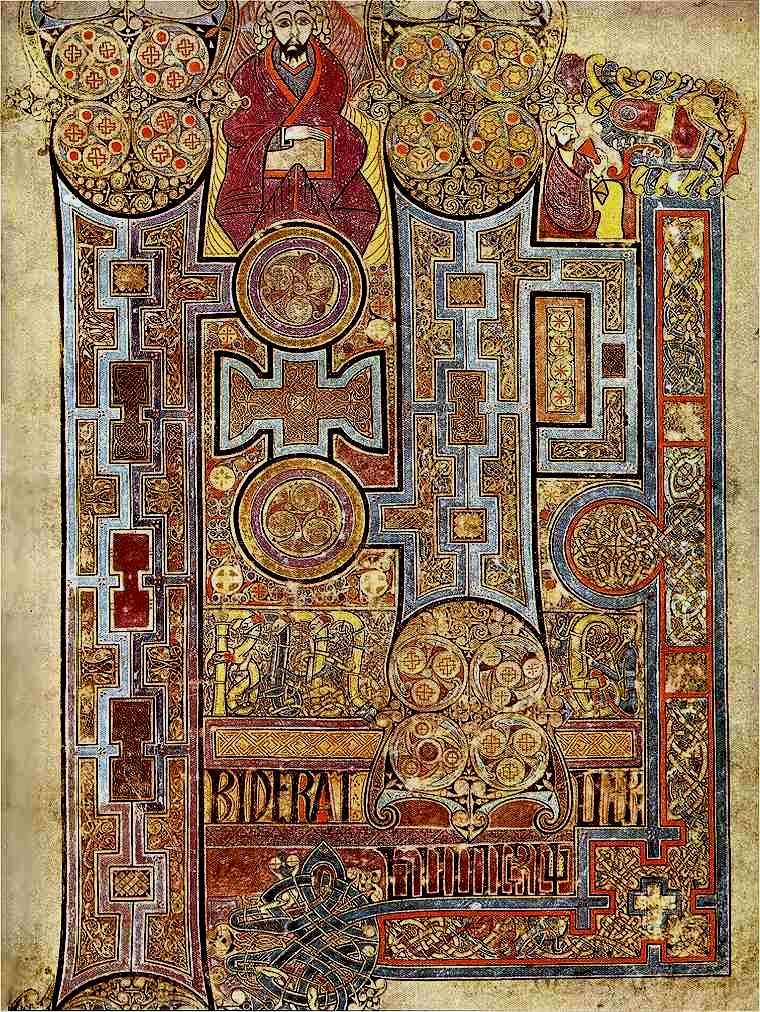
7 min read · 2 sourcesThe Book of Kells (Latin: Codex Cenannensis; Irish: Leabhar Cheanannais; Library of Trinity College Dublin, MS A. I. [58], sometimes known as the Book of Columba) is an illustrated manuscript and Celtic Gospel book in Latin, containing the four Gospels of the New Testament together with various prefatory texts and tables. It was created in a Columban monastery in Ireland or Scotland, and may have had contributions from various Columban institutions across Ireland and Scotland. It is believed to have been created c. 800 AD. The text of the Gospels is largely drawn from the Vulgate, although it also includes several passages drawn from the earlier versions of the Bible known as the Vetus Latina. It is regarded as a masterwork of Western calligraphy and the pinnacle of Insular illumination. The manuscript is named after Abbey of Kells, County Meath, which was its home for centuries. The illustrations and ornamentation of the Book of Kells surpass those of other Insular Gospel books in extravagance and complexity. The decoration combines traditional Christian iconography with the ornate swirling motifs typical of Insular art. Figures of humans, animals and mythical beasts, together with Celtic knots and interlacing patterns in vibrant colours, enliven the manuscript's pages. 1
Origin
The Book of Kells is one of the finest and most famous, and also one of the latest, of a group of manuscripts in what is known as the Insular style, produced from the late 6th through the early 9th centuries in monasteries in Britain and Ireland and in continental monasteries with Hiberno-Scottish or Anglo-Saxon foundations. These manuscripts include the Cathach of St. Columba, the Ambrosiana Orosius, fragmentary Gospel in the Durham Dean and Chapter Library (all from the early 7th century), and the Book of Durrow (from the second half of the 7th century). From the early 8th century come the Durham Gospels, the Echternach Gospels, the Lindisfarne Gospels, and the Lichfield Gospels. Among others, the St. Gall Gospel Book belongs to the late 8th century and the Book of Armagh (dated to 807–809) to the early 9th century. Scholars place these manuscripts together based on similarities in artistic style, script, and textual traditions. The fully developed style of the ornamentation of the Book of Kells places it late in this series, either from the late 8th or early 9th century. The Book of Kells follows many of the iconographic and stylistic traditions found in these earlier manuscripts. For example, the form of the decorated letters found in the incipit pages for the Gospels is surprisingly consistent in Insular Gospels. Compare, for example, the incipit pages of the Gospel of Matthew in the Lindisfarne Gospels and in the Book of Kells, both of which feature intricate decorative knotwork patterns inside the outlines formed by the enlarged initial letters of the text. 1
Medieval period
Kells Abbey was pillaged by Vikings many times at the beginning of the 9th century, and how the book survived is not known. The earliest historical reference to the book, and indeed to the book's presence at Kells, can be found in a 1007 entry in the Annals of Ulster. This entry records that "the great Gospel of Columkille [Columba], the chief relic of the Western World, was wickedly stolen during the night from the western sacristy of the great stone church at Cenannas on account of its wrought shrine". The manuscript was recovered a few months later—minus its golden and bejewelled cover—"under a sod". It is generally assumed that the "great Gospel of Columkille" is the Book of Kells. If this is correct, then the book was in Kells by 1007 and had been there long enough for thieves to learn of its presence. The force of ripping the manuscript free from its cover may account for the folios missing from the beginning and end of the Book of Kells. The description in the Annals of the book as "of Columkille"—that is, having belonged to, and perhaps being made by Columba—suggests that the book was believed at that time to have been made on Iona. Regardless, the book was certainly at Kells in the 12th century, when land charters pertaining to the Abbey of Kells were copied onto some of its blank pages. The practice of copying charters into important books was widespread in the medieval period, and such inscriptions in the Book of Kells provide concrete evidence about its location at the time. The Abbey of Kells was dissolved because of the ecclesiastical reforms of the 12th century. The abbey church was converted to a parish church in which the Book of Kells remained. 1
Book of Kildare
The 12th-century writer Gerald of Wales, in his Topographia Hibernica, described seeing a great Gospel Book in Kildare which many have since assumed was the Book of Kells. The description certainly matches Kells: 1
This book contains the harmony of the Four Evangelists according to Jerome, where for almost every page there are different designs... and other forms almost infinite... Fine craftsmanship is all about you, but you might not notice it. Look more keenly at it and you will penetrate to the very shrine of art. You will make out intricacies, so delicate and subtle, so exact and compact, so full of knots and links, with colours so fresh and vivid, that you might say that all this was the work of an angel, and not of a man. Since Gerald claims to have seen this book in Kildare, he may have seen another, now lost, book equal in quality to the Book of Kells, or he may have misstated his location. 1
Modern period
The Book of Kells remained in Kells until 1654. In that year, Cromwell's cavalry was quartered in the church at Kells, and the governor of the town sent the book to Dublin for safekeeping. Henry Jones, then Bishop of Clogher and Vice-Chancellor of the University of Dublin, presented the manuscript to Trinity College in Dublin in 1661, and it has remained there ever since, except for brief loans to other libraries and museums. It has been on display to the public in the Old Library at Trinity since the 19th century. The manuscript's rise to worldwide fame began in the 19th century. The association with St. Columba, who died the same year Augustine brought Christianity and literacy to Canterbury from Rome, was used to demonstrate Ireland's cultural primacy, seemingly providing "irrefutable precedence in the debate on the relative authority of the Irish and Roman churches". Queen Victoria and Prince Albert were invited to sign the book in 1849. The book's artistry was influential on the Celtic Revival; several Victorian picture books of medieval illuminations featured designs from the book which were in turn extensively copied and adapted, patterns appearing in metalwork, embroidery, furniture and pottery among other crafts. Over the centuries, the book has been rebound several times. During a 19th-century rebinding, the pages were badly cropped, with small parts of some illustrations being lost. The book was also rebound in 1895, but that rebinding broke down quickly. 1
Description
The Book of Kells contains th… 1
The text above is adapted from the Wikipedia article “Book of Kells”, available under the Creative Commons Attribution-ShareAlike 4.0 licence. 1
Book of Kells is 8th-century illuminated manuscript Gospel book, held in Trinity College, Dublin, according to the structured record cited below. This entry was generated automatically from that record and has not yet been reviewed by a person familiar with the tradition. 2
The source record links this tradition to 25 external registers, which can be verified through the citation. 2