The tradition & historical record
6 min read · 2 sourcesIn music, a bow () is a tensioned stick which has hair (usually horse-tail hair) coated in rosin (to facilitate friction) affixed to it. It is moved across some part (generally some type of strings) of a musical instrument to cause vibration, which the instrument emits as sound. The vast majority of bows are used with string instruments, such as the violin, viola, cello, and bass, although some bows are used with musical saws and other bowed idiophones. 1
Materials and manufacture
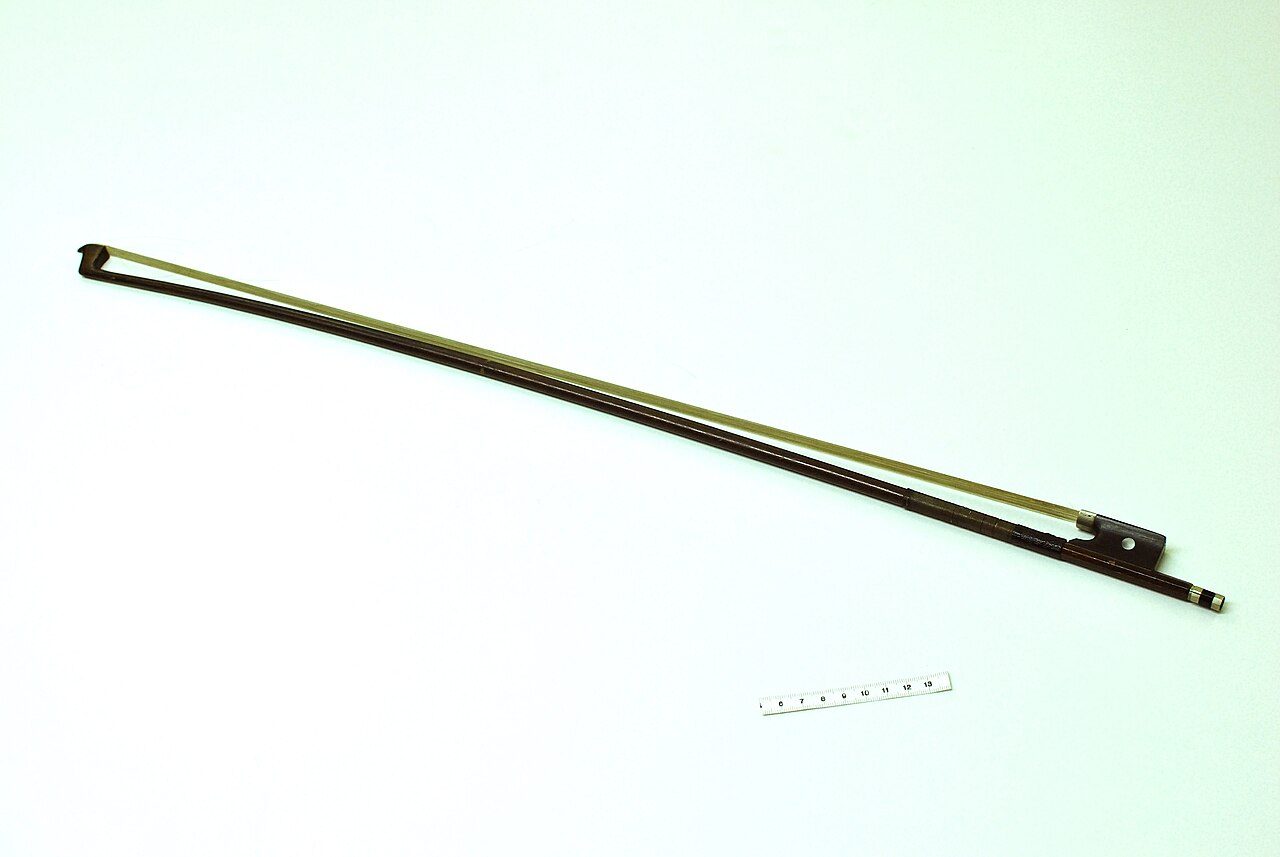
A bow consists of a specially shaped stick with other material forming a ribbon stretched between its ends, which is used to stroke the string and create sound. Different musical cultures have adopted various designs for the bow. For instance, in some bows a single cord is stretched between the ends of the stick. In the Western tradition of bow making—bows for the instruments of the violin and viol families—a hank of horsehair is normally employed. The manufacture of bows is considered a demanding craft, and well-made bows command high prices. Part of the bow maker's skill is the ability to choose high quality material for the stick. Historically, Western bows have been made of pernambuco wood from Brazil. However, pernambuco is now an endangered species whose export is regulated by international treaty, so makers are currently adopting other materials: woods such as Ipê (Tabebuia) and synthetic materials, such as carbon fiber epoxy composite and fiberglass. For the frog, which holds and adjusts the near end of the horsehair, ebony is most often used, but other materials, often decorative, were used as well, such as ivory and tortoiseshell. Materials such as mother of pearl or abalone shell are often used on the slide that covers the mortise, as well as in round decorative "eyes" inlaid on the side surfaces. Sometimes "Parisian eyes" are used, with the circle of shell surrounded by a metal ring. The metal parts of the frog, or mountings, may be used by the maker to mark various grades of bow, ordinary bows being mounted with nickel silver, better bows with silver, and the finest being gold-mounted. 1
Types
Slightly different bows, varying in weight and length, are used for the violin, viola, cello, and double bass. These are generally variations on the same basic design. However, bassists use two distinct forms of the double bass bow. The "French" overhand bow is constructed like the bow used with other bowed orchestral instruments, and the bassist holds the stick from opposite the frog. The "German" underhand bow is broader and longer than the French bow, with a larger frog curved to fit the palm of the hand. The bassist holds the German stick with the hand loosely encompassing the frog. The German bow is the older of the two designs, having superseded the earlier arched bow. The French bow became popular with its adoption in the 19th century by virtuoso Giovanni Bottesini. Both are found in the orchestra, though typically an individual bass player prefers to perform using one or the other type of bow. 1
Bowing
The characteristic long, sustained, and singing sound produced by the violin, viola, violoncello, and double bass is due to the drawing of the bow against their strings. This sustaining of musical sound with a bow is comparable to a singer using breath to sustain sounds and sing long, smooth, or legato melodies. The term used for playing with a bow is "arco", from the Latin word "arcus", meaning bow. Therefore, to play arco is to play with a bow. In modern practice, the bow is almost always held in the right hand while the left is used for fingering. When the player pulls the bow across the strings (such that the frog moves away from the instrument), it is called a down-bow; pushing the bow so the frog moves toward the instrument is an up-bow (the directions "down" and "up" are literally descriptive for violins and violas). Two consecutive notes played in the same bow direction are referred to as a hooked bow; a down-bow following a whole down-bow is called a retake. Generally, the player uses down-bow for strong musical beats and up-bow for weak beats. However, this is reversed in the viola da gamba—players of violin family instruments look like they are "pulling" on the strong beats, where gamba players look like they are "stabbing" on the strong beats. The difference may result from the different ways player hold the bow in these instrument families: violin/viola/cello players hold the wood part of the bow closer to the palm, whereas gamba players use the opposite orientation, with the horsehair closer. 1
Origin
The question of when and where the bow was invented is of interest because the technique of using it to produce sound on a stringed instrument has led to many important historical and regional developments in music, as well as the variety of instruments used. Pictorial and sculptural evidence from early Egyptian, Indian, Hellenic, and Anatolian civilizations indicate that plucked stringed instruments existed long before the technique of bowing developed. In spite of the ancient origins of the bow and arrow, it would appear that bowed string instruments only developed during a comparatively recent period. The Chinese yazheng is a zither played with a bow. The earliest Chinese source of the pipe zither yazheng, bowed with a stick, is from the 8th century. The use of rubbing sticks in Central Asia seems to be older. Presumably this playing technique was first used in lutes in Sogdiana around the 6th century, from where it reached China. Eric Halfpenny, writing in the 1988 Encyclopædia Britannica, says, "bowing can be traced as far back as the Islamic civilization of the 10th century ... it seems likely that the principle of bowing originated among the nomadic horse riding cultures of Central Asia, whence it spread quickly through Islam and the East, so that by 1000 it had almost simultaneously reached China, Java, North Africa, the Near East and Balkans, and Europe." Halfpenny notes that in many Eurasian languages the word for "bridge" etymologically means "horse," and that the Chinese regarded their own bowed instruments (huqin) as having originated with the "barbarians" of Central Asia. The Central Asian theory is endorsed by Werner Bachmann, writing in The New Grove Dictionary of Music and Musicians. 1
Arabic rabāb
The Arabic rabāb is a type of a bowed string instrument so named no later than the 8th century and spread via Islamic trading routes over much of North Africa, the Middle East, parts of Europe, and the Far East. It is the earliest known bowed instrument, and the ancestor of all European bowed instruments, including the rebec, lyra and violin. 1
The text above is adapted from the Wikipedia article “Bow (music)”, available under the Creative Commons Attribution-ShareAlike 4.0 licence. 1
bow is stick-shaped implement with hairs used to play a bowed string musical instrument such as a violin, according to the structured record cited below. This entry was generated automatically from that record and has not yet been reviewed by a person familiar with the tradition. 2
The source record links this tradition to 18 external registers, which can be verified through the citation. 2