The tradition & historical record
6 min read · 2 sourcesA brass instrument is a musical instrument that produces sound by sympathetic vibration of air in a tubular resonator in sympathy with the vibration of the player's lips. The term labrosone, from Latin elements meaning "lip" and "sound", is also used for the group, since instruments employing this "lip reed" method of sound production can be made from other materials like wood or animal horn, particularly early or traditional instruments such as the cornett, alphorn or shofar. There are several factors involved in producing different pitches on a brass instrument. Slides, valves, crooks (though they are rarely used today), or keys are used to change vibratory length of tubing, thus changing the available harmonic series, while the player's embouchure, lip tension and air flow serve to select the specific harmonic produced from the available series. The view of most scholars (see organology) is that the term "brass instrument" should be defined by the way the sound is made, as above, and not by whether the instrument is actually made of brass. Thus one finds brass instruments made of wood, like the alphorn, the cornett, the serpent and the didgeridoo, while some woodwind instruments are made of brass, like the saxophone. 1
Families
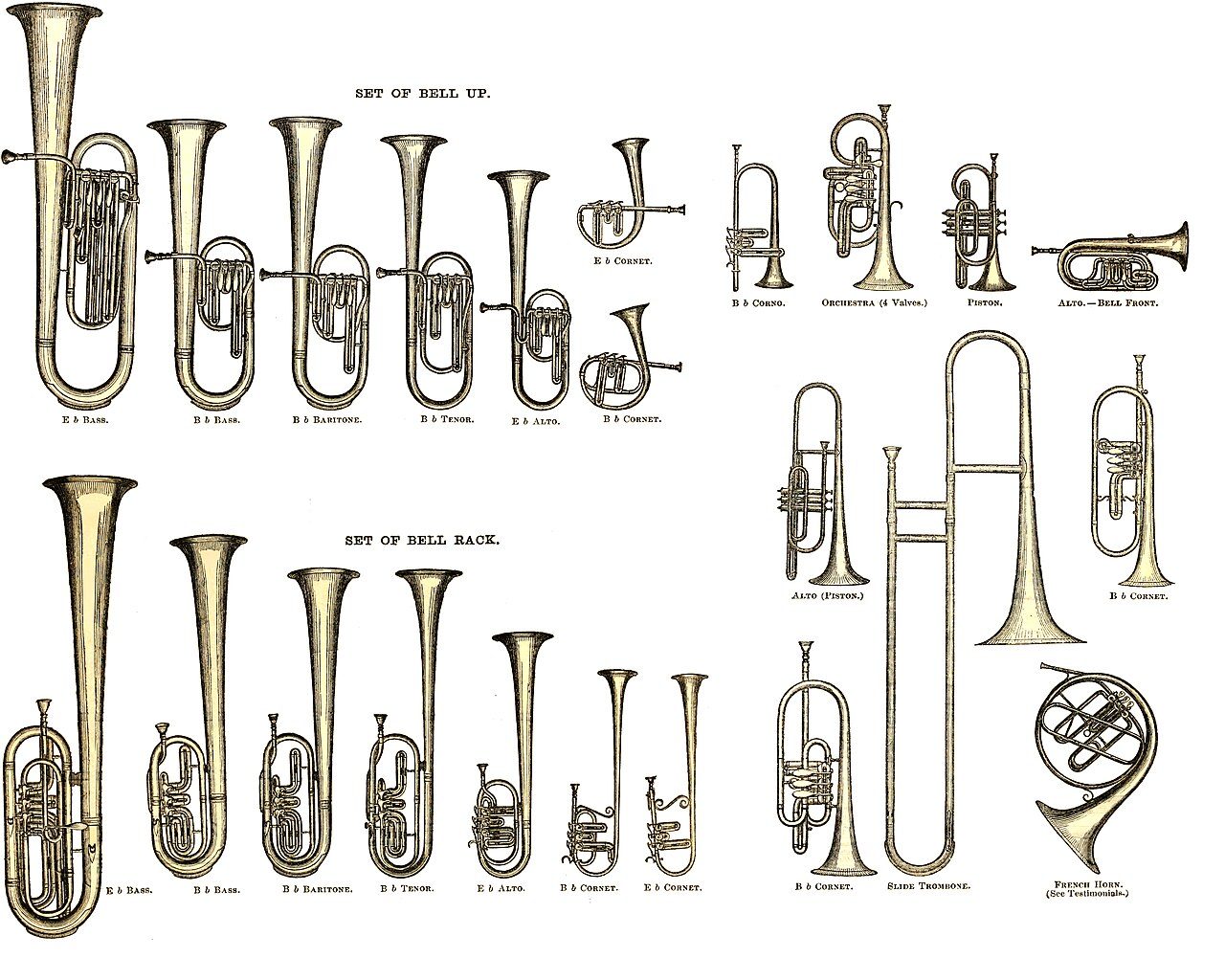
Modern brass instruments generally come in one of two families: 1
Valved brass instruments use a set of valves (typically three or four but as many as seven or more in some cases) operated by the player's fingers that introduce additional tubing, or crooks, into the instrument, changing its overall length. This family includes all of the modern brass instruments except the trombone: the trumpet, horn (also called French horn), euphonium, and tuba, as well as the cornet, flugelhorn, tenor horn (alto horn), baritone horn, sousaphone, and the mellophone. As valved instruments are predominant among the brasses today, a more thorough discussion of their workings can be found below. The valves are usually piston valves, but can be rotary valves; the latter are the norm for the horn (except in France) and are also common on the tuba. Slide brass instruments use a slide to change the length of tubing. The main instruments in this category are the trombone family, though valve trombones are occasionally used, especially in jazz. The trombone family's ancestor, the sackbut, and the folk instrument bazooka are also in the slide family. 1
There are two other families that have, in general, become functionally obsolete for practical purposes. Instruments of both types, however, are sometimes used for period-instrument performances of Baroque or Classical pieces. In more modern compositions, they are occasionally used for their intonation or tone color. 1
Natural brass instruments only play notes in the instrument's harmonic series. These include the bugle and older variants of the trumpet and horn. The trumpet was a natural brass instrument prior to about 1795, and the horn before about 1820. 1
Bore taper and diameter
Brass instruments may also be characterised by two generalizations about geometry of the bore, that is, the tubing between the mouthpiece and the flaring of the tubing into the bell. Those two generalizations are with regard to 1
the degree of taper or conicity of the bore and the diameter of the bore with respect to its length. 1
Cylindrical vs. conical bore
While all modern valved and slide brass instruments consist in part of conical and in part of cylindrical tubing, they are divided as follows: 1
Cylindrical bore brass instruments are those in which approximately constant diameter tubing predominates. Cylindrical bore brass instruments are generally perceived as having a brighter, more penetrating tone quality compared to conical bore brass instruments. The trumpet, and all trombones are cylindrical bore. In particular, the slide design of the trombone necessitates this. Conical bore brass instruments are those in which tubing of constantly increasing diameter predominates. Conical bore instruments are generally perceived as having a more mellow tone quality than the cylindrical bore brass instruments. The "British brass band" group of instruments fall into this category. This includes the flugelhorn, cornet, tenor horn (alto horn), baritone horn, horn, euphonium and tuba. Some conical bore brass instruments are more conical than others. For example, the flugelhorn differs from the cornet by having a higher percentage of its tubing length conical than does the cornet, in addition to possessing a wider bore than the cornet. In the 1910s and 1920s, the E. A. Couturier company built brass band instruments utilizing a patent for a continuous conical bore without cylindrical portions even for the valves or tuning slide. 1
Whole-tube vs. half-tube
The resonances of a brass instrument resemble a harmonic series, with the exception of the lowest resonance, which is significantly lower than the fundamental frequency of the series that the other resonances are overtones of. Depending on the instrument and the skill of the player, the missing fundamental of the series can still be played as a pedal tone, which relies mainly on vibration at the overtone frequencies to produce the fundamental pitch. The bore diameter in relation to length determines whether the fundamental tone or the first overtone is the lowest partial practically available to the player in terms of playability and musicality, dividing brass instruments into whole-tube and half-tube instruments. These terms stem from a comparison to organ pipes, which produce the same pitch as the fundamental pedal tone of a brass instrument of equal length. 1
Whole-tube instruments have larger bores in relation to tubing length, and can play the fundamental tone with ease and precision. The tuba and euphonium are examples of whole-tube brass instruments. Half-tube instruments have smaller bores in relation to tubing length and cannot easily or accurately play the fundamental tone. The second partial (first overtone) is the lowest note of each tubing length practical to play on half-tube instruments. The trumpet and horn are examples of half-tube brass instruments. 1
Other brass instruments
The instruments in this list fall for various reasons outside the scope of much of the discussion above regarding families of brass instruments. 1
Alphorn (wood) Conch (shell) Didgeridoo (wood, Australia) Natural horn (no valves or slides—except tuning crooks in some cases) Jazzophone Keyed bugle (keyed brass) Keyed trumpet (keyed brass) Saxhorn Serpent (keyed brass) Ophicleide (keyed brass) Shofar (animal horn) Vladimirskiy rozhok (wood, Russia) Vuvuzela (simple short horn, origins disputed but achieved fame or notoriety through many plastic examples in the 2010 World Cup) Lur 1
The text above is adapted from the Wikipedia article “Brass instrument”, available under the Creative Commons Attribution-ShareAlike 4.0 licence. 1
brass instrument is class of musical instruments, according to the structured record cited below. This entry was generated automatically from that record and has not yet been reviewed by a person familiar with the tradition. 2
The source record links this tradition to 45 external registers, which can be verified through the citation. 2