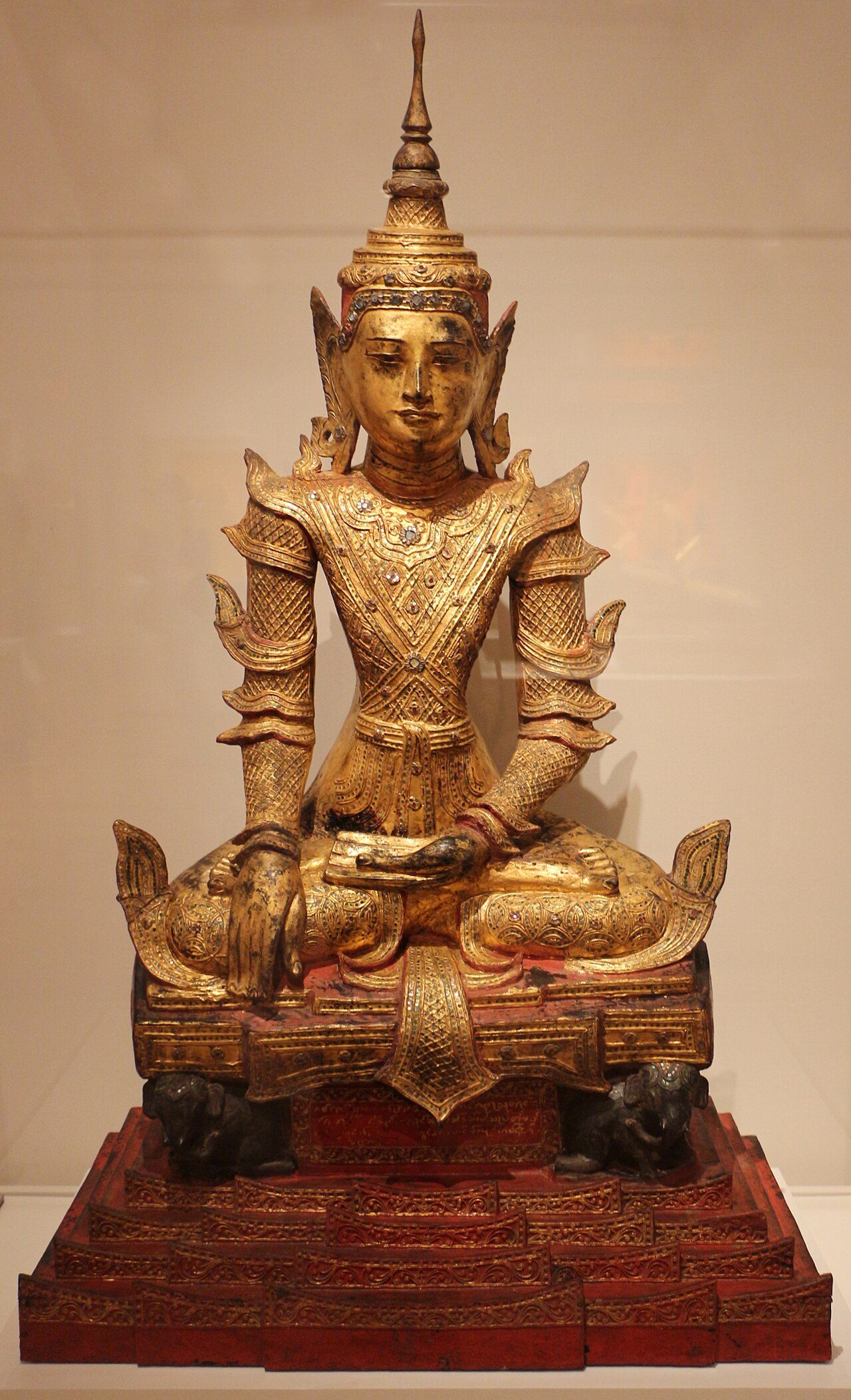
The tradition & historical record
6 min read · 2 sourcesArt of Myanmar refers to visual art created in Myanmar (Burma). Ancient Burmese art was influenced by India and China, and was often religious in nature, ranging from Hindu sculptures in the Thaton Kingdom to Theravada Buddhist images in the Sri Ksetra Kingdom. The Bagan period saw significant developments in many art forms, from wall paintings and sculptures to stucco and wood carving. After a dearth of surviving art between the 14th and 16th centuries, artists created paintings and sculptures that reflect Burmese culture. Burmese artists have been subjected to government interference and censorship, hindering the development of art in Myanmar. Burmese art reflects the central Buddhist elements including the mudra, Jataka tales, the pagoda, and Bodhisattva. Throughout Burmese history, religious art or the royal court were the source of virtually all of Myanmar's visual arts. 1
Pyu and Mon period
Trade with India during the Pyu period brought deep cultural contacts heavily influencing many aspects of visual culture in Myanmar. However, scholarship and archaeology on Pyu, Mon and Dvaravati art in neighbouring Thailand were biased by colonial attitudes in the 20th century, placing a greater emphasis on comparisons to well-documented Gupta art. The three cultures, traditionally divided by differences in artistic styles, actually share many similarities and evidence of cross-cultural influences within their art. Nonetheless, contact with India brought Theravada Buddhism to the Pyu city states in the 6th century, most notably in Sri Ksetra. Early Sri Ksetra religious art was influenced by Southeast India and later Southwest India. By the 9th century, there were notable influences from the Nanzhao Kingdom. Other Pyu city-states remained a mix of Ari Buddhist and Mahayana Buddhist with greater influences from Nanzhao through the migration of Mranma people. In Hanlin, Buddha statues were crowned Buddhas differing from Sri Ksetra by lacking an urna on the forehead, indicating less Indian influence. The Thaton Kingdom and the Mon to the south of the Pyu also exhibited Indian influences in their art. The Mon from this time mainly used alabaster, stone or bronze depicted with the Bhūmisparśa mudra. Mon Buddha images are distinguished from Burmese or Pyu images by the length of the fingers in the mudra. Some of the few pieces of Thaton art dating before the Bagan Kingdom are Hindu showing Vishnu with a tripartite lotus showing the Trimurti (Brahma, Vishnu and Shiva) a configuration unique to Pyu art. 1
Bagan Period
There is significantly more extant art from the Bagan Kingdom onwards. Most notable are the wall paintings and statues decorating the interior of temples in Bagan. The murals of the Bagan period were painted on a dry surface, as opposed to frescos utilizing wet cement. The wall paintings were often captioned in Pali, Old Mon or Old Burmese and typically depicted the Jataka Tales. Many temples also featured ceiling paintings, which were usually patterns. The lotus was a common motif in ceiling art for its symbolic connection with purity in Buddhist art. Sculpture was also very prominent in the period. Buddha images for the purpose of worship within temples. Buddha images of the period are distinct for their round face, short urnas and strict expressions. Many surviving statues are made of bronze, iron or sandstone. Other scenes from Buddhist folklore, like the birth of the Buddha, were common subjects for statues and reliefs. Furthermore, many bronze sculptures depicted Parvati, the consort of the Hindu god Shiva, as she was regarded as an important deva in Bagan. Exteriors of Bagan temples also featured intricate stucco work and reliefs depicting various Buddhist scenes. The art of wooden sculpture also developed in this period with a few surviving pieces being incorporated into the doors of Bagan temples. During this period, ten traditional arts, called pan sè myo (ပန်းဆယ်မျိုး, lit. 'Ten Flowers'), were established within the culture. The ten arts are as follows: Lacquerware is also a distinct craft originating from the late Bagan period with the earliest fragments of basketry in Bagan being dated to the 13th century. 1
Taungoo and Ava periods
After the Mongol invasions of Burma and the subsequent decline of Bagan as a cultural center led to three centuries of warfare and internal division. Art produced in the rise of Burmese kingdoms was often plundered, destroyed or burnt especially when rival kingdoms came to surpass them in power. There is, therefore, significantly less art from the 14th to 16th centuries. Bayinnaung's conquest and subjugation in 1555–1562 of Manipur, Bhamo, Zinme (Chiang Mai), Linzin (Lan Xang), and up the Taping and Shweli rivers in the direction of Yunnan brought back large numbers of skilled craftsmen into Burma. It is thought that the finer sort of Burmese lacquerware, called Yun, was introduced during this period by imported artisans belonging to the Yun or Laos Shan tribes of the Chiang Mai region. Having reunited the various Burmese polities, Bayinnaung built the Kanbawzathadi Palace incorporating gold plates into traditional Burmese architecture. Visitors recorded the palace as being magnificent and splendourous. Art from this period began to see more Shan and Mon influences. Buddha statues from both the Kingdom of Ava and the Taungoo period have larger heads and lotus-petal shaped halos. After the collapse of the empire and the restoration of the Taungoo Kingdom, the capital was moved back to Ava with many referring to this period as the Ava period. This period is not to be confused with the Kingdom of Ava two centuries prior. Buddha images from this period are distinct for their large forehead and oval-shaped faces. Sculptors also began to work with marble and developed a style where the eyes looked down instead of outwards. Paintings in this period, like those found in the Oke Kyaung Monastery in Bagan, continued the religious theme and subject matter of the Bagan period. 1
Arakan art
The Kingdom of Arakan established in the 15th century brought artisans from the Bengal Sultanate and had deep trade and cultural connections to South Asia. The cities of Mrauk U, Dhanyawadi and Waithali had stone sculptures and inscriptions dating between the 6th and 16th centuries. Visitors to the Arakanese court noted the textile splendours and the high respected positions of Weavers within Arakan. Buddha images from Arakan are more square and angled. When the images are crowned, they have a shorter crown wing. One famous piece of Arakan art is the Mahamuni Image. According to legend, it was carved in Dhanyawadi during a visit from Gautama Buddha. Historically, the image has existed at least since the 11th century when King Anawrahta unsuccessfully attempted to move the image to Bagan. The image was later captured by the Konbaung dynasty and moved to the Mahamuni Buddha Temple in Amarapura in 1784. 1
Shan art
Art historians do not have an agreed-upon definition of Shan art, though it generally involves art from the historical and modern-day … 1
The text above is adapted from the Wikipedia article “Art of Myanmar”, available under the Creative Commons Attribution-ShareAlike 4.0 licence. 1
Burmese art is aspect of culture in Myanmar, according to the structured record cited below. This entry was generated automatically from that record and has not yet been reviewed by a person familiar with the tradition. 2
The source record links this tradition to 3 external registers, which can be verified through the citation. 2