The tradition & historical record
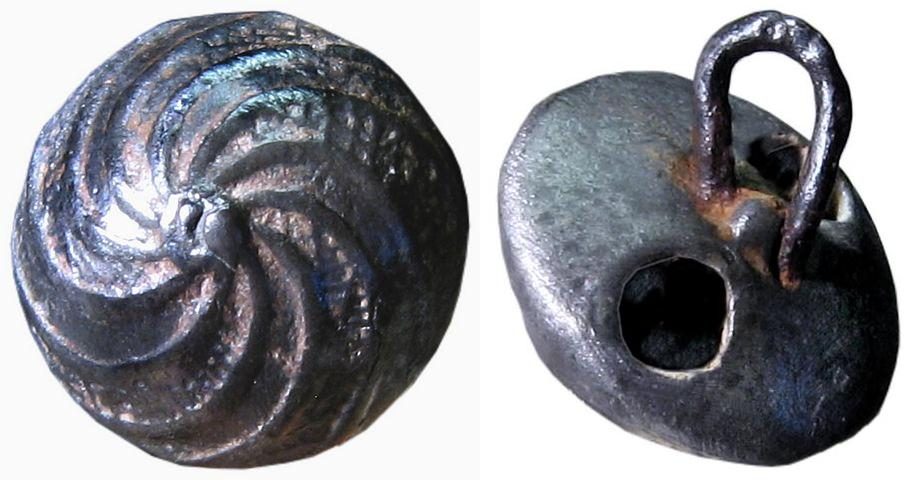
5 min read · 2 sourcesA button () is a fastener that joins two pieces of fabric together by slipping through a loop or by sliding through a buttonhole. In modern clothing and fashion design, buttons are commonly made of plastic but also may be made of metal, wood, or seashell. Buttons can also be used on containers such as wallets and bags. Buttons may be sewn onto garments and similar items exclusively for purposes of ornamentation. In the applied arts and craft, a button can be an example of folk art, studio craft, or even a miniature work of art. In archaeology, a button can be a significant artifact. 1
History
Buttons and button-like objects used as ornaments or seals rather than fasteners have been discovered in the Indus Valley Civilization during its Kot Diji phase (c. 2800–2600 BC). Buttons as apparel have been found at sites of the Catacomb culture, Russia (2500–1950 BC), at the Tomb of the Eagles, Scotland (2200–1800 BC), and at Bronze Age sites in China (c. 2000–1500 BC) and Ancient Rome. Buttons made from seashell were used by the Indus Valley Civilization for ornamental purposes by 2000 BC. Some buttons were carved into geometric shapes and were pierced so that they could be attached to clothing with thread. Ian McNeil (1990) holds that "the button was originally used more as an ornament than as a fastening, the earliest known being found at Mohenjo-daro in the Indus Valley. It is made of a curved shell and is about 5000 years old." Egypt's Eighteenth Dynasty left behind ornate wig covers, fabricated through sewing buttons formed of precious metals onto strips of backing material. Leatherwork from the Roman Empire incorporates some of the first buttonholes, with the legionary's loculus closed through the insertion of a metallic buckle, or button into a leather slit. A similar mechanism would later feature in early medieval footwear. Buttons appeared as a means to close cuffs in the Byzantine Empire and to fasten the necks of Egyptian tunics by no later than the 5th century. 1
Middle Ages
It has been proposed that the European Crusaders brought the innovation of the button loop back from the Middle East, allowing for more fitted garments for men. About this time, the Vikings were also using buttons, which they had come across through their trading partners. Prior to the introduction of the buttonhole, two pieces of fabric were butted together, rather than overlapped, and toggles, belts, or lacings were used. Buttonholes to fasten clothing first appeared in 13th-century Germany. The growing importance of buttons was marked by the establishment of button making guilds in the 13th century. Initially, King Louis IX of France included button makers in the established rosary makers guild, but later regulations categorized button makers in three categories: those who worked in horn, bone, and ivory, those who used metals, and makers who used precious metals and glass. 1
Renaissance
The fitted fashions of the Renaissance made use of buttons. For example, later variations of the tight-fitting jacket known as the doublet had rows of many buttons. An additional opportunity to use buttons came with the incorporatinon of detachable sleeves into garments. This practice had been in use in Florence since the 1200s. Sleeves could be switched out to be washed or to be replaced by fancier sleeves demanded by particular settings. Women's fashion at this time still used lacings, and thus buttons on their clothing were generally decorative. Buttons were also impacted by the elegant culture of the Renaissance courts. They were no longer seen as simply utilitarian objects, but rather as luxury items that could reflect wealth and status. These buttons, some of which were made of precious metal encrusted with jewels, were seen as jewelry. Because their owners might want to move these valuable buttons from one piece of clothing to another, they often were not sewn on with thread. Rather, their shanks were pushed through the fabric and were held in place with metal strips inserted through the shank. At the time, wood, bone, brass and pewter made it possible for less expensive buttons to be produced. 1
17th century
Fabric-covered buttons and embroidered buttons became popular in Europe in the 17th century. These were often small, and served a decorative, rather than functional, purpose. The early 17th century short jerkin, wide breeches and cloak may have been adorned by dozens of buttons, and with so many, they needed to be lightweight. The mid century French-originated knee-length coat, the justaucorps, had buttons from the neck to the knee, buttoned sleeve cuffs, and buttoned flaps on the pockets. French law, concerned with protecting the silk industry in Paris and Lyons, required buttons to be covered in silk. On the other hand, England did not allow fabric buttons in the late 1600s and early 1700s. Tailors could make fabric-covered buttons with leftover fabric, which threatened the guild of button makers. 1
As containers
Since at least the 17th century, when box-like metal buttons were constructed especially for the purpose, buttons have been one of the items in which drug smugglers have attempted to hide and transport illegal substances. At least one modern smuggler has tried to use this method. Also making use of the storage possibilities of metal buttons, during the World Wars, British and US military locket buttons were made, containing miniature working compasses. 1
The text above is adapted from the Wikipedia article “Button”, available under the Creative Commons Attribution-ShareAlike 4.0 licence. 1
button is small fastener used in clothing, according to the structured record cited below. This entry was generated automatically from that record and has not yet been reviewed by a person familiar with the tradition. 2
The source record links this tradition to 36 external registers, which can be verified through the citation. 2