The tradition & historical record
5 min read · 2 sourcesCalligraphy (from Ancient Greek καλλιγραφία (kalligraphía) 'beautiful writing') is fine handwriting as a visual art. It involves the design and execution of lettering or characters using a pen, ink brush, or other writing instruments. Classical calligraphy differs from type design and non-classical hand-lettering, though some calligraphers may practice both. In East Asia and the Islamic world, calligraphy is a prominent element in art. Its visual form is often influenced by the meaning of the text as a whole or the individual words. Modern Western calligraphy is mainly used in formal settings, including wedding invitations and announcements, as well as in type and computer font design, letter cutting, hand-lettered logo design, religious art, graphic design, commissioned calligraphic art, carved stone inscriptions, and memorial documents. It is also used for testimonials, birth and death certificates, maps, and other written works. Modern Western calligraphy incorporates a wide range of styles, from functional inscriptions and designs to fine art pieces, where the legibility of letters varies. Contemporary calligraphy has been defined as "the art of giving form to signs in an expressive, harmonious, and skillful manner". 1
Pens and brushes
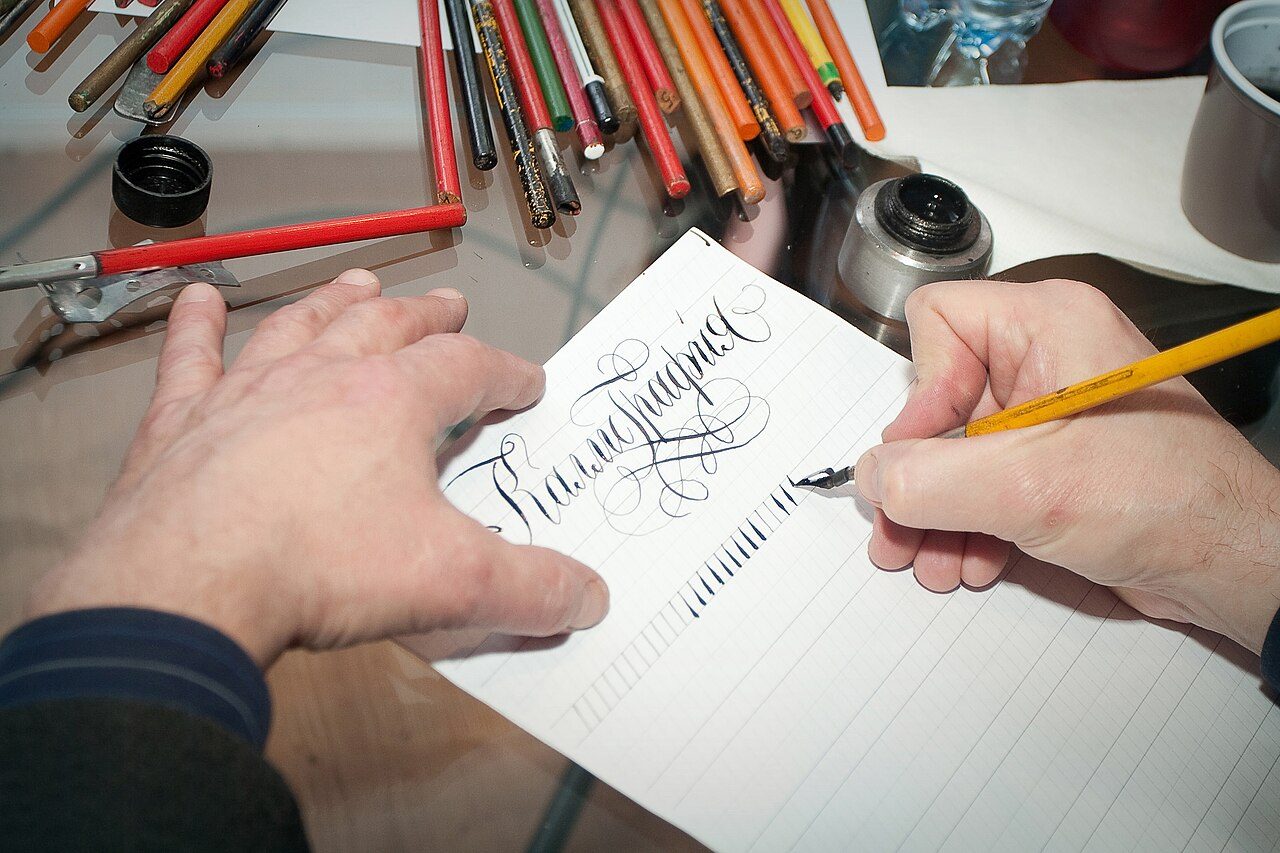
In the Western world, the principal tools for calligraphy are pens and brushes. The nibs of calligraphic pens may be flat, round, or pointed. For decorative purposes, multi-nib pens (steel brushes) can be used. Felt-tip and ballpoint pens may also be used, however, these do not produce angled lines. There are certain styles of calligraphy, such as Gothic script, that require a broad edged pen. In Asia, a makta, or penknife, is frequently used by calligraphers to cut reed pens. Natural reeds offer a wider range of motion compared to metallic pens. Common calligraphy tools include quills, dip pens, ink brushes, fountain pens, and reed pens. 1
Inks, papers, and templates
The ink used for calligraphy is usually water-based and less viscous than the oil-based ink used in printing. Certain specialty papers with high ink absorption and uniform texture help draw cleaner lines. Parchment or vellum are occasionally used, because imperfections can be erased with a knife, and lines can be viewed through it without using a lightbox. Otherwise, lightboxes and templates can be used to achieve straight lines without leaving pencil marks. Ruled paper can be used directly or with a lightbox. Often, it has line spacing between one-quarter or one-half inch, although one-inch spaces are occasionally used, as is the case with Uncial script (from Latin: litterea unciales, lit. 'inch-high letters'). 1
East Asia
Chinese calligraphy is known as shūfǎ or fǎshū (書法, or 法書 in traditional Chinese, 'the method or law of writing'); Japanese calligraphy is called shodō (書道, 'the way of writing'); and Korean calligraphy is referred to as seoye (Korean: 서예; Hanja: 書藝; 'the art of writing'). The calligraphy of Chinese, Japanese, and Korean characters remains an important and highly regarded aspect of contemporary traditional East Asian culture. 1
China
In ancient China, the oldest known Chinese characters are oracle bone script (甲骨文), carved on ox scapulae and tortoise plastrons. The rulers in the Shang dynasty carved pits on such animals' bones and baked them for insight into military affairs, agricultural harvests, weather, or even procreation, as a form of scapulimancy. During the divination ceremony, a heat source was applied to the carved pits, causing the bones to crack; they were then interpreted, with the interpretation being carved directly on the shell or bone, sometimes after the characters were written with a brush. With the development of the bronzeware script (jīn wén) and large seal script (dà zhuàn), "cursive" signs continued. Mao Gong ding is one of the most famous examples of bronzeware script in Chinese calligraphic history. It contains 500 inscribed characters, the largest number of bronze inscriptions discovered to date. Moreover, each archaic kingdom of current China had its own set of characters. In Imperial China, the graphs on old steles have been preserved and can be viewed in museums. Some date back to 200 BCE and are written in the small seal script (小篆 xiǎo zhuàn) style. Around 220 BCE, the emperor Qin Shi Huang, the first to conquer the entire Chinese basin, imposed several reforms, among them Li Si's character unification, which created a set of 3300 standardized small seal characters. Despite the fact that the main writing implement of the time was already the brush, few papers survive from this period, and the main examples of this style are on steles. 1
Technique
To write Chinese characters, traditional East Asian writing uses the Four Treasures of the Study: ink brushes known as máobǐ (毛筆/毛笔), inkstick , paper, and inkstones. They are also known as the Four Friends of the Study (Korean: 문방사우/文房四友, romanized: Munbang sau) in Korean. There are many factors that influence the final result of a calligrapher's work. Physical factors include the shape, size, stretch, and hair type of the ink brush; the colour, pigment density, and water density of the ink; and the paper's surface texture and speed in absorbing water. The calligrapher's technique also influences the result, as the look of finished characters is affected by the amount of ink and water the brush absorbs and by the brush's pressure, angle, and direction. Changing these variables produces thinner or bolder strokes and smooth or toothed borders. Eventually, the speed, acceleration, and deceleration of a skilled calligrapher's movements greatly affect the final shape of characters and give them their "spirit". 1
The text above is adapted from the Wikipedia article “Calligraphy”, available under the Creative Commons Attribution-ShareAlike 4.0 licence. 1
calligraphy is visual art related to writing, according to the structured record cited below. This entry was generated automatically from that record and has not yet been reviewed by a person familiar with the tradition. 2
The source record links this tradition to 58 external registers, which can be verified through the citation. 2