The tradition & historical record
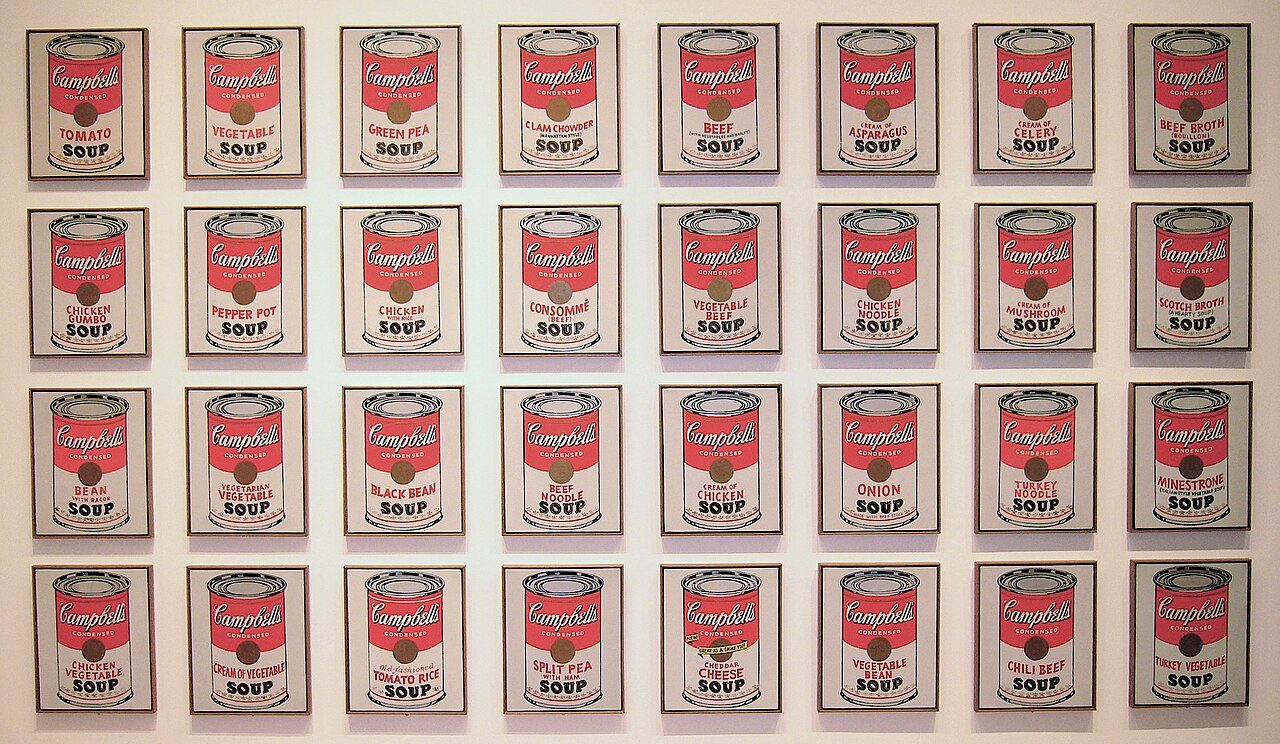
6 min read · 2 sourcesCampbell's Soup Cans is a series of 32 paintings produced by American artist Andy Warhol between 1961 and 1962. Each painting depicts a different variety of Campbell's soup cans in a uniform 20-by-16-inch format. First exhibited in July 1962 at the Ferus Gallery in Los Angeles, the pop art works challenged traditional distinctions between fine art and commercial imagery. Warhol's association with the subject led to his name becoming synonymous with the Campbell's soup cans. The series catapulted Warhol to fame and contributed to critical discourse about originality, reproduction, and the meaning of art in a consumer society. Drawing on his background as a commercial illustrator, Warhol focused on the packaging of everyday items, making high art of the artistic depiction of the commercial packaging rather than of the everyday items themselves, prompting initial controversy but eventual acclaim. The Campbell's Soup Cans series generally refers to the original 32 canvases, but it also encompasses Warhol's many subsequent variations: approximately 20 similar paintings produced in the early 1960s; a 1965 set of 20 larger multi-colored canvases; numerous related drawings, sketches, and stencils created over the years; and two separate editions of 250 ten-print screen print portfolios issued in 1968 and 1969. The original 32 canvases were preserved by art dealer Irving Blum and later acquired by the Museum of Modern Art in 1996. 1
Background
Andy Warhol moved to New York City in 1949 after studying at the Carnegie Institute of Technology in Pittsburgh, and quickly found success as a commercial illustrator, with his first published drawing appearing in Glamour that same year. As a student at Carnegie Tech, Warhol developed his signature "blotted line" technique from tracing images on paper and blotting the wet ink to create irregular, variable lines. Using this technique, he duplicated and varied motifs, often drawing on images from the New York Public Library. Warhol held his first gallery exhibition in 1952 at the Bodley Gallery and, throughout the 1950s, regularly showed drawings and exhibited at institutions including the Museum of Modern Art in 1956. He subsequently used photographs taken by his one-time lover Edward Wallowitch as source material for his drawings, notably his self-published A Gold Book (1957). 1
By 1961, Warhol began producing canvases based on comic strips and newspaper advertisements. He was able to get exposure for these works by using them as a backdrop for his Bonwit Teller window design in April 1961. Yet he remained behind some of his peers in securing gallery representation. Having been rejected by the Leo Castelli Gallery for similarities in his work to the style of comics done by Roy Lichtenstein, Warhol was seeking a distinct direction within the emerging Pop art movement. He turned to everyday commercial imagery such as Campbell's soup cans, dollar bills, and Coca-Cola bottles. In 1961, Warhol said, "I've got to do something that really will have a lot of impacts that will be different enough from Lichtenstein and James Rosenquist, that will be very personal, that won't look like I'm doing exactly what they're doing." 1
Technique and production
During this period, Warhol was wavering between action painting and abstract expressionism, with his style of drip painting. Experimenting with hand painting, stenciling, and rubber stamps, he began to standardize his process using acrylic paint and serial repetition. Warhol was influenced by the painter Max Arthur Cohn's screen printing technique. In late 1961, Warhol began learning silkscreen printing from Floriano Vecchi of Tiber Press, refining his technique through repeated visits and advice on pigments and squeegee handling. Warhol moved toward silkscreening to increase efficiency, which would define his later practice. Soon, Warhol had mastered the process of pushing ink through a glue-prepared silk screen with a rubber squeegee. In late 1961, Warhol began working on Campbell's Soup Cans at his home studio at 1342 Lexington Avenue in New York. The series consisted of 32 hand-painted canvases, each depicting a different variety of Campbell's soup. They were based on photographs taken by his former boyfriend Edward Wallowitch. Contrary to later confusion, the works were not silkscreens but traced and painted canvases incorporating stamped details. Warhol used a rubber stamp to apply the gold fleur-de-lis near the lower portion of each image and worked with commercial-grade acrylic paint rather than the oil paint more typical of fine art. These were among the last works Warhol painted largely by hand. Between November 1961 and mid-1962, he painted roughly fifty soup-can canvases, including the definitive set of thirty-two completed by June 1962. According to the Andy Warhol Catalogue Raisonné, the project also included three large grid paintings (one depicting 200 cans and two depicting 100 cans) and numerous related still lifes. 1
Ferus Gallery exhibition
In June 1962, Warhol sent Blum the 32 completed canvases, each measuring 20-by-16-inches. A June 26 postcard from Blum confirmed their arrival and advised keeping prices low during the initial Los Angeles showing. The exhibition opened July 9, 1962, at the Ferus Gallery, with Warhol absent and without a formal opening. The opening coincided with La Cienega Boulevard's popular Monday Art Walk. The paintings were displayed in a single row on narrow ledges, like grocery items on a shelf. This untraditional presentation choice of the interjection of pop culture into art converted the gallery exhibition into a statement about the boundaries of commercial enterprise. Initially, the installation left many visitors perplexed, uncertain how to interpret the repeated image of a commonplace supermarket product displayed as high art. 1
Only five or six paintings were sold, including Campbell's Soup Can (Tomato), which was reserved by actor Dennis Hopper before the opening. When no further buyers emerged, Blum had the idea to keep all 32 works together as a set. Blum later recalled that he contacted the clients who had bought paintings, including Hopper, Betty Asher, Don Factor, Bob Rowan, and Edwin Janss, and asked them to relinquish their purchases. The buyers agreed, and because the paintings had not yet been delivered and remained in the gallery, Blum was able to acquire the complete set himself. After securing the paintings, Blum contacted Warhol and asked to purchase the entire set. Warhol offered the group for $1,000 ($10643.56 in 2025), and the two agreed to a payment plan under which Blum paid in ten monthly installments of $100 ($1064.36 in 2025). Reportedly, Factor, who is said to have also chosen Campbell's Soup Can (Tomato), "never forgave" Blum. 1
Subsequent early exhibitions
Although Warhol had yet to receive an offer for full-time gallery representation, art dealers Allan Stone and Martha Jackson spent a few months planning a December 1962 exhibition of his work. 1
Critical reception
The initial reaction to the exhibition was marked by skepticism and sales were minimal,… 1
The text above is adapted from the Wikipedia article “Campbell's Soup Cans”, available under the Creative Commons Attribution-ShareAlike 4.0 licence. 1
Campbell's Soup Cans is Paintings by Andy Warhol, according to the structured record cited below. This entry was generated automatically from that record and has not yet been reviewed by a person familiar with the tradition. 2
The source record links this tradition to 8 external registers, which can be verified through the citation. 2