The tradition & historical record
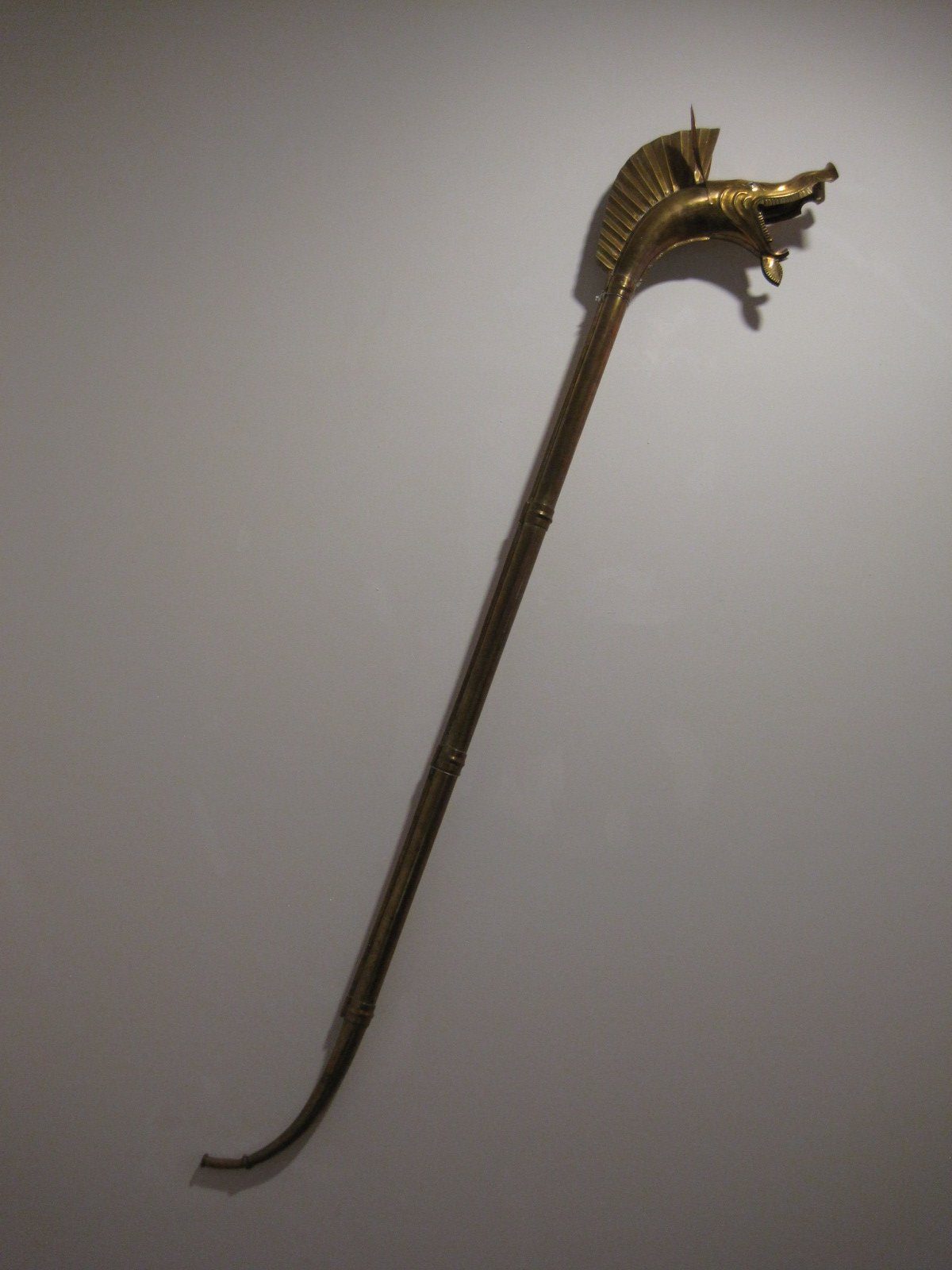
5 min read · 2 sourcesThe carnyx (pl.: carnyces; , KAR-nicks) is a wind instrument that was common in Celtic cultures during the Iron Age, between c. 200 BC and c. 200 AD. It is a type of trumpet made of bronze with an elongated S shape, held so that the long straight central portion was vertical and the short mouthpiece end section and the much wider bell were horizontal in opposed directions. The bell was styled in the shape of the head of an open-mouthed boar or other animal. The Celts used the carnyx in warfare, probably to incite troops to battle and to intimidate opponents, as Polybius recounts. The instrument's significant height—typically around 1.8 metres (6 feet), standing as tall as its player—allowed it to be heard over the heads of the participants in battles or ceremonies. The carnyx was not only used by the Celts but also by the Dacians in modern Romania, and depictions have even been found on a Buddhist sculpture in India, attesting to the far-flung connections of the Iron Age world. 1
Etymology
The word carnyx is derived from the Gaulish root carn- or cern-, meaning 'antler' or 'horn', and the same root of the name of the god Cernunnos. The Greek form karnon (κάρνον) or karnyx (κάρνυξ) is preserved in late lexicographers such as Hesychius, who defined it as a trumpet used by the Galatians. 1
Symbolism
In Iron Age Britain, animal symbolism deliberately conveys aggression and ferocity, with examples including a boar on the Witham Shield, the snouted Deskford carnyx in Scotland and the dragon pair sword scabbard from the River Thames. There is evidence to suggest that the carnyx would be held by a chieftain, as shown by a potential Gaulish king Bituitos figure. The design of the carnyx was likely inspired by the Etruscan lituus, a similarly curved trumpet, as part of the broader incorporation of Mediterranean imagery into Iron Age northern Europe. 1
Tintignac
In 2004, archaeologists discovered a first-century-BC Gallic pit at Tintignac in Corrèze, France (45.3333°N 1.7582°E / 45.3333; 1.7582). The deposit contained more than 500 fragments of metal objects, including seven carnyces, one of which was nearly complete. Prior to this discovery, fragments of only five carnyces had been found, in modern-day Scotland, France, Germany, Romania, and Switzerland. Six of the carnyces had boar's heads, while the seventh appears to be a serpent-like monster. They appear to represent a ritual deposit dating to soon after the Roman conquest of Gaul. The Tintignac finds enabled some fragments found in northern Italy decades before to be identified in 2012 as coming from a carnyx. 1
Tattershall Ferry, Lincolnshire
The first example found in Britain was dredged from the River Witham at Tattershall Ferry (53.08981°N 0.21462°W / 53.08981; -0.21462), Lincolnshire, in 1768. It is interpreted as a votive offering consigned into the river during the Iron Age. Made from hammered sheets of bronze fastened together with tin solder, it was destroyed during an attempt to analyse the composition of the metal used to make it. 1
Deskford, Banffshire
The next example found in Britain is the Deskford Carnyx, discovered at the farm of Leitchestown (57.6585°N 2.8041°W / 57.6585; -2.8041), Deskford, Banffshire, Scotland, in 1816. Seemingly, it too was placed as a ritual deposit in a peat bog. Only the boar's-head bell survives. It was donated to Banff Museum, and is now on loan from Aberdeenshire Museums Service to the Museum of Scotland. The location and age of the Deskford Carnyx in the Pictish heartland suggests the instrument may have had a ceremonial use and was not used only in warfare. Before 2004 this was the best surviving example, and generally copied in earlier reconstructions. The Deskford find was made almost entirely of brass, a metal used almost exclusively by the Romans after their conquest of Southern Britannia and strictly controlled by them, so just as with the vast majority of Iron Age and Roman-era Celtic brass found in Britain, the carnyx may have been made "with some care" from recycled metal. Based in part on the metallurgy, the Museum of Scotland give a date of 80–250 CE for its construction, noting that it was a locally-produced piece, "a specifically Scottish variant" distinct in design from known continental carnyces and that its "decoration is typical of metalwork in northeast Scotland at the time, where there was a flourishing tradition of fine bronze-working". Although metallurgy and style suggest manufacture local to the discovery, Vincent Megaw suggests that the pattern is characteristic also of items produced in Belgium in about 50 CE. 1
The text above is adapted from the Wikipedia article “Carnyx”, available under the Creative Commons Attribution-ShareAlike 4.0 licence. 1
carnyx is Celtic musical instrument; type of bronze trumpet with an elongated S shape, according to the structured record cited below. This entry was generated automatically from that record and has not yet been reviewed by a person familiar with the tradition. 2
The source record links this tradition to 9 external registers, which can be verified through the citation. 2