The tradition & historical record
6 min read · 2 sourcesIn archaeology, cave paintings are a type of parietal art (which category also includes petroglyphs, or engravings), found on the wall or ceilings of caves. The term usually implies prehistoric origin. Some of these paintings may not have been created by Homo sapiens. Discussion around prehistoric art is important in understanding the history of Homo sapiens and how human beings have come to have unique abstract thoughts. Some point to these prehistoric paintings as possible examples of creativity, spirituality, and sentimental thinking in prehistoric humans. 1
Dating
Nearly 350 caves have been discovered in France and Spain that contain art from prehistoric times. Initially, the age of the paintings had been a contentious issue, since methods like radiocarbon dating can produce misleading results if contaminated by other samples, and caves and rocky overhangs (where parietal art is found) are typically littered with debris from many time periods. But subsequent technology has made it possible to date the paintings by sampling the pigment itself, torch marks on the walls, or the formation of carbonate deposits on top of the paintings. The subject matter can also indicate chronology: for instance, the reindeer depicted in the Spanish cave of Cueva de las Monedas places the drawings in the last Ice Age. The oldest claimed cave painting is from Liang Metanduno on Muna Island, a handprint dated at least 67,800 years old. This painting predates by at least 1,100 years a cave painting previously thought to be the oldest, found in the Maltravieso cave, which has been suggested to have been made by a Neanderthal based on its age. The oldest date given to a figurative cave painting is a depiction of several human figures hunting pigs in the caves in the Maros-Pangkep karst of South Sulawesi, Indonesia, in 2019 dated to be over 43,900 years old. Before that finding, the oldest known figurative cave paintings were that of a bull dated to 40,000 years, at Lubang Jeriji Saléh cave, East Kalimantan, Indonesian Borneo, and a depiction of a pig with a minimum age of 35,400 years at Timpuseng cave in Sulawesi. The oldest rock painting is however not found in a cave but was found in a South African excavation site. The hand-drawn lines on the small piece of rock are dating back 73,000 years. 1
Subjects, themes, and patterns in cave painting
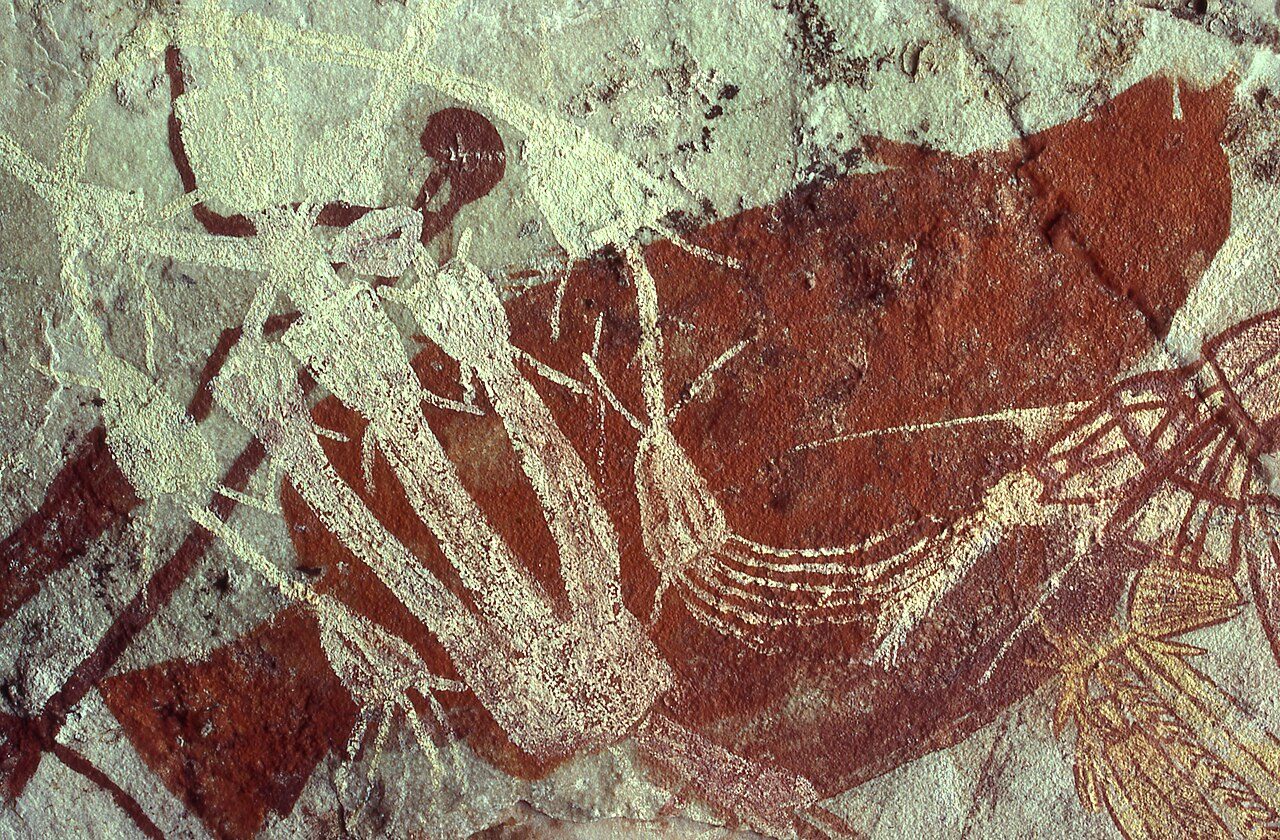
Cave artists used a variety of techniques such as finger tracing, modeling in clay, engravings, bas-relief sculpture, hand stencils, and paintings done in two or three colors. Scholars classify cave art as "Signs" or abstract marks. The most common subjects in cave paintings are large wild animals, such as bison, horses, aurochs, and deer, and tracings of human hands as well as abstract patterns, called finger flutings. The species found most often were suitable for hunting by humans, but were not necessarily the actual typical prey found in associated deposits of bones; for example, the painters of Lascaux have mainly left reindeer bones, but this species does not appear at all in the cave paintings, where equine species are the most common. Drawings of humans were rare and are usually schematic as opposed to the more detailed and naturalistic images of animal subjects. Images of vegetation were also rare as plants account for less than 1% of symbols depicted in European cave art. This is peculiar to scientists as the majority of Earth’s biomass is plants. These artists would have used plants for food, medicine, and shelter yet it remains under represented. A 2012 study found that prehistoric cave artists depicted the walking gait of four-legged animals with greater accuracy than modern artists, suggesting close observation of prey animals was important for survival. Kieran D. O'Hara, geologist, suggests in his book Cave Art and Climate Change that climate controlled the themes depicted. Pigments used include red and yellow ochre, hematite, manganese oxide and charcoal. 1
Theories and interpretations
In the early 20th century, following the work of Walter Baldwin Spencer and Francis James Gillen, scholars such as Salomon Reinach, Henri Breuil and Count Bégouën interpreted the paintings as 'utilitarian' hunting magic to increase the abundance of prey. Jacob Bronowski states, "I think that the power that we see expressed here for the first time is the power of anticipation: the forward-looking imagination. In these paintings the hunter was made familiar with dangers which he knew he had to face but to which he had not yet come." Another theory, developed by David Lewis-Williams and broadly based on ethnographic studies of contemporary hunter-gatherer societies, is that the paintings were made by paleolithic shamans. The shaman would retreat into the darkness of the caves, enter into a trance state, then paint images of their visions, perhaps with some notion of drawing out power from the cave walls themselves. R. Dale Guthrie, who has studied both highly artistic and lower quality art and figurines, identifies a wide range of skill and age among the artists. He hypothesizes that the main themes in the paintings and other artifacts (powerful beasts, risky hunting scenes and the representation of nude women) are the work of adolescent males, who constituted a large portion of cave painters, based on surrounding hand print analysis. 1
Europe
Well-known cave paintings include those of: 1
Cave of El Castillo, Spain (~40,000 y.o.) Chauvet Cave, near Vallon-Pont-d'Arc, France (~35,000 y.o.) Cave of La Pasiega, Cuevas de El Castillo, Cantabria, Spain (~30,000 y.o.?) Caves of Arcy-sur-Cure, France (~28,200 y.o.) Cosquer Cave, with an entrance below sea level near Marseille, France (~27,000 y.o.) Caves of Gargas, France (~27,000 y.o.) Grotte de Cussac, France (~25,000 y.o.) Pech Merle, near Cabrerets, France (25,000 y.o.) Kapova Cave, Bashkortostan, Russia (~18,000 y.o.), the first cave paintings publicized outside Western Europe Lascaux, France (~17,000 y.o.) Cave of Niaux, France (~17,000 y.o.) Font-de-Gaume, in the Dordogne Valley, France (~17,000 y.o.) Badanj Cave, Stolac, Bosnia and Herzegovina (~16,000 y.o., very few engravings are pigmented) Cave of Altamira, near Santillana del Mar, Cantabria, Spain (~15,500 y.o.) La Marche, in Lussac-les-Châteaux, France (~15,000 y.o.) Les Combarelles, in Les Eyzies de Tayac, Dordogne, France (~13,600 y.o.) Cave of the Trois-Frères, in Ariège, France (~13,000 y.o.) Magura Cave, Bulgaria (~10,000 y.o.) Solsem cave, Norway (~3,000 y.o.) 1
The Ignatievka Cave in the Ural Mountains, which contains the image of a mammoth and 160 other paintings, is supposed to be the northernmost Paleolithic cave painting site, but its dating is problematic. About 60 ochre images in a similar manner have been described from the nearby Serpievka-2 cave. Sites discovered in the 21st century include Creswell Crags, Nottinghamshire, England (~14,500 ys old cave etchings and bas-reliefs, but no paintings discovered so far) and Peștera Coliboaia in Romania (~29,000 y.o. 1
East and Southeast Asia
In Indonesia the caves in the district of Maros in Sulawesi are famous for their h… 1
The text above is adapted from the Wikipedia article “Cave painting”, available under the Creative Commons Attribution-ShareAlike 4.0 licence. 1
cave painting is paintings found on cave walls and ceilings, according to the structured record cited below. This entry was generated automatically from that record and has not yet been reviewed by a person familiar with the tradition. 2
The source record links this tradition to 30 external registers, which can be verified through the citation. 2