The tradition & historical record
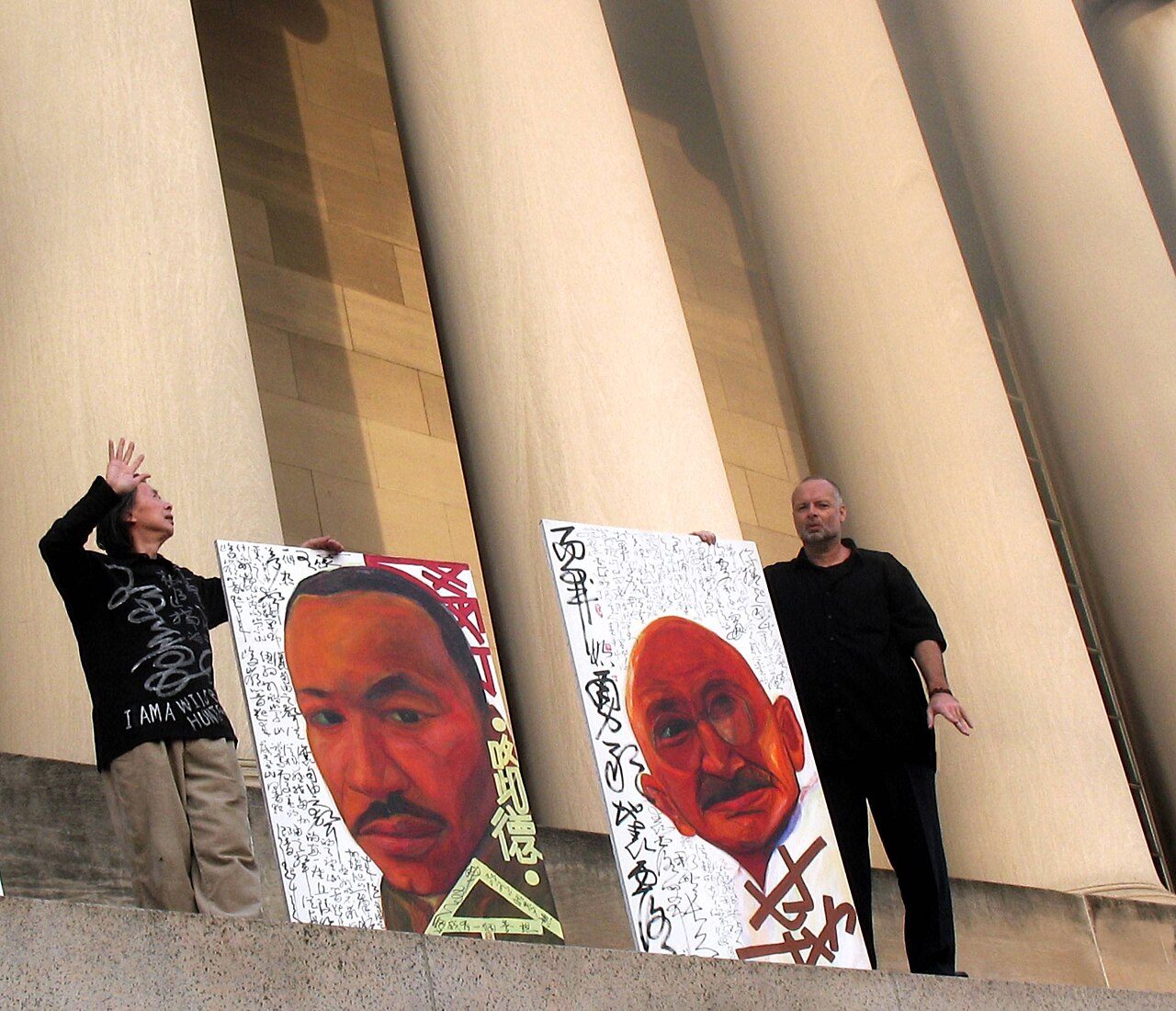
6 min read · 2 sourcesThe Century Mountain Project is an East/West collaboration of art between the Chinese poet and calligrapher Huang Xiang and American artist William Rock. Their paintings, which feature Huang Xiang's calligraphy and poetry and William Rock's painted portraits, honor outstanding thinkers, creators, discoverers, leaders—essentially people who stood out like mountains throughout the centuries. Their subjects include Mozart, Lincoln, Gandhi, Mother Teresa, Rimbaud, Phillis Wheatley, Li Bai, Murasaki Shikibu, Malcolm X, Isadora Duncan, and Edgar Allan Poe. In 2009, their portrait of Anne Frank was exhibited at the Peter Wilhelm Art Center in Budapest; and in June 2010 an exhibit of Huang Xiang and William Rock's Century Mountain paintings was organized by the city of Tarragona, Spain. The artwork created between Huang Xiang and William Rock began in 2006 and continues as an ongoing collaboration. There is no cultural, gender, or race distinctions with regard to the subjects depicted. 1
Seeing the collaborative paintings of Huang Xiang and William Rock is like having a personal encounter with the subject depicted. They have life. This Western style image with calligraphy is not what one usually sees. William Rock is aware of the negative space and Huang Xiang is using the calligraphy to create as an artist would. Formally the artists are opening to accommodate each other. Both artists working together as one. 1
Huang Xiang early life
Huang Xiang was born on December 26, 1941, in Guidong County of Hunan Province. At the time of his birth there occurred a great fire. The fire spreading through his neighborhood reached the very wall of the family compound; newborn Huang and his mother, still connected by the umbilical cord, had to be carried to safety to a nearby temple. Huang's father was in charge of supply for the army group that fought the GMD's last great campaign in Shenyang Province of Manchuria in 1948. The decisive battle there, 'Liaoshen,' was won by the communists, and Huang's father was captured. The family learned late in 1951 that earlier that year Huang's father had been summarily shot in a prison camp near Beijing. Huang Xiang was only nine years old when he first personally suffered similar treatment. One day in all innocence he pulled an ailing fish from the village well. Immediately the village headman grabbed him and accused him of poisoning the well. For three nights Huang was bound in a dark room, and paraded daily through the streets wearing a dunce cap bearing the legend "Huang Xiang counterrevolutionary poisoner of wells." He was only released when chemical analysis failed to detect any poison in the fish. Although an excellent student in grade school, he was not permitted to matriculate into middle school because of his class origins. The denial of public education left Huang Xiang feeling severely hurt, for he strongly desired to continue his schooling. The quandary was soon alleviated, however, when he discovered in a concealed loft in his grandparents, home a treasure trove of college books that his father had put away years earlier. Though aged only ten, he began reading them with a will. 1
The Democracy Wall and Huang Xiang
In 1978 Huang Xiang was the first to post on the Democracy Wall in Beijing. China's movement for democracy has been carried forward in thousands of poems and one poet has emerged supreme: Huang Xiang of the Enlightenment Society. When Huang and his companions had come together some years before in their poor, remote home province of Guizhou "to study social problems, under the merciless oppression and cultural despotism of Lin Biao and the Gang of Four," they had asked themselves why China, with its long history of civilization, progressed so slowly, when Yugoslavia, also a "socialist" state, had developed quickly. Like many in their generation they concluded that the first thing to do was to establish respect for human rights and democracy. They differed from some of their contemporaries in that they read Western classics and respected Buddhism, Christianity, Islam and Chinese Mysticism. But what distinguished them more than anything else was the visionary poet in their midst. It is characteristic that Huang Xiang was presented not as an individual but as a member of a group. Reading the poems and commentaries published by the society, it is clear he drew strength and enrichment from his companions. In turn he became their most eloquent voice. Huang claimed that he was harassed by the authorities after reciting his poems before young people. The police searched for his manuscripts, but he had hidden them in candles by wrapping them in plastic bags, then rolling around them wicks, then finally molding wax around them. He melted the candles to get the poems out. On 11 October 1978 they pasted them up on the blank walls of an alleyway that runs beside the offices of the People's Daily, in the busy shopping center of the capital. 1
Huang Xiang 2010
Huang Xiang uses his art and poetry to build a bridge between East and West and to honor a "Universal Humanity". He considers the paintings in the Century Mountain Project he creates with William Rock, "highly creative something that has not been done before." Huang Xiang completed a Residency with The City of Asylum Pittsburgh in 2007. In April 2008 he returned to China and visited family and friends for the first time in eleven years. Currently, he lives in New York city with his wife, the writer, Zhang Ling. 1
William Rock Biography
William Rock was born in Lorain, Ohio, on July 3. He was raised in Pittsburgh, Pennsylvania and lived his early adult life in Los Angeles, California. He applied for and received his Irish citizenship while living in Paris in 1992. He studied drawing at the California Art Institute and taught himself to paint and sculpt by traveling to museums around the world. He has been immersed in Eastern thought and practice for eighteen years studying and teaching with Chinese and Tibetan monks. His art is exhibited internationally and he has taught and spoken extensively about the nature of creativity, mysticism and art. He has been instrumental in producing several cultural events that promote the arts as a universal dialogue for humanity. 1
The text above is adapted from the Wikipedia article “Century Mountain”, available under the Creative Commons Attribution-ShareAlike 4.0 licence. 1
Century Mountain is art collaboration between Huang Xiang and William Rock, according to the structured record cited below. This entry was generated automatically from that record and has not yet been reviewed by a person familiar with the tradition. 2
The source record links this tradition to 1 external register, which can be verified through the citation. 2