The tradition & historical record
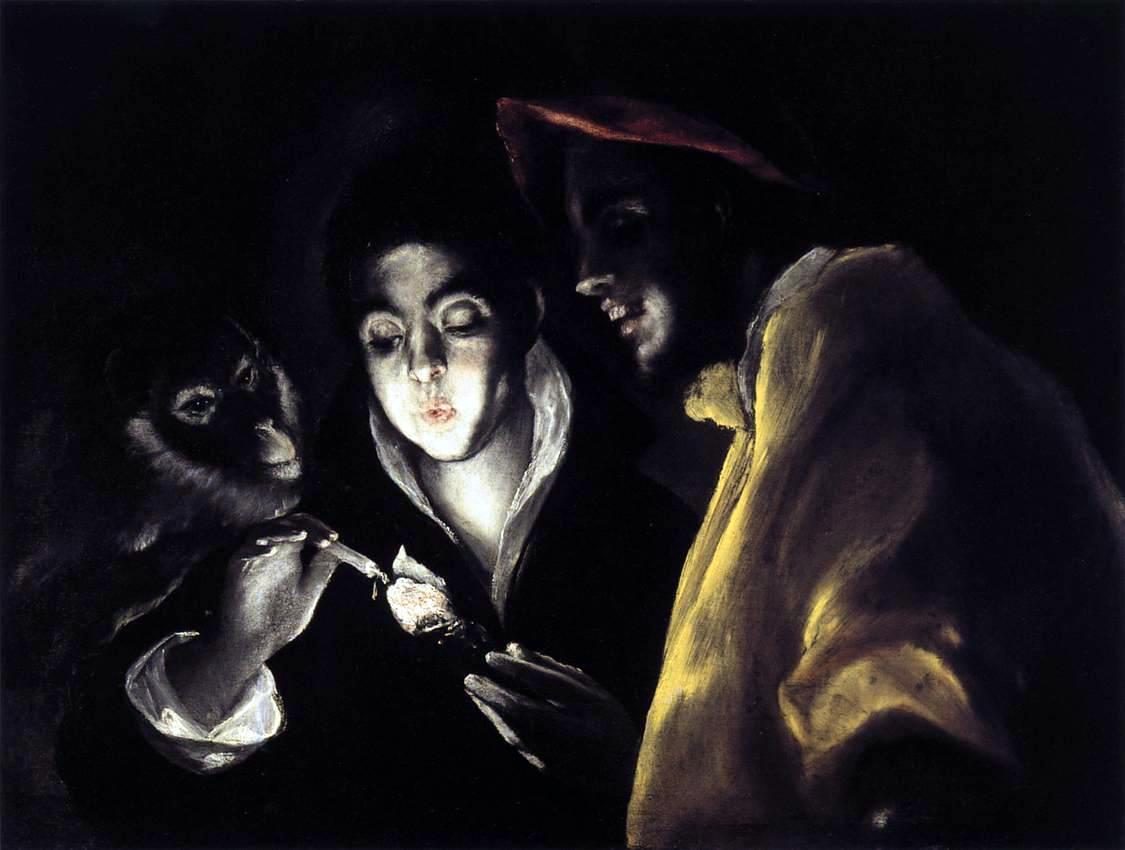
6 min read · 2 sourcesIn art, chiaroscuro (English: kee-AR-ə-SKOOR-oh, -SKURE-, Italian: [ˌkjaroˈskuːro]; lit. 'light-dark') is the use of strong contrasts between light and dark, usually bold contrasts affecting a whole composition. It is also a technical term used by artists and art historians for the use of contrasts of light to achieve a sense of volume in modelling three-dimensional objects and figures. Similar effects in cinema, and black and white and low-key photography, are also called chiaroscuro. Taken to its extreme, the use of shadow and contrast to focus strongly on the subject of a painting is called tenebrism. Further specialized uses of the term include chiaroscuro woodcut for colour woodcuts printed with different blocks, each using a different coloured ink; and chiaroscuro for drawings on coloured paper in a dark medium with white highlighting. Chiaroscuro originated in the Renaissance period but is most notably associated with Baroque art. Chiaroscuro is one of the canonical painting modes of the Renaissance (alongside cangiante, sfumato and unione) (see also Renaissance art). Artists known for using the technique include Leonardo da Vinci, Caravaggio, Rembrandt, Vermeer, Goya, and Georges de La Tour. 1
Origin in the chiaroscuro drawing
The term chiaroscuro originated during the Renaissance as drawing on coloured paper, where the artist worked from the paper's base tone toward light using white gouache, and toward dark using ink, bodycolour or watercolour. These in turn drew on traditions in illuminated manuscripts going back to late Roman Imperial manuscripts on purple-dyed vellum. Such works are called "chiaroscuro drawings", but may only be described in modern museum terminology by such formulae as "pen on prepared paper, heightened with white bodycolour". Chiaroscuro woodcuts began as imitations of this technique. When discussing Italian art, the term sometimes is used to mean painted images in monochrome or two colours, more generally known in English by the French equivalent, grisaille. The term broadened in meaning early on to cover all strong contrasts in illumination between light and dark areas in art, which is now the primary meaning. 1
Chiaroscuro modelling
The more technical use of the term chiaroscuro is the effect of light modelling in painting, drawing, or printmaking, where three-dimensional volume is suggested by the value gradation of colour and the analytical division of light and shadow shapes—often called "shading". The invention of these effects in the West, "skiagraphia" or "shadow-painting" to the Ancient Greeks, traditionally was ascribed to the famous Athenian painter of the fifth century BC, Apollodoros. Although few Ancient Greek paintings survive, their understanding of the effect of light modelling still may be seen in the late-fourth-century BC mosaics of Pella, Macedonia, in particular the Stag Hunt Mosaic, in the House of the Abduction of Helen, inscribed gnosis epoesen, or 'knowledge did it'. The technique also survived in rather crude standardized form in Byzantine art and was refined again in the Middle Ages to become standard by the early fifteenth-century in painting and manuscript illumination in Italy and Flanders, and then spread to all Western art. According to the theory of the art historian Marcia B. Hall, which has gained considerable acceptance, chiaroscuro is one of four modes of painting colours available to Italian High Renaissance painters, along with cangiante, sfumato and unione. The Raphael painting illustrated, with light coming from the left, demonstrates both delicate modelling chiaroscuro to give volume to the body of the model, and strong chiaroscuro in the more common sense, in the contrast between the well-lit model and the very dark background of foliage. To further complicate matters, however, the compositional chiaroscuro of the contrast between model and background probably would not be described using this term, as the two elements are almost completely separated. 1
Chiaroscuro woodcuts
Chiaroscuro woodcuts are old master prints in woodcut using two or more blocks printed in different colours; they do not necessarily feature strong contrasts of light and dark. They were first produced to achieve similar effects to chiaroscuro drawings. After some early experiments in book-printing, the true chiaroscuro woodcut conceived for two blocks was probably first invented by Lucas Cranach the Elder in Germany in 1508 or 1509, though he backdated some of his first prints and added tone blocks to some prints first produced for monochrome printing, swiftly followed by Hans Burgkmair the Elder. The formschneider or block-cutter who worked in the press of Johannes Schott in Strasbourg is claimed to be the first one to achieve chiaroscuro woodcuts with three blocks. Despite Vasari's claim for Italian precedence in Ugo da Carpi, it is clear that his, the first Italian examples, date to around 1516 But other sources suggest, the first chiaroscuro woodcut to be the Triumph of Julius Caesar, which was created by Andrea Mantegna, an Italian painter, between 1470 and 1500. Another view states that: "Lucas Cranach backdated two of his works in an attempt to grab the glory" and that the technique was invented "in all probability" by Burgkmair "who was commissioned by the emperor Maximilian to find a cheap and effective way of getting the imperial image widely disseminated as he needed to drum up money and support for a crusade". Other printmakers who have used this technique include Hans Wechtlin, Hans Baldung Grien, and Parmigianino. In Germany, the technique achieved its greatest popularity around 1520, but it was used in Italy throughout the sixteenth century. Later artists such as Goltzius sometimes made use of it. 1
Compositional chiaroscuro to Caravaggio
Manuscript illumination was, as in many areas, especially experimental in attempting ambitious lighting effects since the results were not for public display. The development of compositional chiaroscuro received a considerable impetus in northern Europe from the vision of the Nativity of Jesus of Saint Bridget of Sweden, a very popular mystic. She described the infant Jesus as emitting light; depictions increasingly reduced other light sources in the scene to emphasize this effect, and the Nativity remained very commonly treated with chiaroscuro through to the Baroque. Hugo van der Goes and his followers painted many scenes lit only by candle or the divine light from the infant Christ. As with some later painters, in their hands the effect was of stillness and calm rather than the drama with which it would be used during the Baroque. Strong chiaroscuro became a popular effect during the sixteenth century in Mannerism and Baroque art. Divine light continued to illuminate, often rather inadequately, the compositions of Tintoretto, Veronese, and their many followers. The use of dark subjects dramatically lit by a shaft of light from a single constricted and often unseen source, was a compositional device developed by Ugo da Carpi (c. 1455 – c. 1
17th and 18th centuries
Tenebrism was especially practiced in Spain and the Spani… 1
The text above is adapted from the Wikipedia article “Chiaroscuro”, available under the Creative Commons Attribution-ShareAlike 4.0 licence. 1
chiaroscuro is use of strong contrasts between light and dark, usually bold contrasts affecting a whole composition in art, according to the structured record cited below. This entry was generated automatically from that record and has not yet been reviewed by a person familiar with the tradition. 2
The source record links this tradition to 32 external registers, which can be verified through the citation. 2