The tradition & historical record
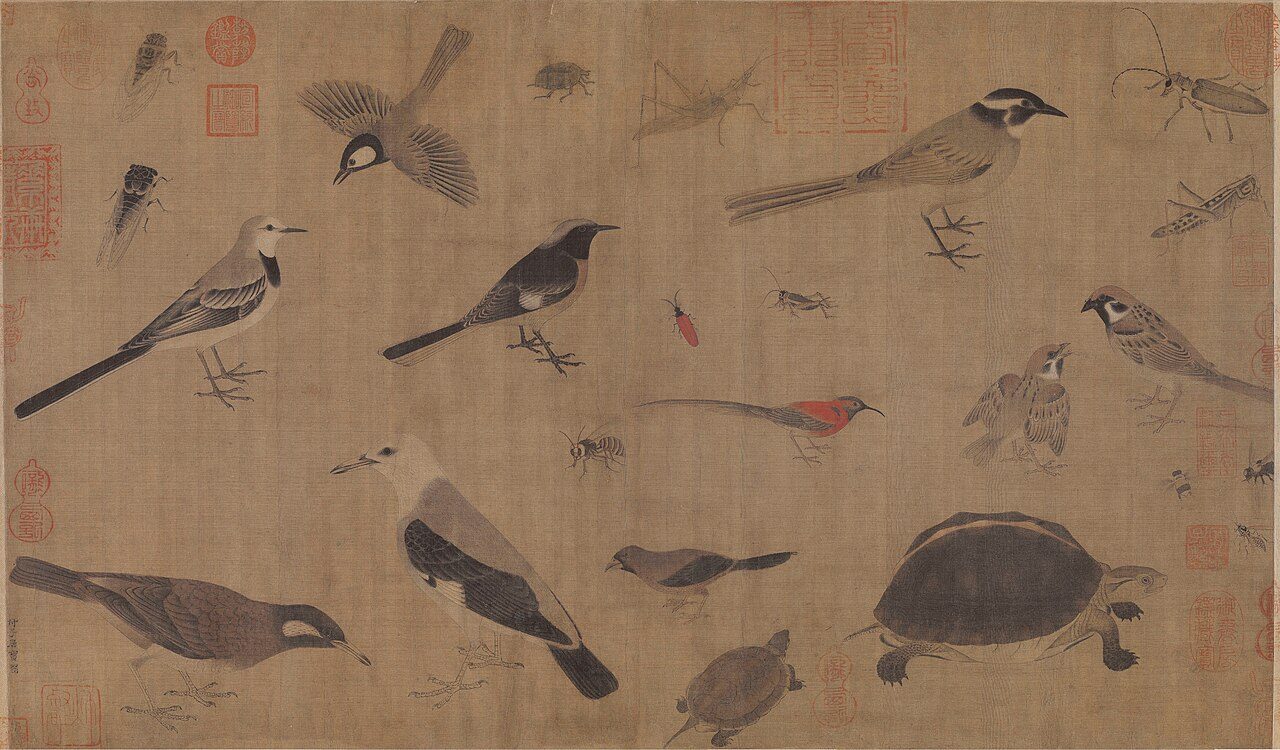
6 min read · 2 sourcesChinese painting (simplified Chinese: 中国画; traditional Chinese: 中國畫; pinyin: Zhōngguó huà) is one of the oldest continuous artistic traditions in the world. Painting in the traditional style is known today in Chinese as guó huà (国画; 國畫), meaning "national painting" or "native painting", as opposed to Western styles of art which became popular in China in the 20th century. It is also called danqing (Chinese: 丹青; pinyin: dān qīng). Traditional painting involves essentially the same techniques as calligraphy and is done with a brush dipped in black ink or coloured pigments; oils are not used. As with calligraphy, the most popular materials on which paintings are made are paper and silk. The finished work can be mounted on scrolls, such as hanging scrolls or handscrolls. Traditional painting can also be done on album sheets, walls, lacquerware, folding screens, and other media. The two main techniques in Chinese painting are: 1
Gongbi (工筆), meaning "meticulous", uses highly detailed brushstrokes that delimit details very precisely. It is often highly colored and usually depicts figural or narrative subjects. It is often practiced by artists working for the royal court or in independent workshops. Ink and wash painting, in Chinese shuǐ-mò (水墨, "water and ink") also loosely termed watercolor or brush painting, and also known as "literati painting", as it was one of the "four arts" of the Chinese Scholar-official class. 1
Specifics and study
Chinese painting and calligraphy distinguish themselves from other cultures' arts by emphasis on motion and change with dynamic life. The practice is traditionally first learned by rote, in which the master shows the "right way" to draw items. The apprentice must copy these items strictly and continuously until the movements become instinctive. In contemporary times, debate emerged on the limits of this copyist tradition within modern art scenes where innovation is the rule. Changing lifestyles, tools, and colors are also influencing new waves of masters. 1
Early periods
The earliest paintings were not representational but ornamental; they consisted of patterns or designs rather than pictures. Early pottery was painted with spirals, zigzags, dots, or animals. It was only during the Eastern Zhou (770–256 BC) that artists began to represent the world around them. In imperial times (beginning with the Eastern Jin dynasty), painting and calligraphy in China were among the most highly appreciated arts in the court and they were often practiced by amateurs—aristocrats and scholar-officials—who had the leisure time necessary to perfect the technique and sensibility necessary for great brushwork. Calligraphy and painting were thought to be the purest forms of art. The implements were the brush pen made of animal hair, and black inks made from pine soot and animal glue. In ancient times, writing, as well as painting, was done on silk. However, after the invention of paper in the 1st century AD, silk was gradually replaced by the new and cheaper material. Original writings by famous calligraphers have been greatly valued throughout China's history and are mounted on scrolls and hung on walls in the same way that paintings are. 1
Artists from the Han (206 BC – 220 AD) to the Tang (618–906) dynasties mainly painted the human figure. Much of what we know of early Chinese figure painting comes from burial sites, where paintings were preserved on silk banners, lacquered objects, and tomb walls. Many early tomb paintings were meant to protect the dead or help their souls to get to paradise. Others illustrated the teachings of the Chinese philosopher Confucius or showed scenes of daily life. During the Six Dynasties period (220–589), people began to appreciate painting for its own beauty and to write about art. 1
Six principles
The "Six principles of Chinese painting" were established by Xie He, a artist, art historian and critic of the 5th century, in "Six points to consider when judging a painting" (繪畫六法, Pinyin: Huìhuà Liùfǎ), taken from the preface to his book "The Record of the Classification of Old Painters" (古畫品錄; Pinyin: Gǔhuà Pǐnlù). This was written circa 550 CE and refers to what were already considered "old" and "ancient" practices. The six elements that define a painting are: 1
"Spirit Resonance", or vitality, which refers to the flow of energy that encompasses theme, work, and artist. Xie He said that without Spirit Resonance, there was no need to look further. "Bone Method", or the way of using the brush, refers not only to texture and brush stroke, but to the close link between handwriting and personality. In his day, the art of calligraphy was inseparable from painting. "Correspondence to the Object", or the depicting of form, which would include shape and line. "Suitability to Type", or the application of color, including layers, value, and tone. "Division and Planning", or placing and arrangement, corresponding to composition, space, and depth. "Transmission by Copying", or the copying of models, not from life only but also from the works of antiquity. 1
Sui, Tang and Five dynasties (581–979)
During the Tang dynasty, figure painting flourished at the royal court. Artists such as Zhou Fang depicted the splendor of court life in paintings of emperors, palace ladies, and imperial horses. Figure painting reached the height of elegant realism in the art of the court of Southern Tang (937–975). Most of the Tang artists outlined figures with fine black lines and used brilliant color and elaborate detail. However, one Tang artist, the master Wu Daozi, used only black ink and freely painted brushstrokes to create ink paintings that were so exciting that crowds gathered to watch him work. From his time on, ink paintings were no longer thought to be preliminary sketches or outlines to be filled in with color. Instead, they were valued as finished works of art. Beginning in the Tang dynasty, many paintings were landscapes, often shanshui (山水, "mountain water") paintings. In these landscapes, monochromatic and sparse (a style that is collectively called shuimohua), the purpose was not to reproduce the appearance of nature exactly (realism) but rather to grasp an emotion or atmosphere, as if catching the "rhythm" of nature. A considerable amount of literary and documentary information about Tang painting has survived, but very few works, especially of the highest quality. A walled-up cave in the Mogao Caves complex at Dunhuang was discovered by Sir Aurel Stein, which contained a vast haul, mostly of Buddhist writings, but also some banners and paintings, making much the largest group of paintings on silk to survive. These are now in the British Museum and elsewhere. They are not of court quality, but show a variety of styles, including those with influences from further west. 1
Song, Liao, Jin and Yuan dynasties (907–1368)
Painting during the Song dynasty (960–1279) reached a further development of landscape painting; immeasurable distances were conveyed through the use of blurred outlines, mountain contours disappearing into the mist, and impressionistic treatment of natural phenomena. 1
The text above is adapted from the Wikipedia article “Chinese painting”, available under the Creative Commons Attribution-ShareAlike 4.0 licence. 1
Chinese painting is artistic tradition, according to the structured record cited below. This entry was generated automatically from that record and has not yet been reviewed by a person familiar with the tradition. 2
The source record links this tradition to 19 external registers, which can be verified through the citation. 2