The tradition & historical record
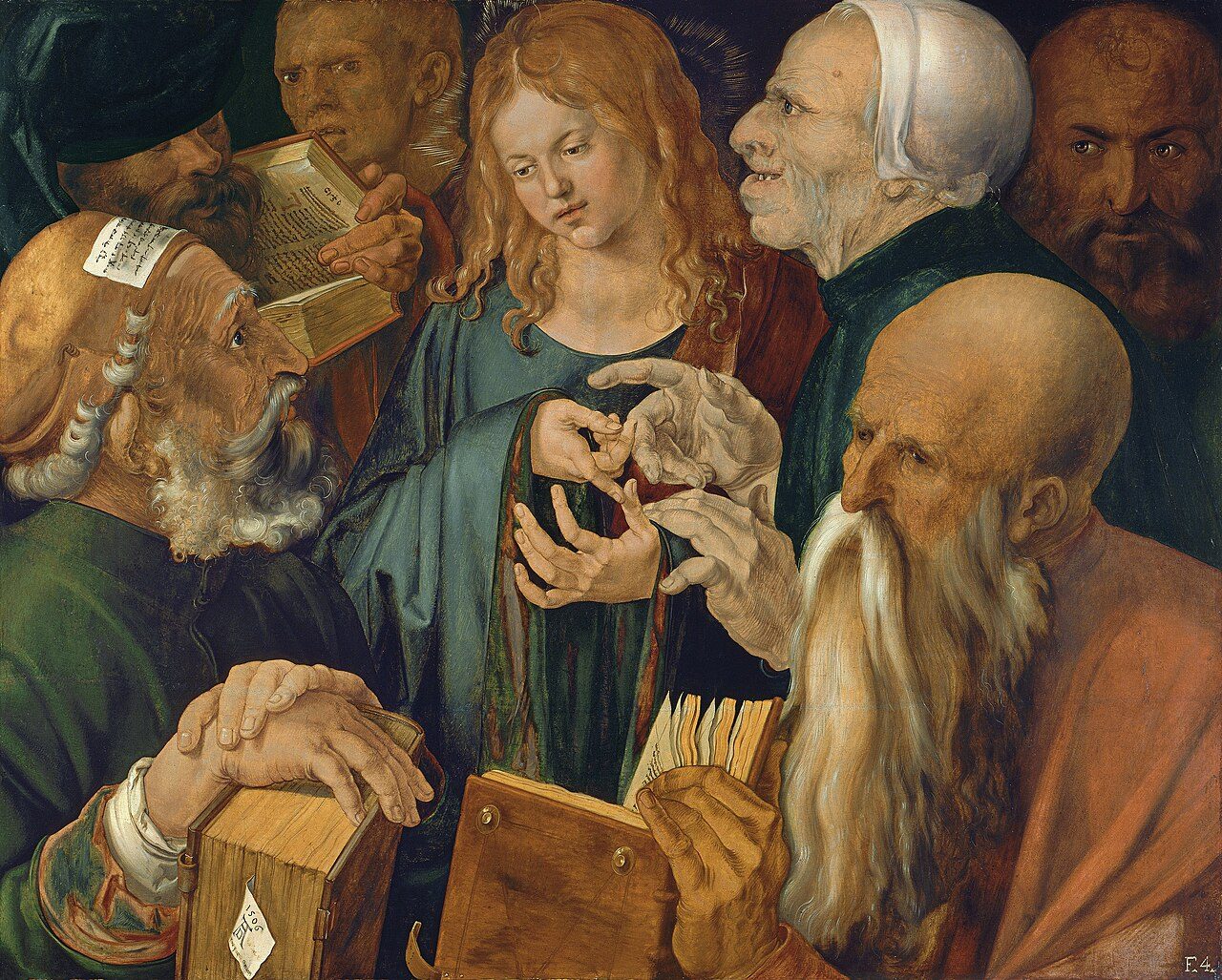
7 min read · 2 sourcesChrist among the Doctors is an oil painting by Albrecht Dürer, dating to 1506, now in the Museo Thyssen-Bornemisza, Madrid, Spain. The work belongs to the time of Dürer's sojourn in Italy, and was according to its inscription executed incidentally in five days while he was working on the Feast of the Rosary altarpiece in Venice. The work was influenced by Leonardo da Vinci and possibly based on the most probably earlier painting by Cima da Conegliano on the same theme. 1
Conception
The topic of the panel painting is the Finding in the Temple episode from Jesus's childhood, found in the Gospel of Luke (2:41–52). On an annual pilgrimage of the holy family to Jerusalem for Passover the twelve-year-old child got lost and was found again after three days in a temple debating with scholars executing His Father's business. The subject had already been treated by Dürer in a panel of the Seven Sorrows Polyptych (1494–1497) executed by his workshop, and about ten years later in a woodcut of the Life of the Virgin series. However, in this work the German artist adopted a dense composition of half-figures, which was introduced by Andrea Mantegna in his The Presentation at the Temple (c. 1454, Berlin) and afterwards present in all Northern Italian schools including Venice. Though Dürer emphasised the focus on faces and hands (and books) even more. 1
Preparatory drawings
Not until his second journey to Italy Dürer made detailed studies after living models before he worked out a final composition for paintings and engravings alike. The first preparatory drawings originate in Venice, all in the same technique: dark ink drawn with a brush, highlighted with white tempera, on large sheets of Venetian blue dyed paper (carta azzurra). The blue color serves as a middle tone, a method he formerly applied in the Green Passion of 1504, and in drawings where he washed the background around the figures to obtain the same effect. Four preparatory drawings for the painting have survived, one of the infant's head (originally with the head of the lute playing angel for the Rosary panel on one sheet now cut) and a hand holding a book (both in the Albertina, Wien), a study of the hands counting off arguments, and a further drawing with two pairs of hands holding a book, of which only one Dürer finally incorporated into the picture (both in the Germanische Nationalmuseum, Nuremberg). 1
The manner of painting
The panel of Jesus among the Doctors has a usual underdrawing grounded with egg-tempera, but covered by just a tenuous layer of oil paint. In fact, it is made "in an almost impromptu fashion, a thin coat of color being applied in broad and fluid strokes utterly different from Dürer's normally meticulous brushwork," as Erwin Panofsky described it. Christof Metzger, chief curator of the Graphic Collection at the Albertina in Vienna, stated that the panel wasn't even finished. Both pairs of hands in the center show still the outlines and hatches of the underdrawing and are hardly colored at all. The two heads in the background, the one in the upper right corner and the one who is looking out of the picture appear unfinished. Copies of the panel in Germany from around 1600 serve as evidence that the image was known north of the Alps, so that Dürer might have brought the painting back with him to Nuremberg. The color palette is rather narrow, essentially two green tones for the cloaks of Jesus and two of the scholars, and a range of brown tones, from the darkened faces in the shadowy back, the book covers and the red cloak of the doctor on the right, the yellowish cap of the figure on the left, to the lighter skin colors and the broken white tones of hair, paper, and the chemise poking out at the wrist on the lower left corner and at the right hand of the doctor in profile; his cap finally is the largest bright part of the composition. The color range is expressively restrained compared to his interpretation on the altar-piece of the Seven Sorrows or the splendour of the Feast of the Rosary and the rich color conception of Italian Renaissance art. 1
"Made in five days"
As usual Dürer signed his work with his monogram and a date, displayed on an object within the scenery, like a little plaque (cartellino) or a piece of paper, a veristic device to invite the beholder into the picture space and hence into the depicted drama, instead of just signing an essentially two-dimensional composition of brush strokes on the surface of a piece of wood. The inscription in Jesus among the Doctors is written on a bookmarker that sticks out of the folio at the bottom of the picture on the left. It reads: 1506/A. D./Opus quinque dierum, "made in five days". He produced the picture in this indeed rather short time to finish an oil painting, so that it was worth the inscription, probably due to the fact, that he prominently had to work on the Feast of the Rosary, commissioned by the German community in Venice residing at the Fondaco dei Tedeschi for their church (which brought him immediate fame that also radiated back to Nuremberg). And with the Virgin with the Siskin and several commissioned portraits there was plenty of work to be done. But the inscription cannot have taken into account the time of the conception, nor the preparatory studies nor the underdrawing. The "five days" may be also an ironic allusion to the "five month" he needed to finish the Rosary altarpiece, as he wrote in its inscription. Opposing the two paintings reveals two kinds of work, done in different "modes of creation", the certainly more accomplished altarpiece was meticulously planned and executed, while the other was done swiftly following an instant inspiration, like a stroke of a genius. 1
Imagery of the figures
The characters occupy the whole panel submerged in a dark background intensifying the tense atmosphere. Especially when compared to his former interpretations of the scene with their spacious compositions and traditional conception, the almost "nightmarish" (Panofsky) staging becomes evident. Here, the young Jesus is besieged by six philosophers surrounding him, arranged on at least four different planes, each with different skin texture, pose and expression, like character studies. They stand in stark contrast to the entirely soft and restraint appearance of the innocent child. Even his halo is not displayed as a golden disc, instead delicate golden lines emanate from his head in form of a faceted cross, like he was illuminated by divine light. So he stands steadfast in the central axis of the picture contemplating his arguments and counting them off on his fingers, while the doctors keep to the books in their hands ready to cite from them. Each of the doctors reacts differently to the words of Jesus. The one on the upper left is depicted with the head over his eyes literally blind to the new thoughts, stubbornly buried into the scripture. The man on the lower left with a cartouche on his beret, a customary depiction of the Pharisees, on the contrary has closed his book and begins to pay attention trying to fathom the Child's arguments. 1
The text above is adapted from the Wikipedia article “Christ Among the Doctors (Dürer)”, available under the Creative Commons Attribution-ShareAlike 4.0 licence. 1
Christ Among the Doctors is painting by Albrecht Dürer in the Thyssen-Bornemisza Museum, according to the structured record cited below. This entry was generated automatically from that record and has not yet been reviewed by a person familiar with the tradition. 2
The source record links this tradition to 7 external registers, which can be verified through the citation. 2