The tradition & historical record
4 min read · 2 sourcesChurch wall paintings (Danish: kalkmalerier) are to be found in some 600 churches across Denmark, no doubt representing the highest concentration of surviving church murals anywhere in the world. Most of them date back to the Middle Ages and were uncovered by Jacob Kornerup (1825–1913) who carried out restoration work in 80 churches across the country towards the end of the 19th century. They lay hidden for centuries as after the reformation, they were covered with limewash (Danish: kalk) only to be revealed and restored during the course of the 19th and 20th centuries. The oldest frescos, dating back to the 12th century, were painted in the Romanesque style by artists from elsewhere in Europe but those from the 14th century and thereafter are in the Gothic style which was used by native Danish painters. It is these that are considered to be the most important for Danish art and culture. A distinction is to be made between these church wall paintings or kalkmalerier and the generic term "fresco" (Danish: fresko) which refers to all types of painting on plastered walls or ceilings. 1
Historical background
The murals in Danish churches can be divided very roughly into two main periods: Romanesque, beginning in the 12th century, and Gothic, from the middle of the 13th century. As in most of Europe the transition in painting styles was less abrupt than in architecture. Painting styles are closely related to those of the neighbouring areas of North Germany and South Sweden, especially the province of Scania, which was Danish territory in the Middle Ages. 1
Romanesque period
With the development of Christianity and the construction of stone churches, Romanesque art came to Denmark from the rest of Europe, with influences mostly from North Germany and the Anglo-Norman English Channel area, and possibly even some from Spain and Italy. Some of this no doubt came from imported manuscripts; there are no surviving "indigenous illuminated manuscripts of significance" from Scandinavia in this period. Many of the churches in Sealand, especially those in Måløv, Jørlunde, Slaglille, Sæby and Kirke Hyllinge, have highly artistic murals dating back to the 12th century. The colours were often imported at considerable cost and the paintings, usually of figures, were true frescos, completed on wet plaster in traditionally geometrical compositions with a blue or green background. Several Sealand church apses have a variant of the usual Christ in Majesty subject, where Christ is surrounded by the Evangelists' symbols, flanked by the Virgin and Saint John with archangels or other figures (Alsted shown above). 1
Gothic period
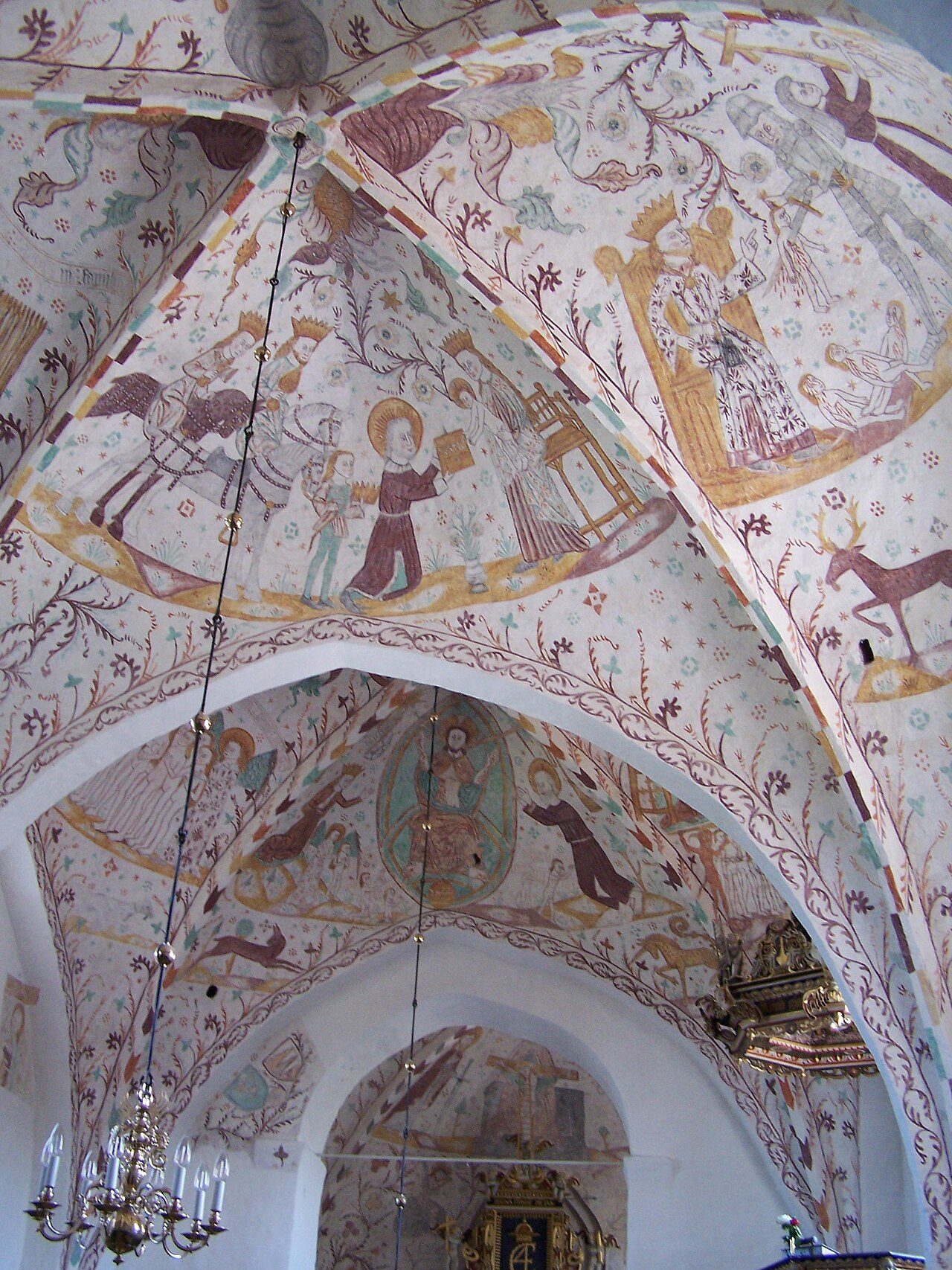
There was a lengthy but smooth transition towards Gothic art, beginning in the middle of the 13th century but extending well into the 15th when many of the flat wooden church ceilings were replaced by brick vaulting. The curvature of the vaults called for new techniques rather than simply following pictures from illuminated manuscripts. The figures no longer stand in a coloured background but are painted directly on the white limewash. Increasingly, the white areas between the figures are filled with stars, flowers, plants and other ornaments. The figures often appear more conventional than in the Romanesque murals. Gothic church murals are found throughout Denmark and in the south of Sweden, and can often be identified as coming from workshops such as the ones in Elmelunde on the island of Møn and Isefjord in northwestern Sealand. Knights in combat became regarded as a suitable subject for church walls. 1
Post-Reformation
The Reformation essentially ended the traditions of church wall-paintings in all Protestant counties. The large anti-Catholic fresco, following a print of 1525 by Sebald Beham, in the parish church of Brøns is one of few such works in Europe. 1
Notable examples of wall paintings
In many of Denmark's churches, wall paintings have been restored. Listed below are some of the most interesting examples: 1
The text above is adapted from the Wikipedia article “Church frescos in Denmark”, available under the Creative Commons Attribution-ShareAlike 4.0 licence. 1
Church frescos in Denmark is collection of cultural heritage, according to the structured record cited below. This entry was generated automatically from that record and has not yet been reviewed by a person familiar with the tradition. 2
The source record links this tradition to 1 external register, which can be verified through the citation. 2