The tradition & historical record
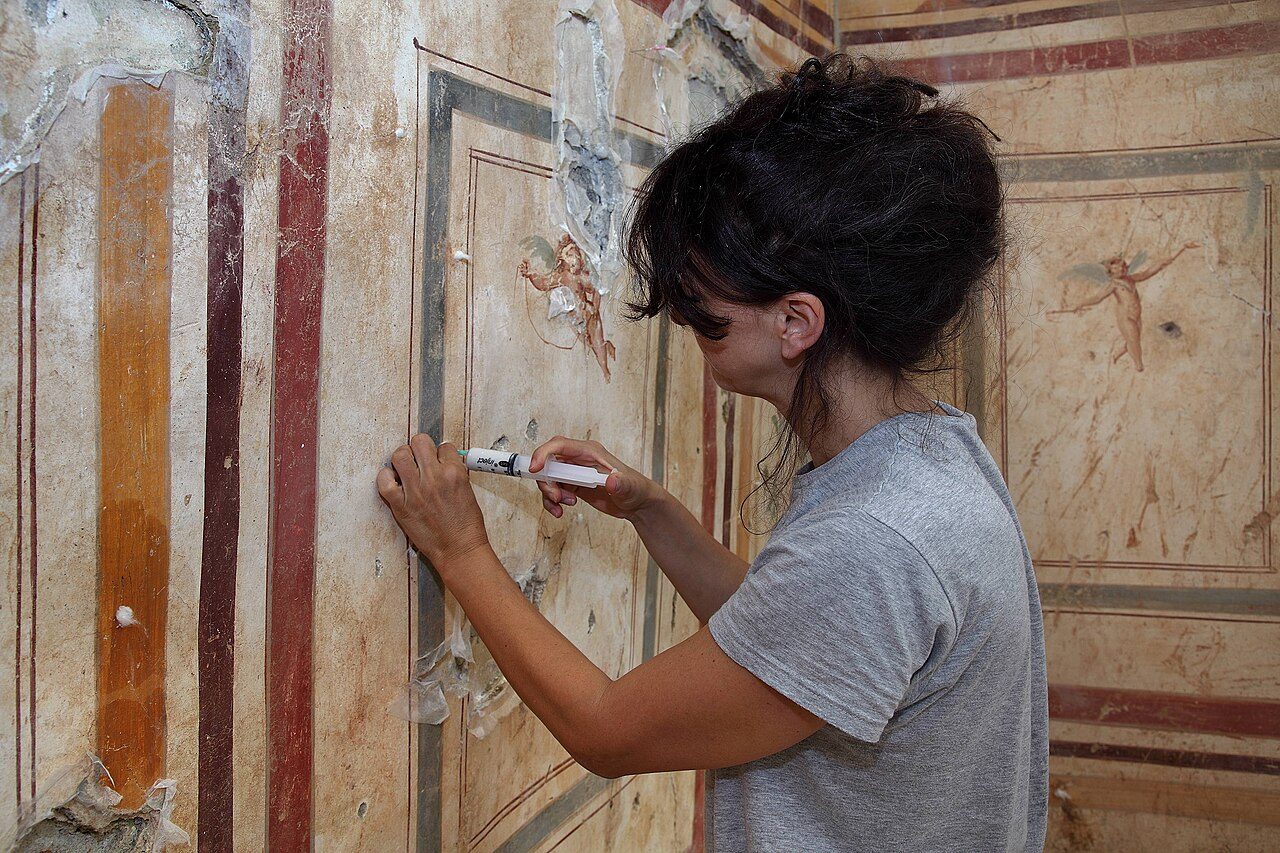
4 min read · 2 sourcesThe conservation and restoration of frescoes is the process of caring for and maintaining frescos, and includes documentation, examination, research, and treatment to insure their long-term viability, when desired. 1
Technology
Fresco is a technique of mural painting in which pigment is applied to freshly-laid or wet lime plaster. Water acts as a type of binding agent that allows the pigment to merge with the plaster, and once the plaster sets the painting becomes an integral part of the wall. 1
Materials (chemical make-up)
Fresco chemicals consist of the following: 1
Silicon dioxide (sand) Calcium oxide (quick lime) Water Calcium hydroxide (slaked lime) Carbon dioxide Calcium carbonate (limestone) Calcium carbonate (limestone) is decomposed by heat to produce calcium oxide (quicklime) and carbon dioxide gas. Then calcium oxide reacts with water to form calcium hydroxide (slaked lime) which is accompanied by the release of heat, a reaction known as exothermic. 1
Pigments used from antiquity to the early 19th century
Carbon black – created by heating wood or other plant material (amphorous carbon) Bone black – charring of bones or waste ivory in absence of air (10% carbon, 84% calcium phosphate, 6% carbon carbonate) Umber – Natural minerals red bole and cinnabrese with silica and clay attributing to its color (iron(III)-oxide, manganese oxide, aluminum oxide) Red ochre – natural minerals containing silica and clay some of which is composed of iron oxide and hematite (anhydrous iron(III)-oxide) Yellow ochre – natural minerals that contain silica and clay, and attributing to its color, goethite (iron oxyhydroxide) Lime white – chalk (calcium carbonate and calcite) Madder lake – an extract from the root of the madder plant (Rubia tintorum) Carmine lake – an extract from two types of scale insects: the cochineal and kermes Realgar – natural mineral (arsenic sulfide) Malachite – natural mineral (basic copper carbonate) Orpiment – natural mineral (arsenic sulfide) Egyptian blue – first artificial pigment and only used during antiquity (calcium copper silicate) Indigo – plant base pigment derived from the woad plant (Isatis tinctoria L.) Red lead – natural mineral minium (lead(II,IV)-oxide) Green earth – natural minerals glauconite or celadonite (aluminum silicate) 1
Deterioration of frescoes
Frescoes can be found in places of worship such as churches, ancient temples and tombs, as well as private residences and commercial establishments used for public entertainment. It is these environments and their pollutants that interact with the chemicals, both organic and inorganic, utilized to create the frescoes and the pigments used that contribute to their aesthetic and structural deterioration. Additionally, wall paintings such as frescoes depending on the technique used, possess a layered structure consisting of support, ground or paint layer. These constituents of wall paintings undergo deterioration physically, chemically or biologically. Although factors like moisture, salts, and atmospheric pollution have generally been the main contributors to the deterioration of wall paintings in most cases, many in the field believe the growth of biological agencies like fungi and microbial flora is also responsible for decay. 1
Chemical degradation
The presence of pigment discoloration, stains and the formation of bio-film are indicative of chemical degradation. Given the variety of organic and inorganic molecules present in frescoes, many type of micro-organisms may grow on the substrate of the fresco provided that environmental conditions (humidity, temperature, light, and pH) are fostered. Chemical deterioration can be attributed to fungi through their metabolites either by assimilation or dissimulation processes. In the assimilation process, the fungi use the components of frescoes as a carbon source through enzyme production, whereas in the dissimulation process, the decay is mainly by the excretion of waste products or secretion of metabolic intermediates including acids and pigments which can damage, stain or disfigure the surface. 1
The text above is adapted from the Wikipedia article “Conservation and restoration of frescos”, available under the Creative Commons Attribution-ShareAlike 4.0 licence. 1
Conservation and restoration of frescos is art preservation techniques, according to the structured record cited below. This entry was generated automatically from that record and has not yet been reviewed by a person familiar with the tradition. 2
The source record links this tradition to 1 external register, which can be verified through the citation. 2