The tradition & historical record
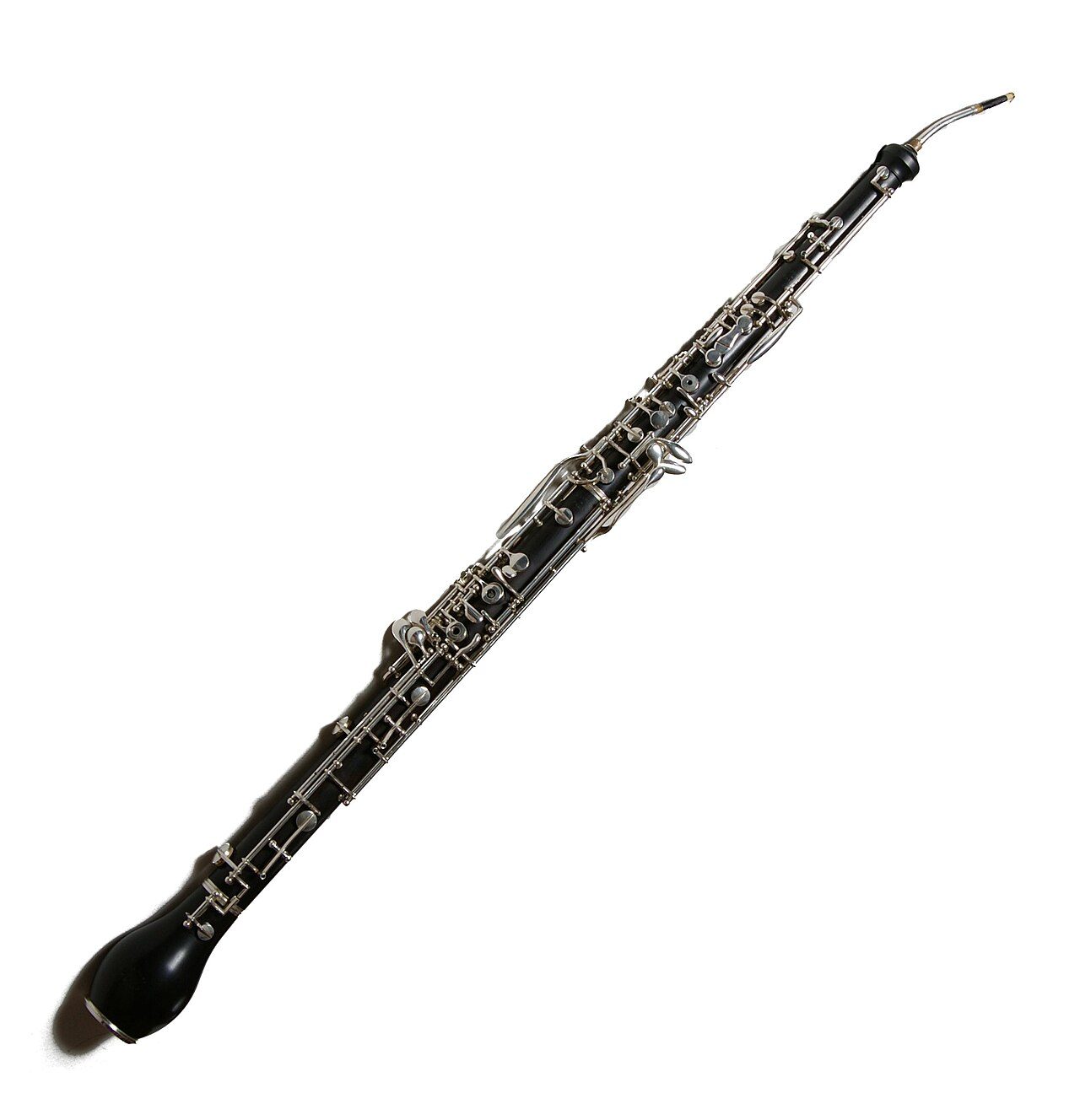
6 min read · 2 sourcesThe cor anglais (UK: , US: or original French: [kɔʁ ɑ̃ɡlɛ]; plural: cors anglais), or English horn (mainly North America), is a double-reed woodwind instrument in the oboe family. It is approximately one and a half times the length of an oboe, making it essentially an alto oboe in F. The cor anglais is a transposing instrument pitched in F, a perfect fifth lower than the oboe (a C instrument). This means that music for the cor anglais is written a perfect fifth higher than the instrument sounds. The fingering and playing technique used for the cor anglais are essentially the same as those of the oboe, and oboists typically double on the cor anglais when required. The cor anglais normally lacks the lowest B♭ key found on most oboes, and so its sounding range stretches from E3 (written B♮) below middle C to C6 two octaves above middle C. Some versions have a Low B♭ key to extend the range down one more note to sounding E♭3. 1
Description and timbre
The pear-shaped bell (called Liebesfuß) of the cor anglais gives it a more covered timbre than the oboe, closer in tonal quality to the oboe d'amore. Whereas the oboe is the soprano instrument of the oboe family, the cor anglais is generally regarded as the alto member of the family, and the oboe d'amore—pitched between the two in the key of A—as the mezzo-soprano member. The cor anglais is perceived to have a more mellow and plaintive tone than the oboe. The difference in sound results primarily from a wider reed and a conical bore that expands over a greater distance than the oboe's; although darker in tone and lower in pitch than the oboe, its sound is distinct from (though naturally blends with) the sound of the bassoon family. Its appearance differs from the oboe in that the instrument is notably longer, the reed is attached to a slightly curved metal tube called the bocal, or crook, and the bell has a bulbous shape ("Liebesfuß"). The cor anglais is usually notated in the treble clef, a perfect fifth higher than sounding pitch. Alto clef written at sounding pitch is occasionally used, even by as late a composer as Sergei Prokofiev. In late-18th- and early-19th-century Italy, where the instrument was often played by bassoonists instead of oboists, it was notated in the bass clef an octave below sounding pitch (as found in Rossini's Overture to William Tell). French operatic composers up to Fromental Halévy notated the instrument at sounding pitch in the mezzo-soprano clef, which enabled the player to read the part as if it were in the treble clef. Although the instrument usually descends only to (written) low B♮, continental instruments with an extension to low B♭ (sounding E♭) have existed since early in the 19th century. 1
History and etymology
The term cor anglais is French for English horn, but the instrument is neither from England nor related to the various conical-bore brass instruments called "horns", such as the French horn, the natural horn, the post horn, or the tenor horn. The instrument originated in Silesia about 1720 when a bulb bell was fitted to a curved oboe da caccia-type body by the Weigel family of Breslau. The two-keyed, open-belled, straight tenor oboe (French taille de hautbois, "tenor oboe"), and more particularly the flare-belled oboe da caccia, resembled the horns played by angels in religious images of the Middle Ages. This gave rise in German-speaking central Europe to the Middle High German name engellisches Horn, meaning angelic horn. Because engellisch also meant English in the vernacular of the time, the "angelic horn" became the "English horn". In the absence of any better alternative, the curved, bulb-belled tenor oboe then retained the name even after the oboe da caccia fell into disuse around 1760. The name first appeared regularly in Italian, German, and Austrian scores from 1749 on, usually in the Italian form corno inglese. The earliest known orchestral part specifically for the instrument is in the Vienna version of Niccolò Jommelli's opera Ezio dating from 1749, where it was given the Italian name corno inglese. Gluck and Haydn followed suit in the 1750s, and the first English horn concertos were written in the 1770s. The Schwarzenberg Wind Harmonie of 1771 employed 2 cors anglais as well as 2 oboes, 2 bassoons and 2 horns. Johan Went was first cor anglais and Ignaz Teimer (father of the Teimer brothers) was second cor anglais. The first oboe trios were composed by Johan Went for the Teimer brothers. 1
Concertos and concertante
Until the 20th century, there were few solo pieces for the instrument with a large ensemble (such as orchestra or concert band). Important examples of such concertos and concertante works are: 1
William Alwyn's Autumn Legend for English horn and string orchestra (1954) Emmanuel Chabrier's Lamento for English horn and orchestra (1875) Aaron Copland's Quiet City for trumpet, English horn, and string orchestra (1940) † Miguel del Aguila, Broken Rondo for solo English horn and orchestra Gaetano Donizetti's Concertino in G major (1816) Arthur Honegger's Concerto da camera for flute, English horn and string orchestra (1948) Gordon Jacob's Rhapsody for English horn and strings (1948) Aaron Jay Kernis's Colored Field (1994) James MacMillan's The World's Ransoming, for obbligato English horn and orchestra (1995–96), part of the orchestral triptych Triduum (1995–97) † Walter Piston's Fantasy for English horn, harp and string orchestra (1952) Ned Rorem's Concerto for English horn and orchestra (1992) Peter Seabourne's Concerto for English horn and orchestra (2013) Jean Sibelius' The Swan of Tuonela (1893) † Jack Stamp's Elegy for English horn and Band (2004) Pēteris Vasks's Concerto for English horn and orchestra (1989) Ermanno Wolf-Ferrari's Concertino in A♭, op. 34 (1947) David Stock's concerto "Oborama" (2010) features the English Horn and its other members as a soloist, the instrument changing in each movement. (ex. Oboe D'amore in movement 3 and Bass Oboe in movement 4) † Though concertante in nature, these are just orchestral works featuring extensive solos, with the player seated within the orchestra 1
Chamber music
Better known chamber music for English horn includes: 1
Ludwig van Beethoven's Trio for 2 oboes and English horn, Op. 87 (1795) Ludwig van Beethoven's Variations on "Là ci darem la mano", for 2 oboes and English horn, WoO 28 (1796) Elliott Carter's Pastoral for English horn and piano (1940) Felix Draeseke's "Kleine Suite" for English horn and piano, Op. 87 (1911) Paul Hindemith's Sonata for English Horn and Piano (1941) Charles Koechlin's Monody for English Horn, Op. 216, Nr. 1
Solos in orchestral works and dramas
The English horn's timbre makes it well suited to the performance of expressive, melancholic solos in orchestral works (including film scores) as well as operas. 1
The text above is adapted from the Wikipedia article “Cor anglais”, available under the Creative Commons Attribution-ShareAlike 4.0 licence. 1
cor anglais is woodwind musical instrument, according to the structured record cited below. This entry was generated automatically from that record and has not yet been reviewed by a person familiar with the tradition. 2
The source record links this tradition to 42 external registers, which can be verified through the citation. 2