The tradition & historical record
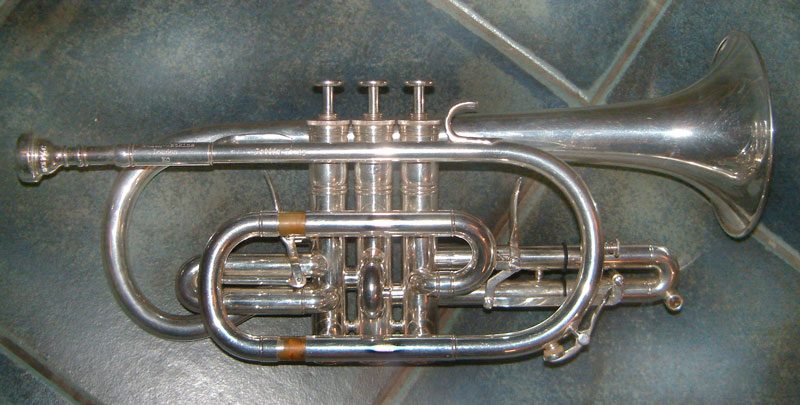
5 min read · 2 sourcesThe cornet (, US: ) is a brass instrument similar to the trumpet but distinguished from it by its conical bore, more compact shape, and mellower tone. The most common cornet is a transposing instrument in B♭. There is also a soprano cornet in E♭ and cornets in A and C. All are unrelated to the Renaissance and early Baroque cornett. 1
History
The cornet was derived from the posthorn by applying valves to it in the 1820s. Initially using Stölzel valves, by the 1830s, Parisian makers were using the improved Périnet piston valves. Cornets first appeared as separate instrumental parts in 19th-century French compositions. The instrument could not have been developed without the improvement of piston valves by Silesian horn players Friedrich Blühmel (or Blümel) and Heinrich Stölzel, in the early 19th century. These two instrument makers almost simultaneously invented valves, though it is likely that Blühmel was the inventor, while Stölzel developed a practical instrument. They were jointly granted a patent for a period of ten years. François Périnet received a patent in 1838 for an improved valve, which became the model for modern brass instrument piston valves. The first notable virtuoso player was Jean-Baptiste Arban, who studied the cornet extensively and published La grande méthode complète de cornet à piston et de saxhorn, commonly referred to as the Arban method, in 1864. Up until the early 20th century, the trumpet and cornet co-existed in musical ensembles; symphonic repertoire often involves separate parts for trumpet and cornet. As several instrument builders made improvements to both instruments, they started to look and sound more alike. The modern-day cornet is used in brass bands, concert bands, and in specific orchestral repertoire that requires a more mellow sound. The name "cornet" derives from the French corne, meaning "horn", itself from Latin cornu. While not musically related, instruments of the Zink family (which includes serpents) are named "cornetto" or "cornett" in modern English, to distinguish them from the valved cornet described here. 1
Relationship to trumpet
The cornet's valves allowed for melodic playing throughout the instrument's register. Trumpets were slower to adopt the new valve technology, so for 100 years or more, composers often wrote separate parts for trumpet and cornet. The trumpet would play fanfare-like passages, while the cornet played more melodic ones. The modern trumpet has valves that allow it to play the same notes and fingerings as the cornet. Cornets and trumpets made in a given key (usually the key of B♭) play at the same pitch, and the technique for playing the instruments is nearly identical. However, cornets and trumpets are not entirely interchangeable, as they differ in timbre. Also available, but usually seen only in the brass band, is an E♭ soprano model, pitched a fourth above the standard B♭. Unlike the trumpet, which has a cylindrical bore up to the bell section, the tubing of the cornet has a mostly conical bore, starting very narrow at the mouthpiece and gradually widening towards the bell. Cornets following the 1913 patent of E. A. Couturier can have a continuously conical bore. This shape is primarily responsible for the instrument's characteristic warm, mellow tone, which can be distinguished from the more penetrating sound of the trumpet. The conical bore of the cornet also makes it more agile than the trumpet when playing fast passages, but correct pitching is often less assured. The cornet is often preferred for young beginners as it is easier to hold, with its centre of gravity much closer to the player. The cornet mouthpiece has a shorter and narrower shank than that of a trumpet, so it can fit the cornet's smaller mouthpiece receiver. 1
Echo cornet
The echo cornet has been called an obsolete variant. It has a mute chamber (or echo chamber) mounted to the side, acting as a second bell when the fourth valve is pressed. The second bell has a sound similar to that of a Harmon mute and is typically used to play echo phrases, whereupon the player imitates the sound from the primary bell using the echo chamber. 1
Playing technique
Like the trumpet and all other modern brass wind instruments, the cornet makes a sound when the player vibrates ("buzzes") the lips in the mouthpiece, creating a vibrating column of air in the tubing. The frequency of the air column's vibration can be modified by changing the lip tension and aperture, or embouchure, and by altering the tongue position to change the shape of the oral cavity, thereby increasing or decreasing the speed of the airstream. In addition, the column of air can be lengthened by engaging one or more valves, thus lowering the pitch. Double and triple tonguing are also possible. Without valves, the player could produce only a harmonic series of notes, like those played by the bugle and other "natural" brass instruments. These notes are far apart for most of the instrument's range, making diatonic and chromatic playing impossible, except in the extreme high register. The valves change the length of the vibrating column and provide the cornet with the ability to play chromatically. 1
Brass band
British brass bands consist only of brass instruments and a percussion section. The cornet is the leading melodic instrument in this ensemble; trumpets are never used. The ensemble consists of about thirty musicians, including nine B♭ cornets and one E♭ cornet (soprano cornet). In the UK, companies such as Besson and Boosey & Hawkes specialized in instruments for brass bands. In America, 19th-century manufacturers such as Graves and Company, Hall and Quinby, E. G. Wright, and the Boston Musical Instrument Manufactury made instruments for this ensemble. 1
The text above is adapted from the Wikipedia article “Cornet”, available under the Creative Commons Attribution-ShareAlike 4.0 licence. 1
cornet is musical instrument, according to the structured record cited below. This entry was generated automatically from that record and has not yet been reviewed by a person familiar with the tradition. 2
The source record links this tradition to 34 external registers, which can be verified through the citation. 2