The tradition & historical record
6 min read · 2 sourcesRussian culture (Russian: Культура России, romanized: Kul'tura Rossii, IPA: [kʊlʲˈturə rɐˈsʲiɪ]) has been formed by the nation's history, its geographical location and its vast expanse, religious and social traditions, and both Eastern and Western influence. Cultural scientists believe that the influence of the East was fairly insignificant, since the Mongols did not coexist with the Russians during conquest, and the indigenous peoples were subjected to reverse cultural assimilation, unlike the Scandinavian and more western neighbors, which have become the main reason for the formation of modern culture among Russians. Russian writers and philosophers have played an important role in the development of European thought. The Russians have also greatly influenced classical music, ballet, theatre, painting, cinema and sport. The nation has also made pioneering contributions to science and technology and space exploration. 1
Language and literature
Russia's 160 ethnic groups speak some 100 languages. According to the 2002 census, 142.6 million people speak Russian, followed by Tatar with 5.3 million and Ukrainian with 1.8 million speakers. Russian is the only official state language, but the Constitution gives the individual republics the right to make their native language co-official next to Russian. Despite its wide dispersal, the Russian language is homogeneous throughout Russia. Russian is the most geographically widespread language of Eurasia and the most widely spoken Slavic language. Russian belongs to the Indo-European language family and is one of the living members of the East Slavic languages; the others being Belarusian and Ukrainian (and possibly Rusyn). Written examples of Old East Slavic (Old Russian) are attested from the 10th century onwards. Over a quarter of the world's scientific literature is published in Russian. Russian is also applied as a means of coding and storage of universal knowledge—60–70% of all world information is published in the English and Russian languages. The language is one of the six official languages of the United Nations. 1
Folklore
Russian folklore takes its roots in the pagan beliefs of ancient Slavs, which is nowadays still represented in the Russian folklore. Epic Russian bylinas are also an important part of Slavic mythology. The oldest bylinas of Kievan cycle were recorded in the Russian North, especially in Karelia, where most of the Finnish national epic Kalevala was recorded as well. 1
Many Russian fairy tales and bylinas were adapted for Russian animations, or for feature movies by famous directors like Aleksandr Ptushko (Ilya Muromets, Sadko) and Aleksandr Rou (Morozko, Vasilisa the Beautiful). Some Russian poets, including Pyotr Yershov and Leonid Filatov, created a number of well-known poetical interpretations of classical Russian fairy tales, and in some cases, like that of Alexander Pushkin, also created fully original fairy tale poems that became very popular. Folklorists today consider the 1920s the Soviet Union's golden age of folklore. The struggling new government, which had to focus its efforts on establishing a new administrative system and building up the nation's backwards economy, could not be bothered with attempting to control literature, so studies of folklore thrived. There were two primary trends of folklore study during the decade: the formalist and Finnish schools. Formalism focused on the artistic form of ancient byliny and faerie tales, specifically their use of distinctive structures and poetic devices. The Finnish school was concerned with connections amongst related legends of various Eastern European regions. 1
Literature
Russian literature is considered to be among the world's most influential and developed. It can be traced to the Middle Ages, when epics and chronicles in Old East Slavic were composed. By the Age of Enlightenment, literature had grown in importance, with works from Mikhail Lomonosov, Denis Fonvizin, Gavrila Derzhavin, and Nikolay Karamzin. From the early 1830s, during the Golden Age of Russian Poetry, literature underwent an astounding golden age in poetry, prose and drama. Romanticism permitted a flowering of poetic talent: Vasily Zhukovsky and later his protégé Alexander Pushkin came to the fore. Following Pushkin's footsteps, a new generation of poets were born, including Mikhail Lermontov, Nikolay Nekrasov, Aleksey Konstantinovich Tolstoy, Fyodor Tyutchev and Afanasy Fet. The first great Russian novelist was Nikolai Gogol. Then came Ivan Turgenev, who mastered both short stories and novels. Fyodor Dostoevsky and Leo Tolstoy soon became internationally renowned. Ivan Goncharov is remembered mainly for his novel Oblomov. Mikhail Saltykov-Shchedrin wrote prose satire, while Nikolai Leskov is best remembered for his shorter fiction. In the second half of the century Anton Chekhov excelled in short stories and became a leading dramatist. Other important 19th-century developments included the fabulist Ivan Krylov, non-fiction writers such as the critic Vissarion Belinsky, and playwrights such as Aleksandr Griboyedov and Aleksandr Ostrovsky. The beginning of the 20th century ranks as the Silver Age of Russian Poetry. This era had poets such as Alexander Blok, Anna Akhmatova, Boris Pasternak, Konstantin Balmont, Marina Tsvetaeva, Vladimir Mayakovsky, and Osip Mandelshtam. 1
Humour
Russia owes much of its humour to the flexibility of the Russian language, allowing for puns and unexpected associations. As with any other nation, its vast scope ranges from lewd jokes and silly word play to political satire. Russian jokes, the most popular form of Russian humour, are short fictional stories or dialogues with a punch line. Russian joke culture features a series of categories with fixed and highly familiar settings and characters. Surprising effects are achieved by an endless variety of plots. Russians love jokes on topics found everywhere in the world, be it politics, spouse relations, or mothers-in-law. Chastushka, a type of traditional musical Russian poetry, is a single quatrain in trochaic tetrameter with an ABAB or ABCB rhyme scheme. Usually humorous, satirical, or ironic in nature, chastushkas are often put to music as well, usually with balalaika or accordion accompaniment. The rigid, short structure (and to a lesser degree, the type of humor these use) parallels limericks. The name originates from the Russian word части́ть, meaning "to speak fast". 1
Visual arts
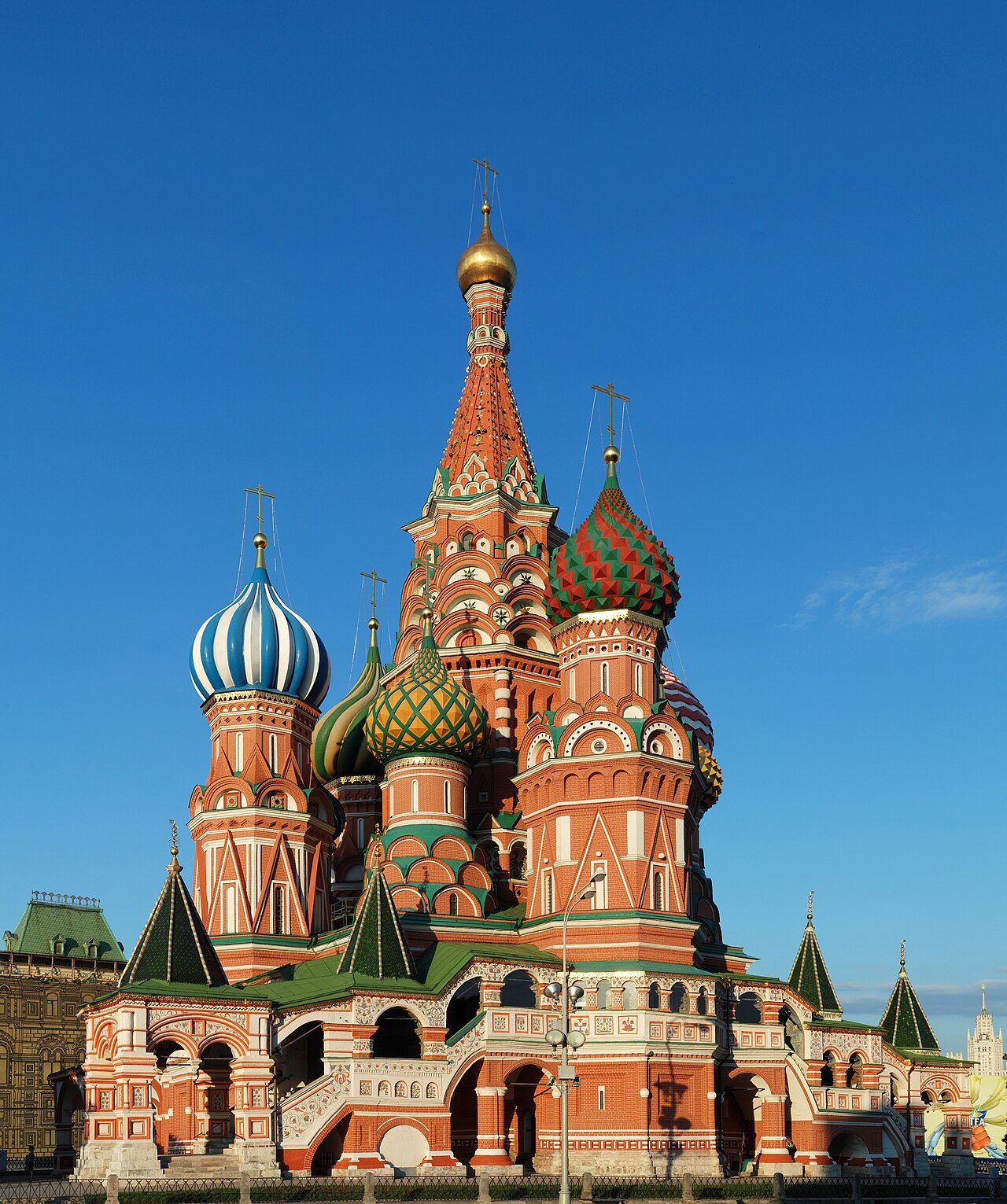
As early as the 12th and 13th centuries Russia had its national masters who were free of all foreign influence, i. e. that of the Greeks on the one hand, and on the other hand that of the Lombard master-masons called in Andrei Georgievich to build the Uspensky (Assumption) Cathedral in the city of Vladimir. Russia's relations with the Greek world were hampered by the Mongol invasion, and it is to the isolation arising from this that we must attribute the originality of Slavo-Russian ornamentation, which has a character of its own, quite unlike the Byzantine style and the Romanesque. 1
The text above is adapted from the Wikipedia article “Culture of Russia”, available under the Creative Commons Attribution-ShareAlike 4.0 licence. 1
culture of Russia is culture of peoples and nationalities of Russia, according to the structured record cited below. This entry was generated automatically from that record and has not yet been reviewed by a person familiar with the tradition. 2
The source record links this tradition to 10 external registers, which can be verified through the citation. 2