The tradition & historical record
4 min read · 2 sourcesThe daf (Persian: دف), also known as dap (دپ), dâyere or riq, is an Iranian frame drum musical instrument, also used in popular and classical music in Persian-influenced South Asia and Central Asia, such as in Afghanistan, Azerbaijan, Tajikistan, Iran, Uzbekistan, Turkey many regions of Georgia, Armenia, Pakistan as well as in parts of India and Russian polar regions. It is also popular among Balkans, Caucasians, Bukharan Jews, Kurds, and Macedonians. The daf is the national musical instrument of Pakistan and is also depicted on the reverse and obverse of the Azerbaijani 1 qəpik coin and 1 manat banknote respectively, since 2006. It traditionally has a round wooden frame (although in the modern era it may also be made of metal), jingles, and a thin, translucent head made of fish- or goat-skin (or, more recently, a synthetic material). The sound is produced by hitting the membrane with either hand – the left hand, which also holds the daf, strikes the edges, and the right hand strikes the center. The right-hand fingers are fastened about their neighbours and suddenly released, like the action of finger-snapping, to produce loud, rapid, sharp sounds. 1
History
The Pahlavi (Middle Persian) name of the daf is dap (دپ); the frame drum used in traditional Uyghur music has the similar name dāp (داپ). Some pictures of daf have been found in paintings that date before the Common Era. The presence of the Iranian daf in the 6th–5th century BCE Behistun Inscription suggests that it existed before the rise of Islam and Sufism. Iranian music has always been a spiritual tool. It shows that daf played an important role in Mazdean Iran emerging as an important element during the Sassanian period, during the Kâvusakân dynasty. Also, there is a kind of square frame drum in the stonecutting of Taq-e Bostan (another famous monument located 5km northeast of Kermanshah city). These frame drums were played in the ancient Middle East, Greece, and Rome and reached medieval Europe through Islamic culture. 1
Nowruz (the first day of the Iranian New Year and the national festival of the Iranian people) and other festive occasions have been accompanied by daf in the Sassanid periods (224 AD–651 AD). In this period, the daf was played in order to accompany Iranian classical music. Dafs were likely used in the court to be played in the modes and melodies of traditional music. This traditional or classical music was created by Barbod the Great and was named the khosravani after the mythical king Khosrow II. Recent research reveals that these modes were used in the recitation of Mazdean (Zoroastrian) prayers. The modes were passed down from master to student and are today known as the radif and dastgāh system. Many of the melodies were lost, but most of those that remain date to the Sassanid period. Dafs can be played to produce highly complex and intense rhythms, causing one to go under a trance and reach an ecstatic and spiritually-high state. 1
In Islam
In Islam, the daf holds special importance in conservative Sunni communities as it is the only musical instrument whose use is permitted, specifically by women during celebrations and men in battle. It also holds special importance in Islamic Sufi music. 1
Structure and construction
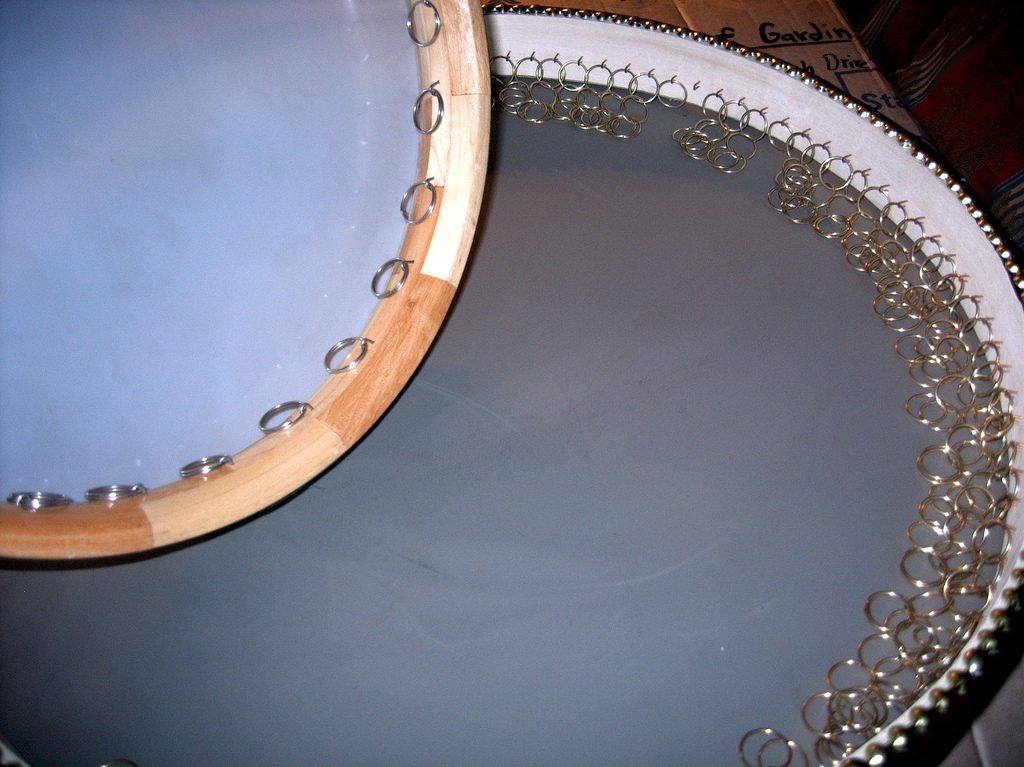
The jingles, which are thin metal plates or rings, are attached to hooks in three or four rectangular holes in the circular wooden frame. The drumhead is made of fish or goat skin. The width of the frame is 45–50 centimetres (18–20 in) and the depth, 5–7 centimetres (2–3 in). In order to bend the frame, the wood ("buka", "orev") may be softened in water before being bent around a hot metal cylinder. The frame is closed by gluing the ends together. Finally, the skin is attached to the frame by fixing it with another wooden frame or by using nails. Another variation is to have the ring-style jingles arranged around the edge of the inside of the drum the whole way around or to have several tiers half way around the inside edge. 1
Notable performers
Ulfatmo Mamadambarova, singer and musician 1
The text above is adapted from the Wikipedia article “Daf”, available under the Creative Commons Attribution-ShareAlike 4.0 licence. 1
daf is a frame drum, according to the structured record cited below. This entry was generated automatically from that record and has not yet been reviewed by a person familiar with the tradition. 2
The source record links this tradition to 7 external registers, which can be verified through the citation. 2