The tradition & historical record
6 min read · 2 sourcesThe didgeridoo ( ; also spelt didjeridu, among other variants) is a wind instrument, played with vibrating lips to produce a continuous drone while using a special breathing technique called circular breathing. The didgeridoo was developed by Aboriginal peoples of northern Australia at least 1,000 years ago, and is now in use around the world, though still most strongly associated with Indigenous Australian music. In the Yolŋu languages of the indigenous people of northeast Arnhem Land the name for the instrument is the yiḏaki, sometimes more recently also called mandapul. In the Bininj Kunwok language of West Arnhem Land it is known as mako (pronounced, and sometimes spelt, as mago). A didgeridoo is usually cylindrical or conical, and can measure anywhere from 1 to 3 m (3 to 10 ft) long. Most are around 1.2 m (4 ft) long. Generally, the longer the instrument, the lower its pitch. Flared instruments play a higher pitch than unflared instruments of the same length. 1
History
There is currently no consensus on the exact age of the didgeridoo. Archaeological studies suggest that people of the Kakadu region in Northern Australia have been using the didgeridoo for less than 1,000 years, based on the dating of rock art paintings. A clear rock painting in Ginga Wardelirrhmeng, on the northern edge of the Arnhem Land plateau, from the freshwater period (that had begun 1500 years ago) shows a didgeridoo player and two song-men participating in an Ubarr ceremony. It is thus thought that it was developed by Aboriginal peoples of northern Australia, possibly in Arnhem Land. T. B. Wilson's Narrative of a Voyage Round the World (1835) includes a drawing of an Aboriginal man from Raffles Bay on the Cobourg Peninsula (about 350 kilometres (220 mi) east of Darwin) playing the instrument. Others observed such an instrument in the same area, made of bamboo and about 3 feet (0.9 m) long. In 1893, English palaeontologist Robert Etheridge, Junior observed the use of "three very curious trumpets" made of bamboo in northern Australia. There were then two native species of bamboo growing along the Adelaide River, Northern Territory". According to A. P. Elkin, in 1938, the instrument was "only known in the eastern Kimberley [region in Western Australia] and the northern third of the Northern Territory". 1
Etymology
The name didgeridoo is not of Aboriginal Australian linguistic origin and is considered to be an onomatopoetic word. The earliest occurrences of the word in print include a 1908 edition of the Hamilton Spectator referring to a "'did-gery-do' (hollow bamboo)", a 1914 edition of The Northern Territory Times and Gazette, and a 1919 issue of Smith's Weekly, in which it was referred to as a "didjerry" and was said to produce the sound "didjerry, didjerry, didjerry and so on ad infinitum". A rival explanation, that didgeridoo is a corruption of the Irish phrase dúdaire dubh or Scottish Gaelic dùdaire dúth, is controversial. Irish dúdaire or dúidire, and Scottish Gaelic dùdaire, are nouns that, depending on the context, may mean "trumpeter", "hummer", "crooner" or "puffer", while Irish dubh means "black", and Scottish Gaelic dúth means "native". 1
Other names
There are numerous names for the instrument among the Aboriginal peoples of northern Australia, none of which closely resemble the word "didgeridoo" (see below). Some didgeridoo enthusiasts, scholars and Aboriginal people advocate using local language names for the instrument. Yiḏaki (transcribed yidaki in English, sometimes spelt yirdaki) is one of the most commonly used names although, strictly speaking, it refers to a specific type of the instrument made and used by the Yolngu peoples of north-east Arnhem Land. Some Yolngu people began using the word mandapul after 2011, out of respect for the passing of a Manggalili man who had a name sounding similar to yidaki. In west Arnhem Land, it is known as a mako, a name popularised by virtuoso player David Blanasi, a Bininj man, whose language was Kunwinjku, and who brought the didgeridoo to world prominence. However the mako is slightly different from the Yiḏaki: usually shorter, and sounding somewhat different – a slightly fuller and richer sound, but without the "overtone" note. The word is pronounced mago and is sometimes spelt that way. There are at least 45 names for the didgeridoo which are still used in the lingua franca by some Aboriginal people. The following are some of the more common regional names. 1
Description and construction
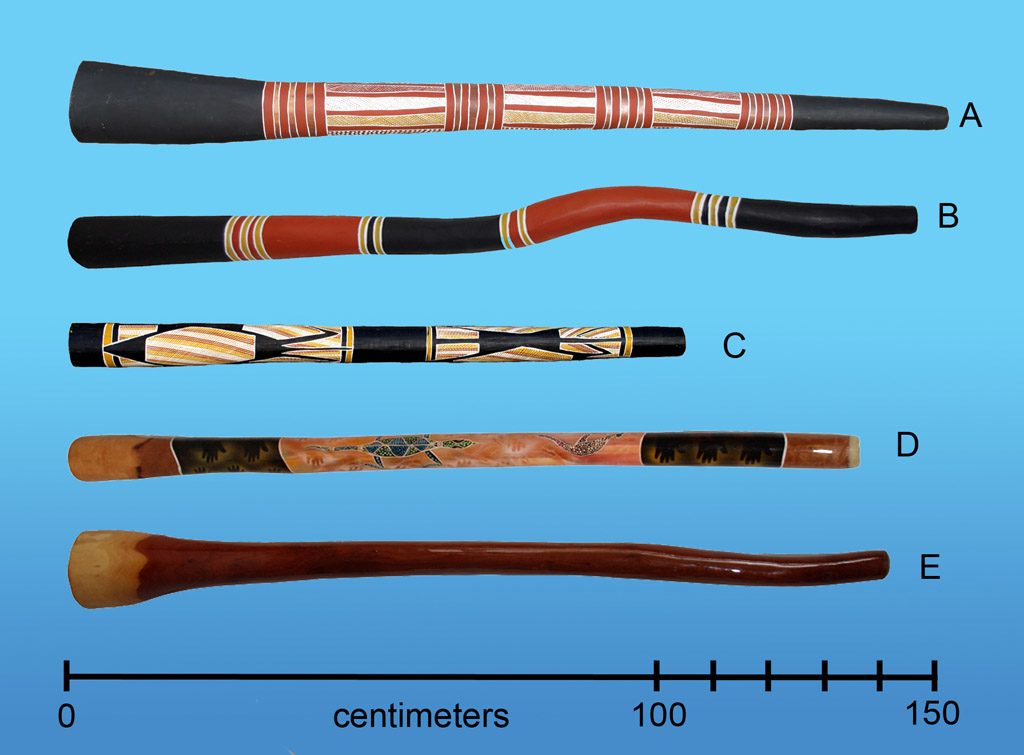
A didgeridoo is usually cylindrical or conical, and can measure anywhere from 1 to 3 m (3 to 10 ft) long. Most are around 1.2 m (4 ft) long. Generally, the longer the instrument, the lower its pitch or key. However, flared instruments play a higher pitch than unflared instruments of the same length. The didgeridoo is classified as a wind instrument and is similar in form to a straight trumpet, but made of wood. It has also been called a dronepipe. 1
Traditional
Traditional didgeridoos are usually made from hardwoods, especially the various eucalyptus species that are endemic to northern and central Australia. Generally the main trunk of the tree is harvested, though a substantial branch may be used instead. Traditional didgeridoo makers seek suitably hollow live trees in areas with obvious termite activity. Termites attack these living eucalyptus trees, removing only the dead heartwood of the tree, as the living sapwood contains a chemical that repels the insects. Various techniques are employed to find trees with a suitable hollow, including knowledge of landscape and termite activity patterns, and a kind of tap or knock test, in which the bark of the tree is peeled back, and a fingernail or the blunt end of a tool, such as an axe, is knocked against the wood to determine if the hollow produces the right resonance. Once a suitably hollow tree is found, it is cut down and cleaned out, the bark is taken off, the ends trimmed, and the exterior is shaped; this results in a finished instrument. A rim of beeswax may be applied to the mouthpiece end. 1
The text above is adapted from the Wikipedia article “Didgeridoo”, available under the Creative Commons Attribution-ShareAlike 4.0 licence. 1
didgeridoo is traditional Australian wind instrument, according to the structured record cited below. This entry was generated automatically from that record and has not yet been reviewed by a person familiar with the tradition. 2
The source record links this tradition to 28 external registers, which can be verified through the citation. 2