The tradition & historical record
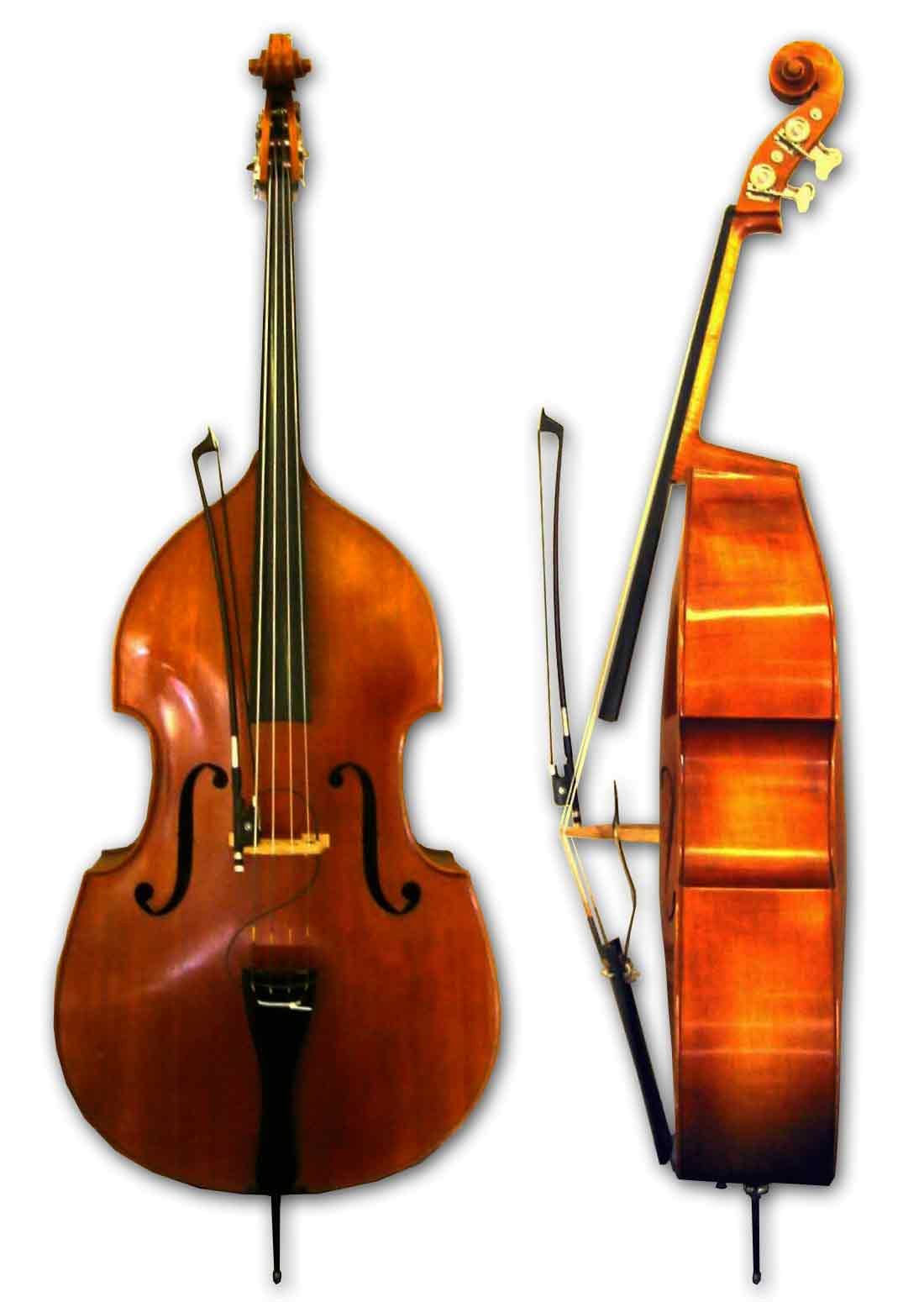
7 min read · 2 sourcesThe double bass, also known as the upright bass, the acoustic bass, the bull fiddle, the bass fiddle, the string bass, the contrabass, or simply the bass, is the largest and lowest-pitched chordophone in the modern symphony orchestra (excluding rare additions such as the octobass). It has four or five strings, and its construction is in between that of the gamba (viol) and the violin family. The bass is a standard member of the orchestra's string section, along with violins, violas, and cellos, as well as the concert band, and is featured in concertos, solo, and chamber music in Western classical music. The bass is used in a range of other genres, such as jazz, blues, rock and roll, rockabilly, country music, bluegrass, tango, folk music and certain types of film and video game soundtracks. The instrument's exact lineage is still a matter of some debate, with scholars divided on whether the bass is derived from the viol or the violin family. Being a transposing instrument, the bass is typically notated one octave higher than tuned to avoid excessive ledger lines below the staff. 1
Terminology
A person who plays this instrument is called a "bassist", "double bassist", "double bass player", "contrabassist", "contrabass player" or "bass player". The names contrabass and double bass refer (respectively) to the instrument's range, and to its use one octave lower than the cello (i.e. the cello part was the main bass line, and the "double bass" originally played a copy of the cello part; only later was it given an independent part). The terms for the instrument among classical performers are contrabass (which comes from the instrument's Italian name, contrabbasso), string bass (to distinguish it from brass bass instruments in a concert band, such as tubas), or simply bass. In jazz, blues, rockabilly and other genres outside of classical music, this instrument is commonly called the upright bass, standup bass or acoustic bass to distinguish it from the (usually electric) bass guitar. In folk and bluegrass music, the instrument is also referred to as a "bass fiddle" or "bass violin" (or more rarely as "doghouse bass" or "bull fiddle"). While not a member of the violin-family of instruments, the construction of the upright bass is quite different from that of the acoustic bass guitar, as the latter is a derivative of the electric bass guitar, and usually built like a larger and sturdier variant of a viola de gamba, its ancestor. The double bass is sometimes confusingly called the violone, bass violin or bass viol. 1
Description
A typical double bass stands around 180 cm (6 feet) from scroll to endpin. Whereas the traditional "full-size" (4⁄4 size) bass stands on average 74.8 inches (190 cm), the more common 3⁄4 size bass (which has become the most widely used size in the modern era, even among orchestral players) stands on average 71.6 inches (182 cm) from scroll to endpin. Other sizes are also available, such as a 1⁄2 size or 1⁄4 size, which serve to accommodate a player's height and hand size. These names of the sizes do not reflect the true size relative to a "full size" bass; a 1⁄2 bass is not half the length of a 4⁄4 bass, but is only about 15% smaller. Double basses are typically constructed from several types of wood, including maple for the back, spruce for the top, and ebony for the fingerboard. It is uncertain whether the instrument is a descendant of the viola da gamba or of the violin, but it is traditionally aligned with the violin family. While the double bass is nearly identical in construction to other violin family instruments, it also embodies features found in the older viol family. The standard notes of the open strings are E1, A1, D2, and G2, the same as an acoustic or electric bass guitar. However, the resonance of the wood, combined with the violin-like construction and long scale length gives the double bass a much richer tone than the bass guitar, in addition to the ability to use a bow, while the fretless fingerboard accommodates smooth glissandos and legatos. 1
Playing style
Like other violin and viol-family string instruments, the double bass is played either with a bow (arco) or by plucking the strings (pizzicato). When employing a bow, the player can either use it traditionally or strike the wood of the bow against the string. In orchestral repertoire and tango music, both arco and pizzicato are employed. In jazz, blues, and rockabilly, pizzicato is the norm, except for some solos and occasional written parts in modern jazz that call for bowing. Bowed notes in the lowest register of the instrument produce a dark, heavy, mighty, or even menacing effect, when played with a fortissimo dynamic; however, the same low pitches played with a delicate pianissimo can create a sonorous, mellow accompaniment line. Classical bass students learn all of the different bow articulations used by other string section players (e.g., violin and cello), such as détaché, legato, staccato, sforzato, martelé ("hammered"-style), sul ponticello, sul tasto, tremolo, spiccato and sautillé. Some of these articulations can be combined; for example, the combination of sul ponticello and tremolo can produce eerie, ghostly sounds. Classical bass players do play pizzicato parts in orchestra, but these parts generally require simple notes (quarter notes, half notes, whole notes), rather than rapid passages. 1
Classical players perform both bowed and pizz notes using vibrato, an effect created by rocking or quivering the left hand finger that is contacting the string, which then transfers an undulation in pitch to the tone. Vibrato is used to add expression to string playing. In general, very loud, low-register passages are played with little or no vibrato, as the main goal with low pitches is to provide a clear fundamental bass for the string section. 1
History
The double bass is generally regarded as a modern descendant of the violone (It. "large viol"), a member of the chordophone family that originated in Europe in the 15th century. Before the 20th century many double basses had only three strings, in contrast to the five to six strings typical of instruments in the viol family or the four strings of instruments in the violin family. The double bass's proportions are dissimilar to those of the violin and cello; for example, it is deeper (the distance from front to back is proportionally much greater than the violin). In addition, while the violin has bulging shoulders, most double basses have shoulders carved with a more acute slope, like members of the viol family. Many very old double basses have had their shoulders cut or sloped to aid playing with modern techniques. Before these modifications, the design of their shoulders was closer to instruments of the violin family. The double bass is the only modern bowed string instrument that is tuned in fourths (like a viol), rather than fifths (see: § Tuning, below). 1
Design
There are two major approaches to the design outline shape of the double bass: the violin form (shown in the labelled picture in … 1
The text above is adapted from the Wikipedia article “Double bass”, available under the Creative Commons Attribution-ShareAlike 4.0 licence. 1
double bass is acoustic stringed instrument of the violin family, according to the structured record cited below. This entry was generated automatically from that record and has not yet been reviewed by a person familiar with the tradition. 2
The source record links this tradition to 62 external registers, which can be verified through the citation. 2