The tradition & historical record
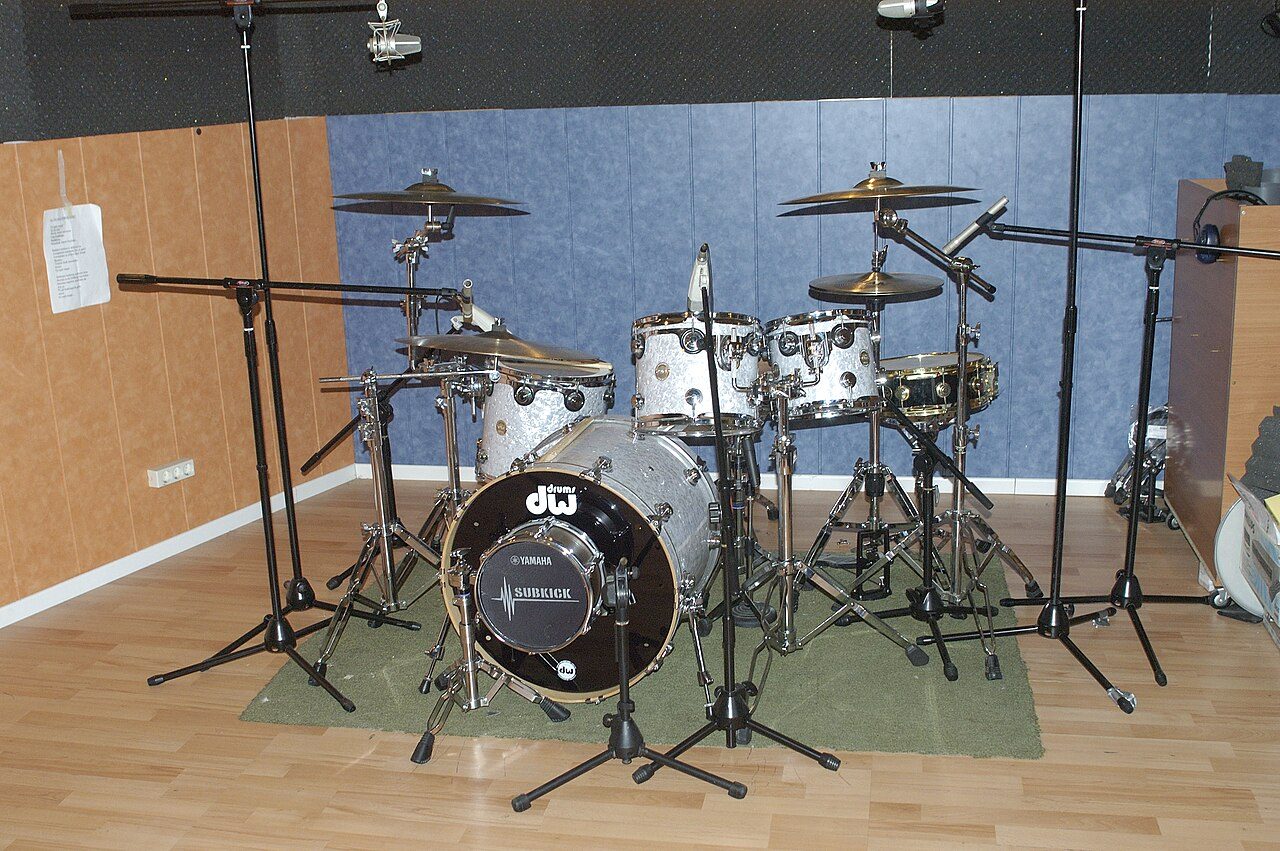
7 min read · 2 sourcesA drum kit, acoustic drum kit or drum set (also known as a trap set or simply drums in popular music and jazz contexts) is a musical instrument consisting of a collection of percussion instruments arranged to be played by a single musician. It typically includes drums, cymbals, and sometimes other auxiliary percussion instruments, such as a tambourine or a cowbell. The drummer usually plays while seated on a drum throne, using drumsticks or special wire or nylon brushes to strike the drums and cymbals, as well as pedals to operate the bass drum and hi-hat, allowing them to adapt the sound to their desired effect. The drum set is not standardized, but usually consists of: 1
A snare drum, mounted on a stand A bass drum, played with a beater moved by one or more foot-operated pedals Two or more tom-toms, including rack toms or floor toms One or more cymbals, including a ride cymbal and crash cymbal Hi-hat cymbals, a pair of cymbals that can be played with a foot-operated pedal as well as the hands Drum sets may be smaller consisting of only snare drum, bass drum, hi-hat, and one cymbal. Conversely, they can also be quite expansive. The drum kit is a part of the standard rhythm section and is used in many types of popular and traditional music styles, ranging from rock and pop to blues and jazz. 1
Early development
Before the development of the classic drum kit, drums and cymbals used in military and orchestral music settings were played separately by different percussionists. In the 1840s, percussionists began to experiment with foot pedals as a way to enable them to play more than one instrument, but these devices would not be mass-produced for another 75 years. By the 1860s, percussionists started combining multiple drums into a kit. The bass drum, snare drum, cymbals, and other percussion instruments were all struck with hand-held drumsticks. Drummers in musical theater appeared in stage shows, where the budget for pit orchestras was often limited due to an insufficient amount of money able to employ a full percussionist team. This contributed to the creation of the drum kit by developing techniques and devices that would enable one person to replace multiple percussionists. Double-drumming was developed to enable one person to play both bass and snare drums with sticks, while the cymbals could be played by tapping the foot on a "low-boy". With this approach, the bass drum was usually played on beats one and three (in 44 time). While the music was first designed to accompany marching soldiers, this simple and straightforward drumming approach led to the birth of ragtime music, when the simple marching beats became more syncopated. This resulted in a greater swing and dance feel. The drum kit was initially referred to as a "trap set", and from the late 1800s to the 1930s, drummers were referred to as "trap drummers". By the 1870s, drummers were using an overhang pedal. Most drummers in the 1870s preferred to do double-drumming without any pedal to play multiple drums, rather than use an overhang pedal. 1
20th century
By World War I, drum kits were often marching-band-style bass drums with many percussion items around them and suspended from them. Drum kits became a central part of jazz, especially Dixieland. The modern drum kit was developed in the vaudeville era, during the 1920s, in New Orleans. Drummers such as Baby Dodds, Zutty Singleton, and Ray Bauduc took the idea of marching rhythms and combined the bass drum, snare drum, and "traps" – a term used to refer to the percussion instruments associated with immigrant groups, which included miniature cymbals, tom toms, cowbells, and woodblocks. They started incorporating these elements into ragtime, which had been popular for a few decades, creating an approach that evolved into a jazz drumming style. Budget constraints and space considerations in musical theater pit orchestras led bandleaders to pressure percussionists to cover more percussion parts. Metal consoles were developed to hold Chinese tom-toms, with swing-out stands for snare drums and cymbals. On top of the console was a "contraption" tray (shortened to "trap"), used to hold items like whistles, klaxons, and cowbells. These kits were dubbed "trap kits". Hi-hat stands became available around 1926. In 1918, Baby Dodds, playing on Mississippi River riverboats with Louis Armstrong, modified the military marching setup, experimenting with playing the drum rims instead of woodblocks, hitting cymbals with sticks (which was not yet common), and adding a side cymbal above the bass drum, which became known as the ride cymbal. William Ludwig developed the "sock" or early low-mounted hi-hat after observing Dodds' drumming. Dodds asked Ludwig to raise the newly produced low-hat cymbal nine inches to make them easier to play, thus creating the modern hi-hat cymbal. 1
Grooves
Kit drumming, whether accompanying voices and other instruments or performing a drum solo, consists of two elements: 1
A groove that sets the basic time-feel and provides a rhythmic framework for the song (examples include a backbeat or shuffle). Grooves can set the mood of the song. Drum fills and other ornaments and variations that provide variety and add interest to the drum sound. Fills could include a sting at the end of a musical section or act as a drum showpiece. 1
Fills
A fill or fill-in is a departure from the repetitive rhythm pattern in a song. A drum fill can be used to "fill in" the space between the end of one verse and the beginning of another verse or chorus. Fills vary from a simple few strokes on a tom or snare to a distinctive rhythm played on the hi-hat, to sequences several bars long that are short virtuosic drum solos. As well as adding interest and variation to the music, fills serve an important function in indicating significant changes of sections in songs as well as linking them together. A vocal cue is a short drum fill that introduces a singer's entrance into the piece. A fill ending with a cymbal crash on beat one is often used to lead into a chorus or verse. 1
Drum solos
A drum solo is an instrumental section without any accompanying instruments that highlights the drums. While other instrument solos are typically accompanied by the other rhythm section instruments (e.g., bass guitar and electric guitar), for most drum solos, the band members stop playing so that all focus will be on the drummer. In some drum solos, the other rhythm section instrumentalists may play "punches" at certain points – sudden, loud chords of short duration. Drum solos are common in jazz but are also used in several rock genres, such as heavy metal and progressive rock. During drum solos, drummers have a degree of creative freedom, allowing them to use complex polyrhythms that would otherwise be unsuitable with an ensemble. In live concerts, drummers may be given extended drum solos, even in genres where drum solos are rare on recordings. 1
The text above is adapted from the Wikipedia article “Drum kit”, available under the Creative Commons Attribution-ShareAlike 4.0 licence. 1
drum kit is musical instrument made up of a group of percussion instruments, according to the structured record cited below. This entry was generated automatically from that record and has not yet been reviewed by a person familiar with the tradition. 2
The source record links this tradition to 33 external registers, which can be verified through the citation. 2