The tradition & historical record
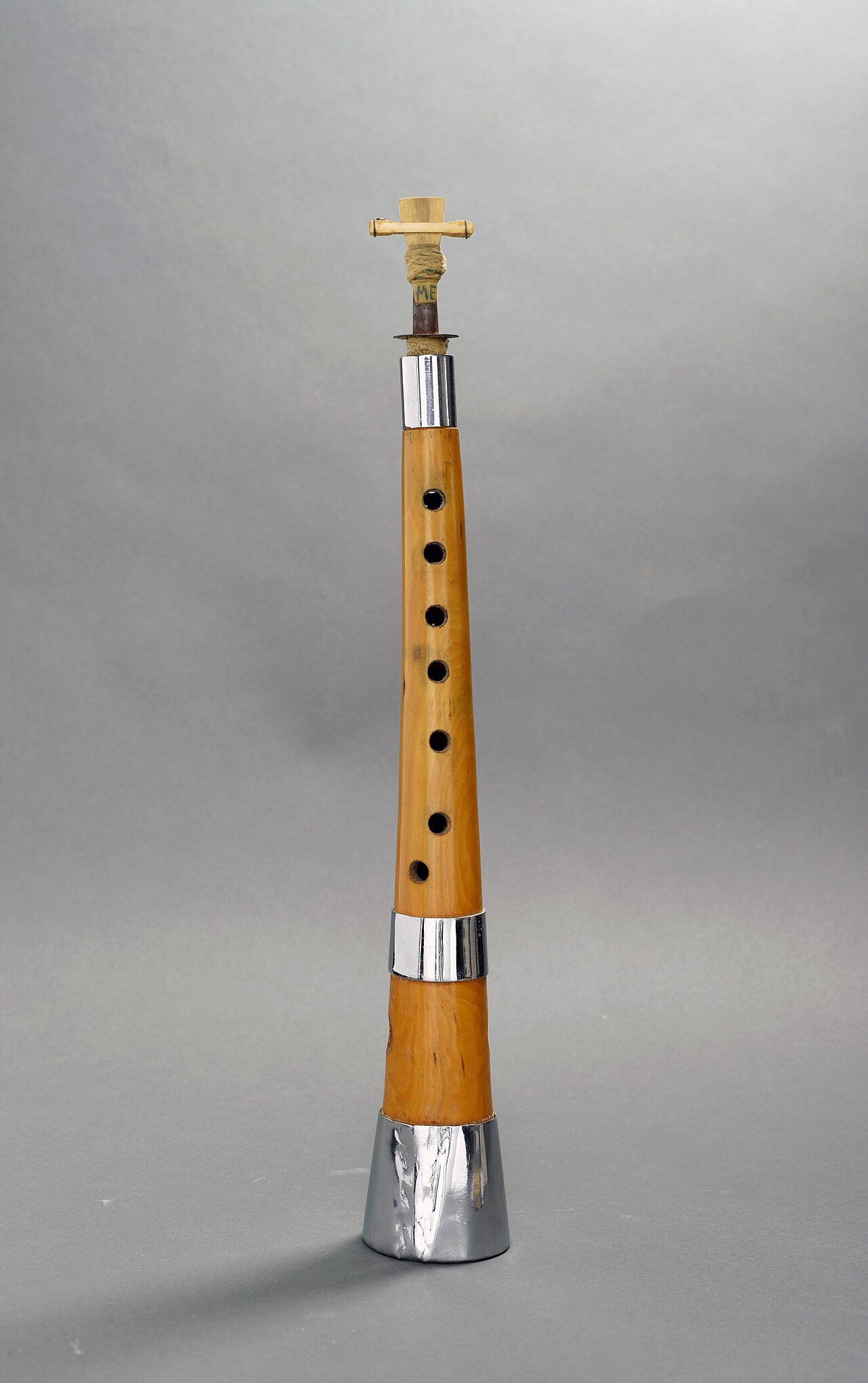
4 min read · 2 sourcesThe dulzaina (Spanish: [dulˈθajna]) is a Spanish double reed instrument in the oboe family. It has a conical shape and is the equivalent of the Breton bombarde. It is often replaced by an oboe or a double reeded clarinet as seen in Armenian and Ukrainian folk music. Many varieties of the dulzaina exist in Spain. In the Valencian Community, it is known as a dolçaina or xirimita and is accompanied by a drum called the tabalet. The Catalan variety of the dulzaina is called a gralla, and the Basque variety is called a bolin-gozo. In the region of Aragon, especially in the town of Huesca, the dulzaina is played along with gaitas de boto, regional bagpipes, and sometimes drums. The instrument was first introduced in Spain through Arabic people. The dulzaina is also heard in a large portion of the region of Castilla y León, where it frequently has keys over the holes. The instrument is deeply rooted in the folklore of Burgos, Segovia, Soria, in some areas of Ávila, Madrid, Guadalajara, Toledo, Cuenca, León and Salamanca, less extended in the Basque Autonomous Community and widely used in Navarre and La Rioja. 1
Valencian G dolçaina
Valencian G dolçaina, otherwise known as dolçaina en sol, is the most typically used dolçaina in Valencia . 1
Range
The range in the concert pitch goes from A3 to E5. F#5 may be occasionally used, but it needs to be the next note progression of the scale and it has to be slurred to the previous note. 1
Music reading and writing
Music for the dolçaina is always written in treble clef. G-dolçaina (dolçaina en sol) is a transposing instrument and its music is written in treble clef. Scores written for dolçaina should ideally be transposed into treble clef. Therefore, the lowest written note is D4 (the first one below the treble clef staff) and the highest one is A5 (on the first additional line above the treble clef staff). Unless specifically stated otherwise, in the following sections, when there is a reference to notes or keys, one must think on the ones that are used by dolçaina players (in G) and not to the actual pitch (in C). 1
Acoustics
The dolçaina has a penetrating, very powerful sound. Until some years ago, events involving dolçaina were restricted to the streets and squares of many towns and cities. Historically, the dolçaina has played a main role in big gatherings of people during Valencian festivities and traditions, so it is unsurprising that its powerful sound has been specially valued and developed. Because of its double reed and conical shaped tube, the dolçaina has a sound characteristic of an oboe or a xeremia. However, there are some important differences. Even though the dolçaina produces a high-pitched sound range, it has a great timbric identity thanks to its richness in harmonics. Under certain acoustic conditions, it can also sound like a soprano saxophone or a trumpet. Mastering tuning is achieved by fingering and subtle changes in air pressure and in the embouchure. Fingering consists of eight finger holes (7 on the front part and one on the rear part for the thumb; like a recorder). 1
Registers
The dolçaina's effective range is divided into two registers, middle register and upper register. They can be distinguished by their timbre and by the way they are produced. 1. Middle register: The sound is natural. It is the most relaxed register. It comprises the first octave, from low D (concert A 3) to high D (concert A 4). Tuning in this register is relatively easy. 2. Upper register: they are the first harmonics of the natural notes. They can be produced by increasing the air pressure - commonly known as "over blowing". Tuning in this register is very hard and playing the notes in it is tiring and difficult. Sustaining playing in this register is truly exhausting. It is situated in the second octave, from high E (concert B4) to high A (concert E5). 1
The text above is adapted from the Wikipedia article “Dulzaina”, available under the Creative Commons Attribution-ShareAlike 4.0 licence. 1
dulzaina is double-reed instrument, according to the structured record cited below. This entry was generated automatically from that record and has not yet been reviewed by a person familiar with the tradition. 2
The source record links this tradition to 9 external registers, which can be verified through the citation. 2