The tradition & historical record
6 min read · 2 sourcesThe erhu (Chinese: 二胡; pinyin: èrhú; [aɻ˥˩xu˧˥]) is a Chinese two-stringed bowed musical instrument, more specifically a spike fiddle, that is sometimes known in the Western world as the Chinese violin or a Chinese two-stringed fiddle. It is used as a solo instrument as well as in small ensembles and large orchestras. It is the most popular of the huqin family of traditional bowed string instruments used by various ethnic groups of China. As a very versatile instrument, the erhu is used in both traditional and contemporary music arrangements, such as pop, rock and jazz. 1
History
The erhu can be traced back to proto-Mongolic instruments which first appeared in China during the Tang dynasty. It is believed to have evolved from the xiqin (奚琴). The xiqin is believed to have originated from the Xi people located in current northeast China. The first Chinese character of the name of the instrument (二, èr, 'two') is believed to come from the fact that it has two strings. An alternate explanation states that it comes from the fact that it is the second-highest huqin in pitch to the gaohu in the modern Chinese orchestra. The second character (胡, hú) indicates that it is a member of the huqin family, with hu commonly translated to mean 'barbarians'. The name huqin literally means 'instrument of the Hu peoples', suggesting that the instrument may have originated from regions to the north or west of China generally inhabited by nomadic people on the extremities of past Chinese kingdoms. For most of history, the erhu was mostly a folk instrument used in southern China, whereas the sihu was preferred among northern musicians. However, in the 1920s, Liu Tianhua introduced the erhu to Beijing, and since, it has become the most popular of the huqin. 1
Historical erhu and bowed string bows
Historic bowed zithers of China, including the xiqin, yazheng, and wenzhenqin, and also the Korean ajaeng, were originally played by bowing with a rosined stick, which created friction against the strings. As soon as the horsehair bow was invented, it spread very widely. 1
Construction
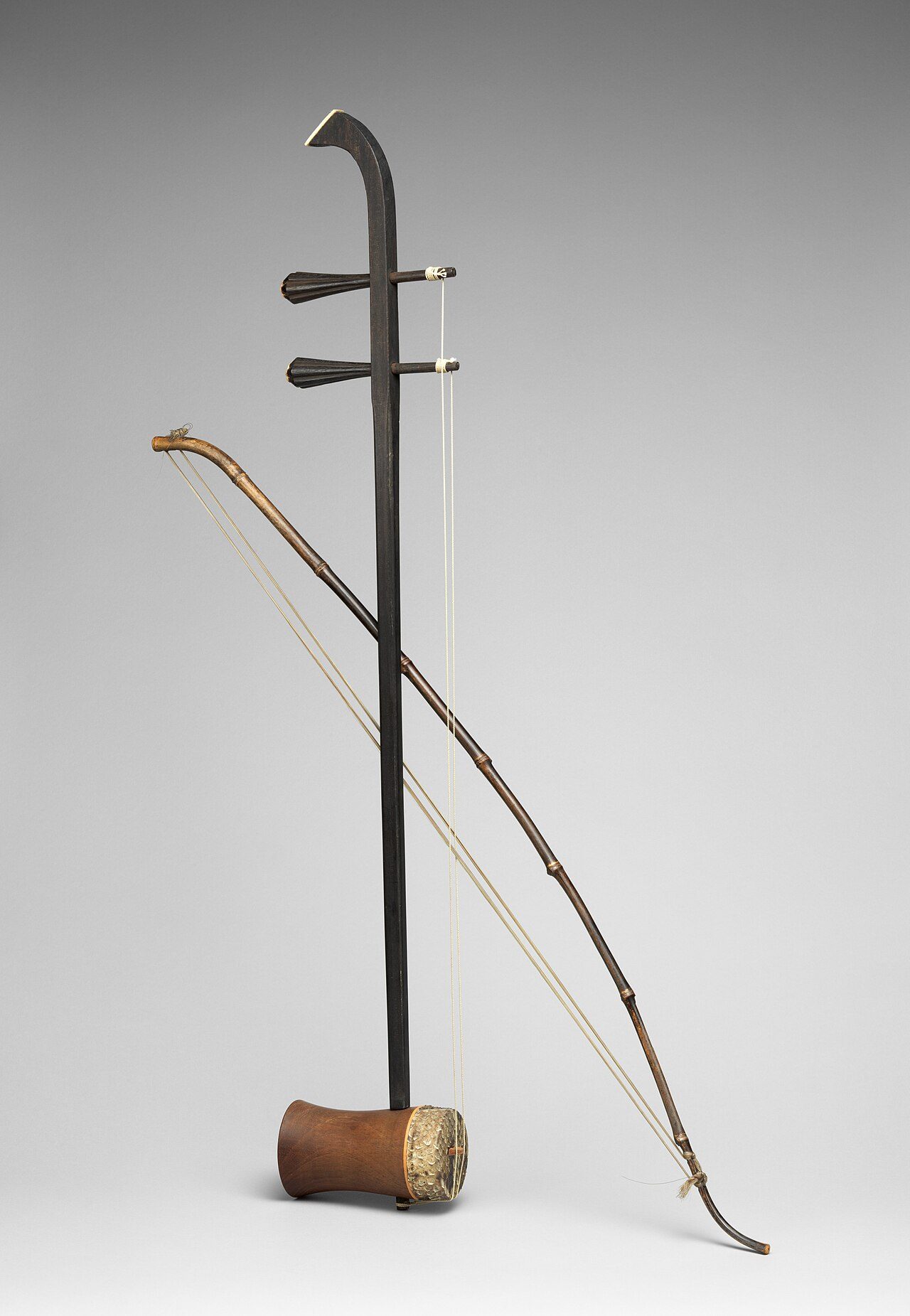
The erhu consists of a long vertical stick-like neck, at the top of which are two big tuning pegs, and at the bottom is a small resonator body (sound box) which is covered with python skin on the front (playing) end. Two strings are attached from the pegs to the base, and a small loop of string (千斤, qiān jīn) placed around the neck and strings acting as a nut pulls the strings towards the skin, holding a minute wooden bridge in place. The erhu has some unusual features: 1
Its characteristic sound is produced through the vibration of the python skin by bowing. There is no fingerboard; the player stops the strings by pressing their fingertips onto the strings without the strings touching the neck. The horse hair bow is never separated from the strings (which were formerly of twisted silk but which today are usually made of metal); it passes between them as opposed to over them (the latter being the case with western bowed stringed instruments). Although there are two strings, they are very close to each other and the player's left hand in effect plays as if on one string. The inside string (nearest to player) is generally tuned to D4 and the outside string to A4, a fifth higher. The maximum range of the instrument is three and a half octaves, from D4 up to A7, before a stopping finger reaches the part of the string in contact with the bow hair. The usual playing range is about two and a half octaves. Various dense and heavy hardwoods are used in making the erhu. According to Chinese references the woods include zi tan (紫檀, red sandalwood and other woods of the genus Pterocarpus such as padauk), lao hong mu (老红木, aged red wood), wu mu (乌木, black wood), and hong mu (红木, red wood). Particularly fine erhu are often made from pieces of old furniture. 1
Use of python skin
In 1988 China passed its Law on the Protection of Endangered Species after ratifying the UN Convention on the International Trade in Endangered Species (CITES), making it illegal to use and trade unlicensed pythons. To regulate the use of python skins, China's State Forestry Administration introduced a certification scheme between python skin sellers in Southeast Asia and musical instrument makers in China. From January 1, 2005, new regulations also require erhu to have a certificate from the State Forestry Administration, which certify that the erhu python skin is not made with wild pythons, but from farm-raised pythons. Individuals are allowed to take up to two erhu out of China when traveling; commercial buyers need additional export certificates. Outside China, manufacturers of erhu can issue their own CITES licenses with approval by governments of their respective countries. Such exports are legal as they have been made from legal skin sources. Some erhu are made of recycled products. The Hong Kong Chinese Orchestra began their research for an alternative to python skin in 2005 and has since designed the Eco-Huqin series, which substitutes python skin with PET Polyester Membrane. For this innovation the Hong Kong Chinese Orchestra received the Ministry of Culture Innovation Award in 2012. 1
Erhu music
A notable composer for the erhu was Liú Tiānhuá (刘天华/劉天華, 1895–1932), a Chinese musician who also studied Western music. He composed 47 exercises and 10 solo pieces (1918–1932) which were central to the development of the erhu as a solo instrument. His works for the instrument include Yue Ye (月夜; Moon Night) and Zhu ying Yao hong (烛影摇红; Shadows of Candles Flickering Red). Other solo pieces include Er Quan Ying Yue (1950, Two Springs Reflecting the Moon) by Abing, Sai Ma (Horse Race) by Huang Haihuai, Henan Xiaoqu (Henan Folk Tune) by Liu Mingyuan, and Sanmenxia Changxiangqu (1961, Sanmen Gorge Capriccio) by Liu Wenjin. Most solo works are commonly performed with yangqin accompaniment, although pieces such as the ten solos by Liú Tiānhuá and Er Quan Ying Yue (Two Springs Reflecting the Moon) originally did not have accompaniment. In addition to the solo repertoire, the erhu is one of the main instruments in regional music ensembles such as Jiangnan sizhu, Chinese opera ensembles, and the modern large Chinese orchestra. The erhu is used in the music of the Cirque du Soleil show O and in solo performances in select Shen Yun tours. Even fusion progressive rock groups like The Hsu-nami have incorporated the erhu into their music and it is their lead instrument. It is incorporated in the Taiwanese black metal band ChthoniC and played by the Tibetan singer alan, and used in the song "Field Below" by Regina Spektor. An instrumental album by erhu artist Song Fei (宋飞) expresses the painting Along the River During the Qingming Festival (清明上河图; Qīngmíng Shànghé Tú) drawn in the Song dynasty by Zhang Zeduan (张择端). 1
The text above is adapted from the Wikipedia article “Erhu”, available under the Creative Commons Attribution-ShareAlike 4.0 licence. 1
erhu is Chinese two-stringed musical instrument, according to the structured record cited below. This entry was generated automatically from that record and has not yet been reviewed by a person familiar with the tradition. 2
The source record links this tradition to 21 external registers, which can be verified through the citation. 2