The tradition & historical record
6 min read · 2 sourcesEthiopian art is the manifestation in art of the Ethiopian civilization. In a primarily Christian civilization, Ethiopian art traditions have developed for millennia alongside Christian Art the world over, and since the 7th century, the Islamic artistic traditions as well. The main artistic expressions have been architecture, painting, goldsmithing, and manuscript illuminations. There is also a range of traditions in textiles, many with woven geometric decoration, alongside many more plain styles. 1
Overview
Prehistoric rock art comparable to that of other African sites survives in a number of places, and until the arrival of Christianity stone stelae, often carved with simple reliefs, were erected as grave-markers and for other purposes in many regions; Tiya is one important site. The "pre-Axumite" Iron Age culture of about the 5th century BCE to the 1st century CE was influenced by the Kingdom of Kush to the north, and settlers from Arabia, and produced cities with simple temples in stone, such as the ruined continuations of traditional church art. The powerful Kingdom of Aksum emerged in the 1st century BCE and dominated Ethiopia until the 10th century, has become very largely Christian from the 4th century. 1
Painting
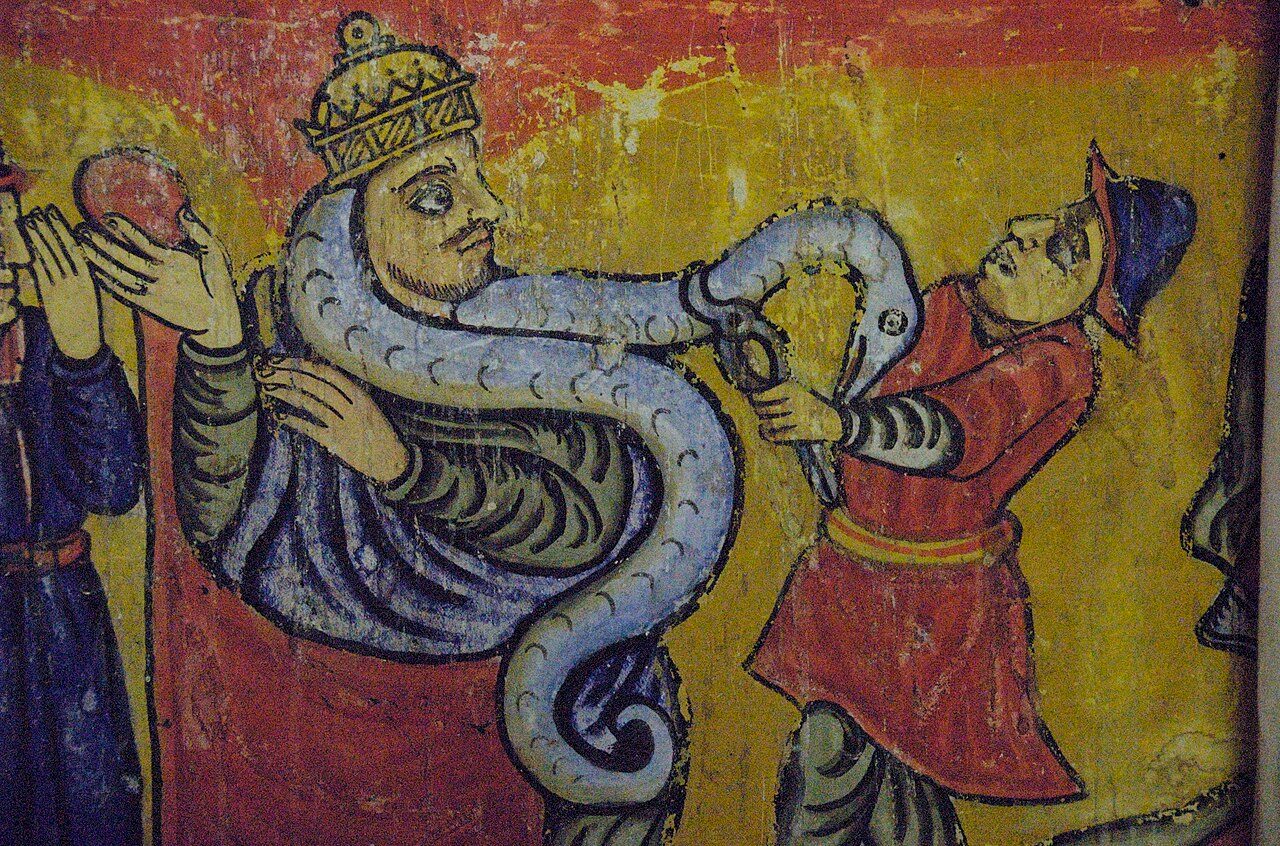
Church paintings in Ethiopia were likely produced as far back as the introduction of Christianity in the 4th century AD, although the earliest surviving examples come from the church of Debre Selam Mikael in the Tigray Region, dated to the 11th century AD. However, the 7th-century AD followers of the Islamic prophet Muhammad who fled to Axum in temporary exile mentioned that the original Church of Our Lady Mary of Zion was decorated with paintings. Other early paintings include those from the rock-hewn churches of Lalibela, dated to the 12th century AD, and in nearby Geneta Maryam, dated to the 13th century AD. However, paintings in illuminated manuscripts predate the earliest surviving church paintings; for instance, the Ethiopian Garima Gospels of the 4th-6th centuries AD contain illuminated scenes imitating the contemporary Byzantine style. Ethiopian painting, on walls, in books, and in icons, is highly distinctive, though the style and iconography are closely related to the simplified Coptic version of Late Antique and Byzantine Christian art. It is typified by simplistic, almost cartoonish, figures with large, almond-shaped, eyes. Colours are usually bright and vivid. Most paintings are religious in nature, often decorating church walls and bibles. One of the best-known examples of this type of painting is at Debre Berhan Selassie in Gondar (pictured), famed for its angel-covered roof (angels in Ethiopian art are often represented as winged heads) as well as its other murals dating from the late 17th century. Diptychs and triptychs are also commonly painted with religious icons. From the 16th century, Roman Catholic church art and European art in general began to exert some influence. 1
Crosses and other metalwork
Another important form of Ethiopian art, also related to Coptic styles, is crosses made from wood and metal. They are usually copper alloy or brass, plated (at least originally) with gold or silver. The heads are typically flat cast plates with elaborate and complex openwork decoration. The cross motif emerges from the decoration, with the whole design often forming a rotated square or circular shape, though the designs are highly varied and inventive. Many incorporate curved motifs rising from the base, which are called the "arms of Adam". Except in recent Western-influenced examples, they usually have no corpus, or figure of Christ, and the design often incorporates numerous smaller crosses. Engraved figurative imagery has sometimes been added. Crosses are mostly either processional crosses, with the metal head mounted on a long wooden staff, carried in religious processions and during the liturgy, or hand crosses, with a shorter metal handle in the same casting as the head. Smaller crosses worn as jewelry are also common. The Lalibela Cross is an especially venerated hand cross, perhaps of the 12th century, which was stolen from a church in Lalibela in 1997 and eventually recovered and returned from a Belgian collector in 2001. Distinctive forms of the crown were worn in ceremonial contexts by royalty and important noble officials, as well as senior clergy. Royal crowns rose high, with a number of circular bands, while church crowns often resemble an elongated version of the typical European closed crown, with four arms, joined at the top and surmounted by a cross. 1
Contemporary art
In the 21st century, contemporary Ethiopian artists have increasingly blended traditional aesthetics with global and modern influences. Artists such as Julie Mehretu, Elias Sime, and Aida Muluneh have received international recognition for their innovative use of materials and themes related to identity, urban life, and cultural heritage. Their works have been featured in exhibitions such as the Venice Biennale and the Museum of Modern Art, reflecting Ethiopia’s growing presence in the global contemporary art scene. Girma, H. (2023). Modern Ethiopian Art: Tradition and Transformation. Addis Ababa University Press. Solomon, M. (2024). “Ethiopian Artists in the Global Contemporary Scene.” African Arts Journal, 57(2), 45–59. 1
Other arts and crafts
Ethiopia has great ethnic and linguistic diversity, and styles in secular traditional crafts vary greatly in different parts of the country. There is a range of traditions in textiles, many with woven geometric decoration, although many types are also usually plain. Ethiopian church practices make a great deal of use of colourful textiles, and the more elaborate types are widely used as church vestments and as hangings, curtains, and wrappings in churches, although they have now largely been supplanted by Western fabrics. Examples of both types can be seen in the picture at the top of the article. Icons may normally be veiled with a semi-transparent or opaque cloth; very thin chiffon-type cotton cloth is a specialty of Ethiopia, though usually with no pattern. Colourful basketry with a coiled construction is common in rural Ethiopia. The products have many uses, such as storing grains, seeds, and food and being used as tables and bowls. The Muslim city of Harar is well known for its high-quality basketry, and many craft products of the Muslim minority relate to wider Islamic decorative traditions. 1
The text above is adapted from the Wikipedia article “Ethiopian art”, available under the Creative Commons Attribution-ShareAlike 4.0 licence. 1
Ethiopian art is art of Ethiopian culture, according to the structured record cited below. This entry was generated automatically from that record and has not yet been reviewed by a person familiar with the tradition. 2
The source record links this tradition to 4 external registers, which can be verified through the citation. 2