The tradition & historical record
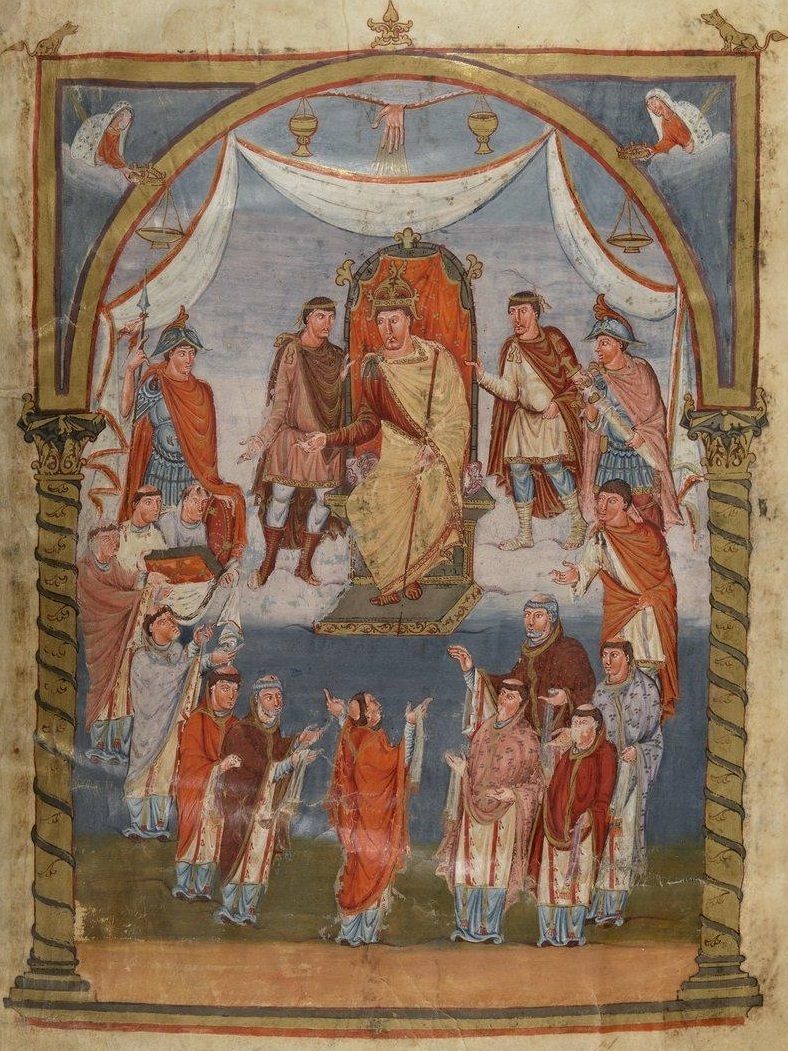
2 min read · 2 sourcesThe First Bible of Charles the Bald (BNF Lat. 1), also known as the Vivian Bible, is a Carolingian-era Bible commissioned by Count Vivian of Tours in 845, the lay abbot of Saint-Martin de Tours, and presented to Charles the Bald in 846 on a visit to the church, as shown in the presentation miniature at the end of the book. It is 495 mm by 345 mm and has 423 vellum folia. It is now in the Bibliothèque nationale de France in Paris. 1
It is also thought to be the third illuminated Bible to have been made at Tours following the Bamberg Bible (Staatsbibliothek Bamberg Msc. Bibl. 1) and Moutier-Grandval Bible (British Library Add MS 10546). The Vivian Bible contains many illuminations, including the Psalms frontispiece, depicting David Composing Psalms, and the presentation miniature, in which Charles the Bald receives the book. The psalms frontispiece is said to have connections with the prophet Audradas because of the writing above David's head. This connection can also be seen with the four virtues which are in the corners of the painting. These virtues are depicted as women on clouds with their arms outstretched. We can see David's guards, who also have a symbolic meaning. They are meant to represent two Old Testament families that guarded David. Along with the guards we see David at the center who is playing the lyre, and his four musicians. All these figures are held within a large mandorla, illustrating the heavenly realm. 1
The text above is adapted from the Wikipedia article “First Bible of Charles the Bald”, available under the Creative Commons Attribution-ShareAlike 4.0 licence. 1
First Bible of Charles the Bald is illuminated manuscript, according to the structured record cited below. This entry was generated automatically from that record and has not yet been reviewed by a person familiar with the tradition. 2
The source record links this tradition to 6 external registers, which can be verified through the citation. 2