The tradition & historical record
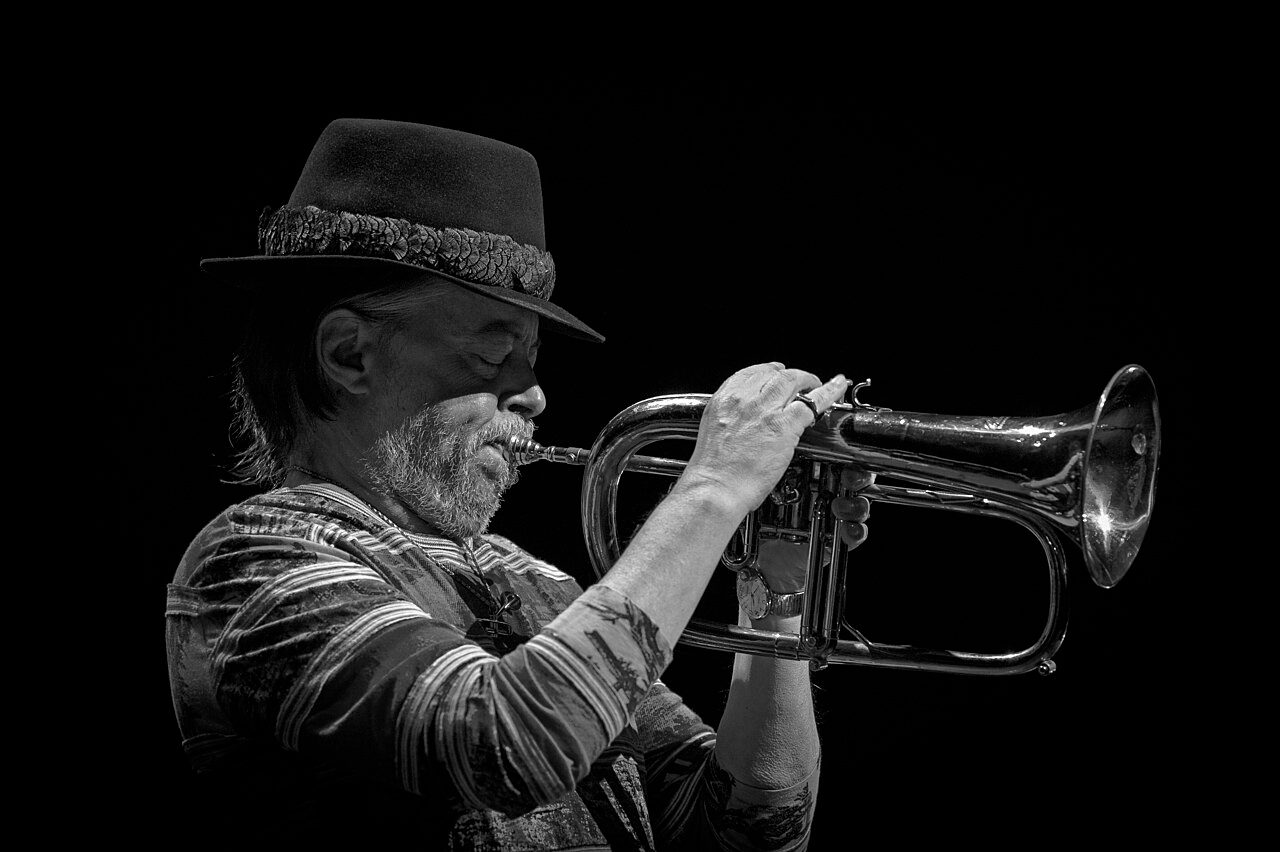
5 min read · 2 sourcesThe flugelhorn (, also fluegelhorn, flugel horn; from German, Flügelhorn) is a high brass instrument similar to the trumpet and cornet, but with the wider conical bore of a bugle, producing a darker, mellower sound or timbre. Like trumpets and cornets, most flugelhorns are built in B♭, though some are in C. Developed in Germany in the late 18th century from earlier traditional signal instruments, bugles were fitted with tone holes to produce keyed bugles around 1800. The keyed bugle was soon replaced by valved bugles after the invention of valves in the 1820s. Modern flugelhorns usually have piston valves, though flugelhorns with rotary valves are common in central and eastern Europe. Initially adopted by military and brass bands in Europe, the flugelhorn began to be used as a solo jazz instrument in the mid 20th century by musicians including Miles Davis, Shorty Rogers, Clark Terry, and Chuck Mangione. It has established a place in band, jazz, and popular music, and is commonly played by trumpet players as a doubling instrument. 1
History
The German word Flügel means wing or flank in English. In early 18th century Germany, a ducal hunt leader known as a Flügelmeister used a Flügelhorn to direct his wing of the hunting party. It was originally a form of signal horn called a Halbmond (lit. 'half-moon'), a large, semicircular brass or silver valveless horn with a conical bore. Military use dates from the Seven Years' War, during which the instrument was employed as a predecessor of the bugle. By the end of the 18th century, attempts were made to extend the bugle's limited natural series of six to eight notes to a full chromatic scale using tone holes and keys, resulting in the first keyed bugles appearing in Dublin and London around 1800. The keyed bugle was adopted by British and European military and brass bands, and helped to popularize the melodic and virtuosic playing of brass instruments to new and wide cross-sections of the general public. The first bugles with valves were sold in Berlin in 1828 by Heinrich Stölzel, inventor of the first piston valves. Based on the keyed bugle, the valved bugle retained the bell construction of red brass or copper with brass or nickel silver keys and fittings. The valved bugle was called the Flügelhorn in Bavaria and replaced the keyed bugle as the primary soprano melody instrument in Bavarian bands and ensembles, and has remained in that role since. The valved bugles also provided the Paris-based instrument maker Adolphe Sax, creator of the saxophone, with the inspiration for his saxhorn family of instruments, including the B♭ soprano size which served as the model for the modern piston-valve flugelhorn. A variant of the rotary valve flugelhorn is the oval-shaped kuhlohorn in B♭ developed in the late 1890s by Johannes Kuhlo. 1
Construction
The modern flugelhorn is usually pitched in 4½-foot (4½′) B♭, like most trumpets and cornets, with three piston valves. It is also sometimes built in 4′ C. Instruments made with rotary valves are used in central and eastern Europe, and feature a "shepherd crook" shape in the first tubing bend, retained from the earliest Prussian cornets and valved bugles. The internal profile of a flugelhorn mouthpiece is more deeply funnel-shaped than trumpet and cornet mouthpieces, which are shaped more like a cup, but less conical than a horn mouthpiece. 1
The flugelhorn is mainly distinguished from both the cornet and trumpet by its wider conical bore, which undergoes conical expansion for a longer proportion of its tubing. The flugelhorn's cylindrical valves are mounted directly onto the leadpipe a short distance from the mouthpiece receiver, leaving a much longer proportion of its length after the valves to gradually expand into the bell flare. On the trumpet and cornet, the leadpipe is much longer, and the valves are mounted after the first bow, resulting in a higher proportion of cylindrical bore tubing. 1
Variants
Some flugelhorns are built with a fourth valve that lowers the pitch by a perfect fourth, like the fourth valve often found on euphoniums, tubas, and piccolo trumpets. This adds a useful low range that, coupled with the flugelhorn's darker sound, extends the instrument's capabilities. At least one manufacturer makes a four-valve flugelhorn where the fourth valve is instead tuned to a quarter tone, enabling the playing of microtonality and other extended techniques. The flumpet, designed by the trumpet builder David Monette in 1989 for the jazz musician Art Farmer, combines the sound qualities of the flugelhorn with the construction of the trumpet. A bass flugelhorn in 8′ C, called a fiscorn, is used in pairs in the cobla bands of Catalonia that provide music for sardana dancers. 1
Performance
The valves give the flugelhorn the same facility and agility as the cornet or trumpet. It employs the same fingering, and its similarity in size means it can be played by trumpet and cornet players, with some adjustment to breath and embouchure. Its upper range can be more difficult to articulate clearly and with correct intonation compared to the trumpet, due to the wider bore and more free-flowing mouthpiece. On brass instruments with wide conical bores such as the flugelhorn, notes above the bell cutoff frequency around the tenth harmonic become more difficult to center and continuous glissandi are possible, making valve fingering largely redundant. 1
Timbre
The timbre of the flugelhorn is softer than the trumpet or cornet. Its wide conical bore dampens the higher frequency partials in the sound to produce a mellow, more rounded tone quality compared to instruments with a cylindrical bore at the same pitch. The sound of the flugelhorn has been described as halfway between a trumpet and a horn, whereas the cornet's sound is halfway between a trumpet and a flugelhorn. 1
The text above is adapted from the Wikipedia article “Flugelhorn”, available under the Creative Commons Attribution-ShareAlike 4.0 licence. 1
flugelhorn is brass musical instrument, according to the structured record cited below. This entry was generated automatically from that record and has not yet been reviewed by a person familiar with the tradition. 2
The source record links this tradition to 27 external registers, which can be verified through the citation. 2