The tradition & historical record
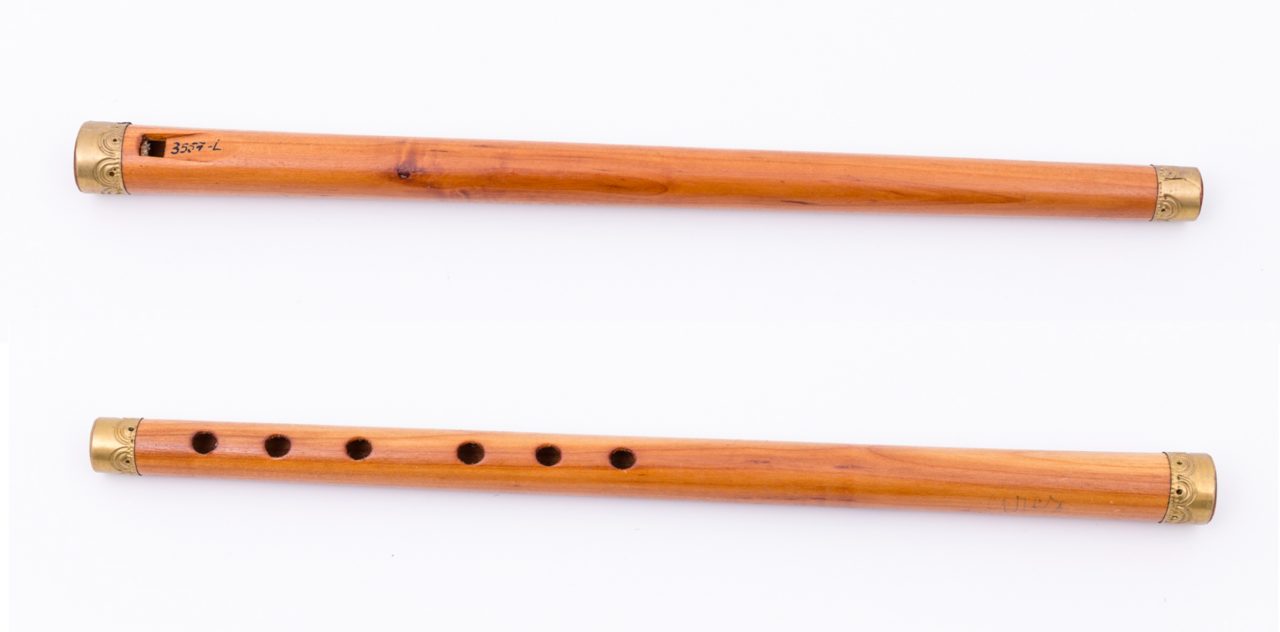
6 min read · 2 sourcesThe fluier (Romanian: fluier; [ˈflu.jer]) is a traditional Romanian wind instrument, a type of shepherd's flute, common throughout the entire Romanian cultural area. It is an instrument with ancient Romanian roots, used predominantly in solo performance. In traditional culture, the fluier is primarily associated with the image of the solitary shepherd, for whom it serves as a means of self-expression and an accompaniment to daily life. The instrument's name is presumed to originate from the Latin: flare – "to blow". The fluier family includes instruments of various designs: single and double, end-blown, transverse and semi-transverse, open or equipped with a fipple, with a varying number of finger-holes or none at all. By length, they are distinguished as small, medium, and large. They are most often made of wood, with bone or metal fluiers being less common. The playing technique is characterized by high virtuosity and a wealth of expressive devices. In traditional practice, an archaic method of sound production with a guttural background (Romanian: ison gâjâit, ison gutural, gemut) is widely used. In this technique, a steady low resonance sounds along with the main melody, giving the performance a characteristic acoustic depth. The fluier played an important role in shepherd culture, performing not only musical but also ritual, signaling, and communicative functions. 1
Origin and early evidence
The fluier is a wind instrument specific to the Romanian cultural area, which encompasses the historical and modern territories inhabited by Romanians. A combination of archaeological, historical, linguistic, and organological data testifies to its deep roots in the region. The oldest archaeological finds confirm the existence of flutes in this territory since prehistoric times: a bone flute from the Upper Paleolithic era was discovered at the Molodova V Paleolithic site (Chernivtsi Oblast, Ukraine). Later, ancient authors such as Xenophon and Strabo mentioned the use of flutes by the Thracian tribes who inhabited these lands. The Romanian linguistic heritage itself serves as important indirect evidence of the instrument's long history. The rich and diverse terminology used for the instrument – which includes numerous words derived from the root fluier alongside a multitude of other regional names, as well as the great variety of fluier designs, each historically established in specific regions, point to a long and continuous process of the instrument's evolution within the Carpatho-Danubian space. 1
Spread in the Middle Ages
The migration of the Vlachs (ancestors of the Romanians) in the 13th–14th centuries, associated with the development of mountain pastoralism, had a significant influence on the culture of the Carpathian region. Medieval chronicles attest to the widespread establishment of shepherd settlements organized under "Vlach law" (Latin: jus valachicum) among the Slavic peoples of Central Europe – in Galicia, Slovakia, the Polish Podhale, and Moravian Wallachia. The name of the flute, fluier, spread alongside these pastoral practices and their associated terminology. Over time, it was adapted by neighboring peoples, which is reflected in the names of related shepherd's wind instruments: the Hungarian furulya, the Slovak fujara, the Polish fujarka, as well as the Ukrainian frilka and floyara. 1
The fluier at the hospodars' courts (16th–18th centuries)
Beginning in the 16th century, written sources confirm that the fluier was used not only in folk settings but also in the musical life at the courts of the hospodars (rulers) of the Romanian principalities. One of the earliest accounts belongs to the Saxon theologian and poet Johannes Sommer, who wrote in 1562–1563 that in the Principality of Moldavia, "the youth glorify the hospodar with the playing of the fluier". 1
By the 17th century, the fluier had gained a prominent place in court chamber ensembles. At the courts of hospodars Matei Basarab (1634–1654) and Vasile Lupu (1634–1653), its sound was an integral part of musical life. The traveler Paul of Aleppo, who visited Wallachia in 1653–1568, testified that at the hospodars' feasts, pieces performed with the "piercing voice of the fluiers" were invariably played. Fluier players (fluierași) were also part of court ensembles that performed colinde (carols) at Christmas and Epiphany. Even as a courtly instrument, the fluier continued to be associated with its pastoral origins. The Moldavian hospodar and scholar Dimitrie Cantemir, in his allegorical novel Hieroglyphic History (1704), mentions the fluier several times, characterizing it specifically as a shepherd's instrument. This association with the pastoral environment persisted until the end of the 18th century: around 1776, the Polish envoy Karol Boscamp-Lasopolski noted that at a reception in Iași, Moldavian pieces were performed to the accompaniment of the shepherd's fluier – "an instrument very fashionable in this country." Gradually, towards the end of the century, the traditional repertoire at the courts began to be replaced by music of Ottoman, and later, Western European origin. 1
Research
Systematic descriptions of Romanian folk instruments, including the fluier family, began to appear in the late 19th century. One of the first researchers was the archaeologist and folklorist Teodor Burada. In the early 20th century, the musicologist and music historian Mihail Poslușnicu wrote a historical overview of the fluier and other Romanian folk instruments in his book The History of Romanian Music. From the Renaissance to the Era of Artistic Culture Consolidation (1928). The study of the fluier tradition was carried out by the Hungarian composer and folklorist Béla Bartók, as well as leading 20th-century Romanian ethnomusicologists – Constantin Brăiloiu, Tiberiu Alexandru, Ovidiu Papană, and others. Synthesizing works on the organology and genre structure of the fluier tradition also appeared, including: Tiberiu Alexandru's monographs The Musical Instruments of the Romanian People (1956) and Romanian Folk Music (1975); Vasile Chiseliță's study Instrumental Music of Northern Bukovina. The Fluier Repertoire (2002); the collective monograph by Moldovan musicologists The Musical Art of Moldova. History and Modernity (2009); and the second volume of Ovidiu Papană's five-volume edition Romanian Folk Instruments. Musical-Acoustic Studies (2019). Based on field recordings made by Constantin Brăiloiu and his colleagues in the 1930s and early 1940s, as well as later materials collected by the staff of the Institute of Ethnography and Folklore, a series of vinyl records and compact discs were released. These include authentic fluier music from both the pre-war period (recordings from the 1930s) and the post-war period (up to the 1960s). Among them are: 1
Antologia muzicii populare româneşti (1960–1962) – a two-volume edition of folk melodies (six LPs, Electrecord label). 1
Varieties
The fluier family includes at least 17 structural varieties. 1
The text above is adapted from the Wikipedia article “Fluier”, available under the Creative Commons Attribution-ShareAlike 4.0 licence. 1
fluier is Romanian flute, according to the structured record cited below. This entry was generated automatically from that record and has not yet been reviewed by a person familiar with the tradition. 2
The source record links this tradition to 4 external registers, which can be verified through the citation. 2