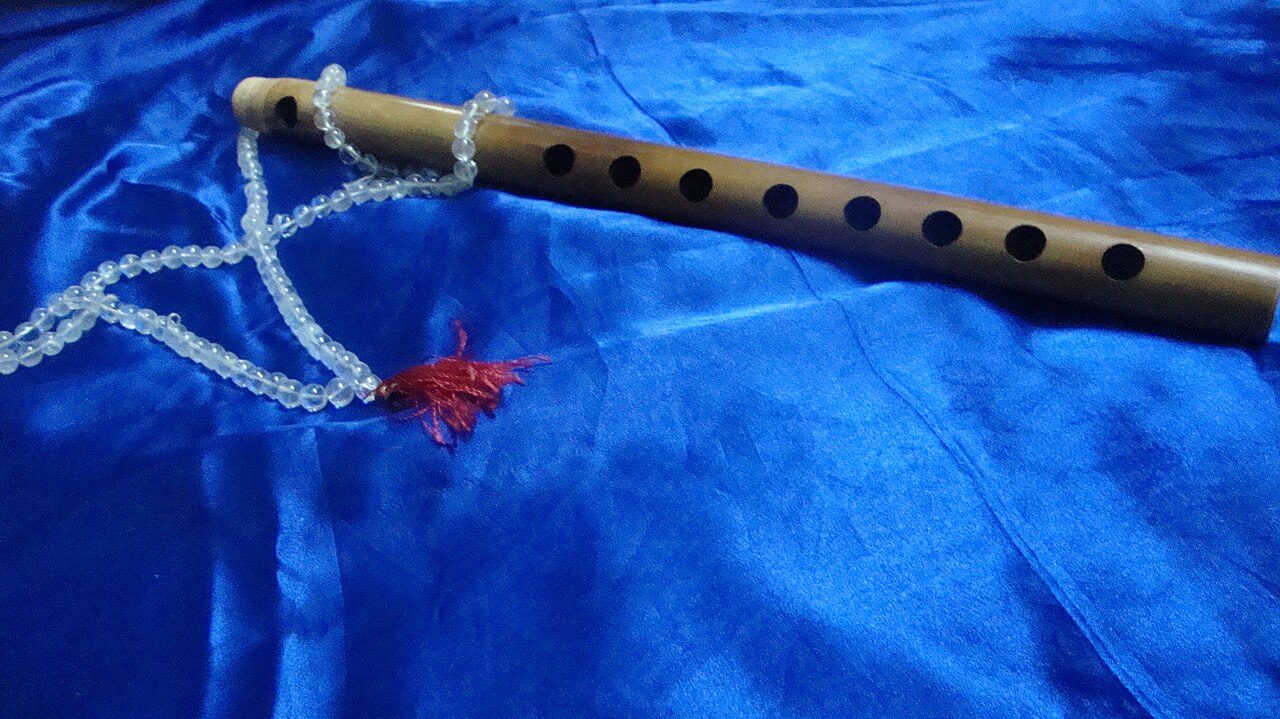
The tradition & historical record
7 min read · 2 sourcesThe flute is a member of a family of musical instruments in the woodwind group. Like all woodwinds, flutes are aerophones, producing sound with a vibrating column of air. Flutes produce sound when the player's air flows across an opening. In the Hornbostel–Sachs classification system, flutes are edge-blown aerophones. A musician who plays the flute is called a flautist or flutist. Paleolithic flutes with hand-bored holes are the earliest known identifiable musical instruments. A number of flutes dating to about 53,000 to 45,000 years ago have been found in the Swabian Jura region of present-day Germany, indicating a developed musical tradition from the earliest period of modern human presence in Europe. While the oldest flutes currently known were found in Europe, Asia also has a long history with the instrument. A playable bone flute discovered in China is dated to about 9,000 years ago. The Americas also had an ancient flute culture, with instruments found in Caral, Peru, dating back 5,000 years and in Labrador dating back about 7,500 years. The bamboo flute has a long history, especially in China and India. Flutes have been discovered in historical records and artworks starting in the Zhou dynasty (c.1046–256 BC). The oldest written sources reveal the Chinese were using the kuan (a reed instrument) and xīao (an end-blown flute, often of bamboo) in the 12th–11th centuries BC, followed by the chi (or ch'ih) in the 9th century BC and the yüeh in the 8th century BC. 1
Etymology and terminology
The word flute first appeared in the English language during the Middle English period, as floute, flowte, or flo(y)te, possibly from Old French flaute and Old Provençal flaüt, or possibly from Old French fleüte, flaüte, flahute via Middle High German floite or Dutch fluit. The English verb flout has the same linguistic root, and the modern Dutch verb fluiten still shares the two meanings. Attempts to trace the word back to the Latin flare (to blow, inflate) have been called "phonologically impossible" or "inadmissable". The first known use of the word flute was in the 14th century. According to the Oxford English Dictionary, this was in Geoffrey Chaucer's The Hous of Fame, c. 1380. A musician who plays any instrument in the flute family can be called a flutist, flautist, or flute player. Flutist dates back to at least 1603, the earliest quotation cited by the Oxford English Dictionary. Flautist was used in 1860 by Nathaniel Hawthorne in The Marble Faun, after being adopted during the 18th century from Italy (flautista, itself from flauto), like many musical terms in England since the Italian Renaissance. Other English terms, now virtually obsolete, are fluter (15th–19th centuries) and flutenist (17th and 18th centuries). 1
History
A fragment of a juvenile cave bear's femur, with two to four holes, was found at Divje Babe in Slovenia and dated to about 43,000 years ago. It may be the oldest flute discovered, but this has been disputed. In 2008, a flute dated to at least 35,000 years ago was discovered in Hohle Fels cave near Ulm, Germany. It is a five-holed flute with a V-shaped mouthpiece and was made from a vulture wing bone. The discovery was published in the journal Nature, in August 2009. This was the oldest confirmed musical instrument ever found, until a redating of flutes found in Geißenklösterle cave revealed them to be older, at 42,000 to 43,000 years. The Hohle Fels flute is one of several found in the Hohle Fels cavern next to the Venus of Hohle Fels and a short distance from the oldest known human carving. On announcing the discovery, scientists suggested that the "finds demonstrate the presence of a well-established musical tradition at the time when modern humans colonized Europe". Scientists have also suggested that this flute's discovery may help to explain "the probable behavioural and cognitive gulf between" Neanderthals and early modern human. 1
An 18.7 cm flute with three holes, made from a mammoth tusk and dated to 30,000–37,000 years ago, was found in 2004 in the Geißenklösterle cave near Ulm, in the southern German Swabian Alb. Two flutes made from swan bones were excavated a decade earlier from the same cave and dated to about 36,000 years ago. A playable 9,000-year-old Chinese Gudi (literally, "bone flute") was excavated from a tomb in Jiahu along with 29 similar specimens. 1
Acoustics
A flute produces sound when a stream of air directed across a hole in the instrument creates a vibration of air at the hole. The airstream creates a Bernoulli or siphon. This excites the air contained in the resonant cavity (usually cylindrical) within the flute. The flutist changes the pitch of the sound produced by opening and closing holes in the body of the instrument, thus changing the effective length of the resonator and its corresponding resonant frequency. By varying the air pressure, a flutist can also change the pitch by causing the air in the flute to resonate at a harmonic rather than the fundamental frequency without opening or closing any of the holes. Head joint geometry appears particularly critical to acoustic performance and tone, but there is no clear consensus among manufacturers on a particular shape. Acoustic impedance of the embouchure hole appears the most critical parameter. Critical variables affecting this acoustic impedance include: the length of the chimney (the hole between the lip-plate and the head tube), chimney diameter, and radii or curvature of the ends of the chimney and any designed restriction in the "throat" of the instrument, such as that in the Japanese Nohkan flute. A study in which professional flutists were blindfolded could find no significant differences between flutes made from a variety of metals. In two different sets of blind listening, no flute was correctly identified in a first listening, and in a second, only the silver flute was identified. The study concluded that there was "no evidence that the wall material has any appreciable effect on the sound color or dynamic range". 1
Materials
Historically, flutes were most commonly made of reed, bamboo, wood, or other organic materials. They were also made of glass, bone, and nephrite. Most modern flutes are made of metal, primarily silver and nickel. Silver is less common than silver alloys. Other materials used for flutes include gold, platinum, grenadilla and copper. 1
Types
In its most basic form, a flute is an open tube which is blown into. After focused study and training, players use controlled air-direction to create an airstream in which the air is aimed downward into the tone hole of the flute's headjoint. There are several broad classes of flutes. With most flutes, the musician blows directly across the edge of the mouthpiece, with 1/4 of their bottom lip covering the embouchure hole. However, some flutes, such as the whistle, gemshorn, flageolet, recorder, tin whistle, tonette, fujara, and ocarina have a duct that directs the air onto the edge (an arrangement that is termed a "fipple"). These are known as fipple flutes. 1
The text above is adapted from the Wikipedia article “Flute”, available under the Creative Commons Attribution-ShareAlike 4.0 licence. 1
flute is musical instrument of the woodwind family, according to the structured record cited below. This entry was generated automatically from that record and has not yet been reviewed by a person familiar with the tradition. 2
The source record links this tradition to 67 external registers, which can be verified through the citation. 2