The tradition & historical record
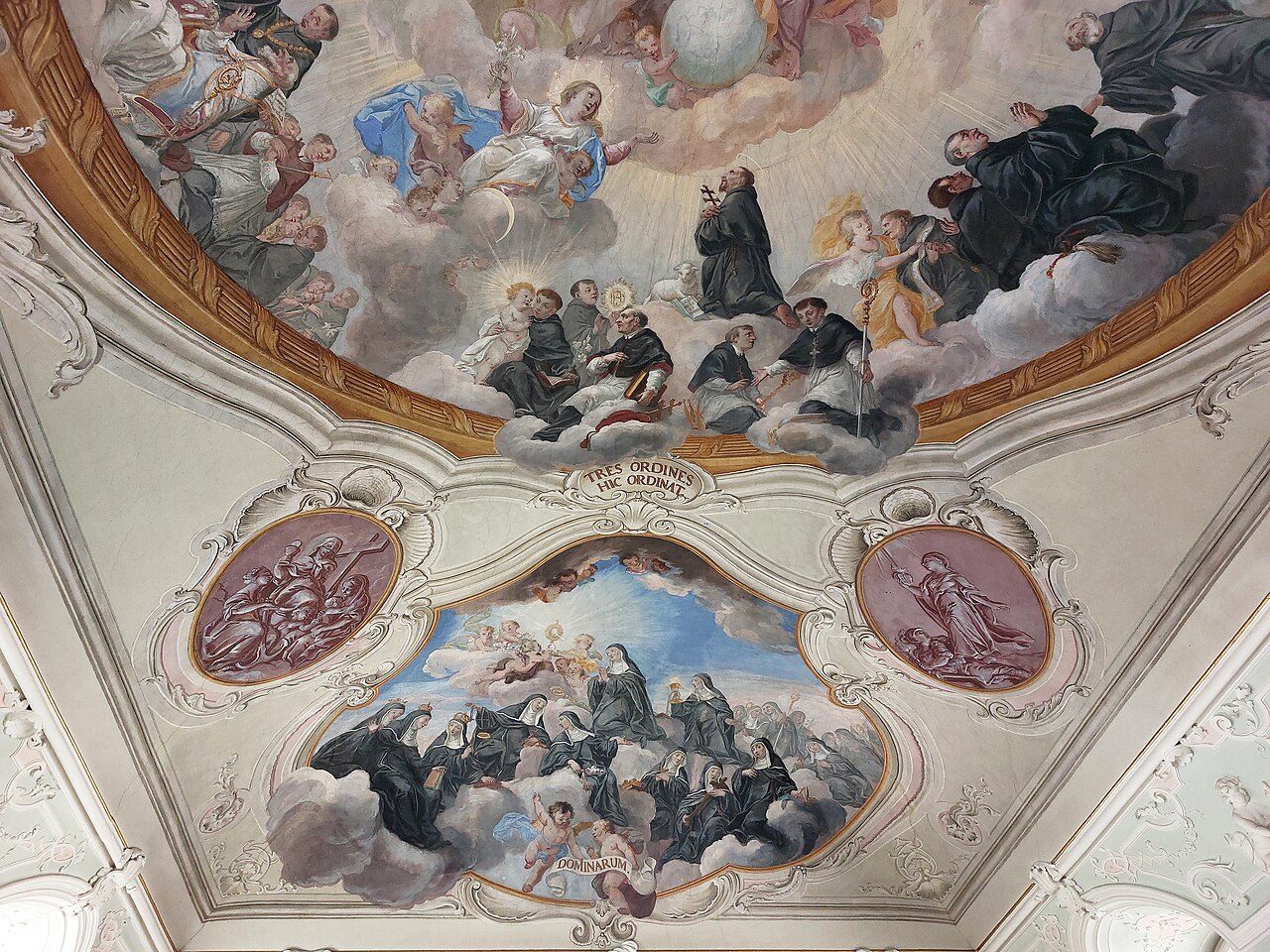
6 min read · 2 sourcesFresco (pl. frescos or frescoes) is a technique of mural painting executed upon freshly laid ("wet") lime plaster. Water is used as the vehicle for the dry-powder pigment to merge with the plaster, and with the setting of the plaster, the painting becomes an integral part of the wall. The word fresco (Italian: affresco) is derived from the Italian adjective fresco meaning "fresh", and may thus be contrasted with fresco-secco or secco mural painting techniques, which are applied to dried plaster, to supplement painting in fresco. The fresco technique has been employed since antiquity and is closely associated with Italian Renaissance painting. The word fresco is commonly and inaccurately used in English to refer to any wall painting regardless of the plaster technology or binding medium. This, in part, contributes to a misconception that the most geographically and temporally common wall painting technology was the painting into wet lime plaster. Even in apparently buon fresco technology, the use of supplementary organic materials was widespread, if under-recognized. 1
Technology
Buon fresco pigment is mixed with room temperature water and is used on a thin layer of wet, fresh plaster, called the intonaco (after the Italian word for plaster). Because of the chemical makeup of the plaster, a binder is not required, as the pigment mixed solely with the water will sink into the intonaco, which itself becomes the medium holding the pigment. The pigment is absorbed by the wet plaster; after a number of hours, the plaster dries in reaction to air: it is this chemical reaction which fixes the pigment particles in the plaster. The chemical processes are as follows: 1
calcination of limestone in a lime kiln: CaCO3 → CaO + CO2 slaking of quicklime: CaO + H2O → Ca(OH)2 setting of the lime plaster: Ca(OH)2 + CO2 → CaCO3 + H2O 1
In painting buon fresco, a rough underlayer called the arriccio is added to the whole area to be painted and allowed to dry for some days. Many artists sketched their compositions on this underlayer, which would never be seen, in a red pigment called sinopia, a name also used to refer to these under-paintings. Later, new techniques for transferring paper drawings to the wall were developed. The main lines of a drawing made on paper were pricked over with a point, the paper held against the wall, and a bag of soot (spolvero) banged on them to produce black dots along the lines. If the painting was to be done over an existing fresco, the surface would be roughened to provide better adhesion. On the day of painting, the intonaco, a thinner, smooth layer of fine plaster was added to the amount of wall that was expected to be completed that day, sometimes matching the contours of the figures or the landscape, but more often just starting from the top of the composition. 1
Other types of wall painting
A secco or fresco-secco painting is done on dry plaster (secco meaning "dry" in Italian). The pigments thus require a binding medium, such as egg (tempera), glue or oil to attach the pigment to the wall. It is important to distinguish between a secco work done on top of buon fresco, which according to most authorities was in fact standard from the Middle Ages onwards, and work done entirely a secco on a blank wall. Generally, buon fresco works are more durable than any a secco work added on top of them, because a secco work lasts better with a roughened plaster surface, whilst true fresco should have a smooth one. The additional a secco work would be done to make changes, and sometimes to add small details, but also because not all colours can be achieved in true fresco, because only some pigments work chemically in the very alkaline environment of fresh lime-based plaster. Blue was a particular problem, and skies and blue robes were often added a secco, because neither azurite blue nor lapis lazuli, the only two blue pigments then available, works well in wet fresco. It has also become increasingly clear, thanks to modern analytical techniques, that even in the early Italian Renaissance painters quite frequently employed a secco techniques so as to allow the use of a broader range of pigments. In most early examples this work has now entirely vanished, but a whole painting done a secco on a surface roughened to give a key for the paint may survive very well, although damp is more threatening to it than to buon fresco. A third type called a mezzo-fresco is painted on nearly dry intonaco—firm enough not to take a thumb-print, says the sixteenth-century author Ignazio Pozzo—so that the pigment only penetrates slightly into the plaster. 1
Egypt and ancient Near East
The first known Egyptian fresco was found in Tomb 100 at Hierakonpolis, and dated to c. 3500–3200 BC. Several of the themes and designs visible in the fresco are otherwise known from other Naqada II objects, such as the Gebel el-Arak Knife. It shows the scene of a "Master of Animals", a man fighting against two lions, individual fighting scenes, and Egyptian and foreign boats. Ancient Egyptians painted many tombs and houses, but those wall paintings are not frescoes. An old fresco from Mesopotamia is the Investiture of Zimri-Lim (modern Syria), dating from the early 18th century BC. 1
Aegean civilizations
The oldest frescoes done in the buon fresco method date from the first half of the second millennium BCE during the Bronze Age and are to be found among Aegean civilizations, more precisely Minoan art from the island of Crete and other islands of the Aegean Sea. The most famous of these, the Bull-Leaping Fresco, depicts a sacred ceremony in which individuals jump over the backs of large bulls. The oldest surviving Minoan frescoes are found on the island of Santorini (classically known as Thera), dated to the Neo-Palatial period (c. 1640–1600 BC). While some similar frescoes have been found in other locations around the Mediterranean basin, particularly in Egypt and Morocco, their origins are subject to speculation. Some art historians believe that fresco artists from Crete may have been sent to various locations as part of a trade exchange, a possibility which raises to the fore the importance of this art form within the society of the times. The most common form of fresco was Egyptian wall paintings in tombs, usually using the a secco technique. 1
Classical antiquity
Frescoes were also painted in ancient Greece, but few of these works have survived. In southern Italy, at Paestum, which was a Greek colony of the Magna Graecia, a tomb containing frescoes dating back to 470 BC, the so-called Tomb of the Diver, was discovered in June 1968. These frescoes depict scenes of the life and society of ancient Greece, and constitute valuable historical testimonials. One shows a group of men reclining at a symposium, while another shows a young man diving into the sea. 1
The text above is adapted from the Wikipedia article “Fresco”, available under the Creative Commons Attribution-ShareAlike 4.0 licence. 1
fresco painting is technique of mural painting executed upon freshly laid lime plaster, according to the structured record cited below. This entry was generated automatically from that record and has not yet been reviewed by a person familiar with the tradition. 2
The source record links this tradition to 35 external registers, which can be verified through the citation. 2