The tradition & historical record
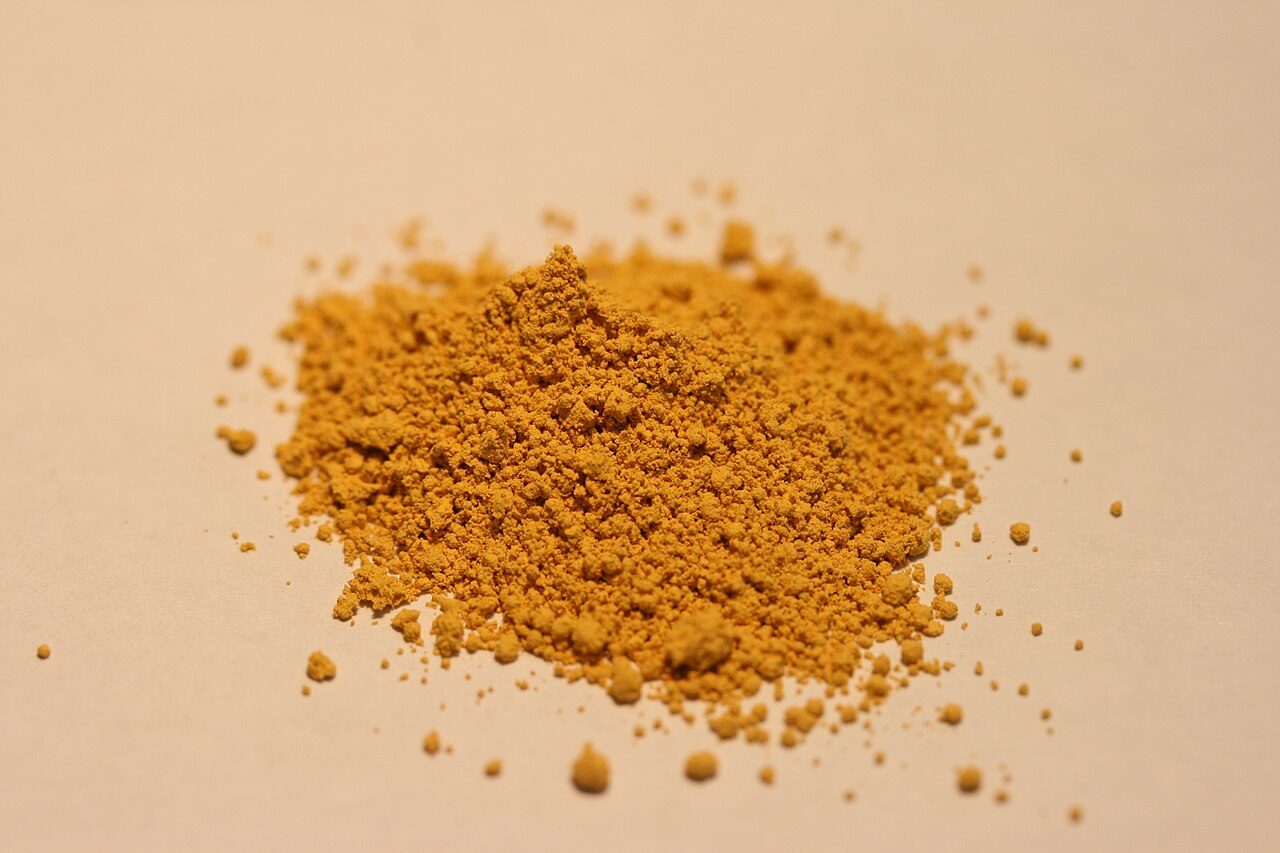
4 min read · 2 sourcesGolden ochre, less often Gold Ochre (French: Ocre d’or, German: Gold Ocker, Ancient Greek: ὠχρός yellow-pale, orange or french ochre (obsolete)) — one of the most famous and brightly colored varieties of ochre — is a natural or (rarely) artificial pigment. In terms of mineral composition, golden ochre is clay with an admixture of aluminosilicates and a high content of the yellow dye itself, iron hydroxide, most often in the form of brown iron ore or limonite. The exact composition of ochre and its impurities vary greatly depending on the place of origin. Golden ochre is one of the oldest paints, known as a painting material since the times of cave paintings. In wall painting it is one of the main yellow pigments. Golden ochre has good density, the same covering power, high light fastness, pure color and soft structure. To this day it is used in all painting techniques without exception. 1
Description and properties
The golden ochre pigment is a natural mixture that consists primarily of crystalline iron oxide hydrate with some clay. The closest to golden ochre among related minerals is light ochre, which has a less warm and rich color. If in light ochre the content of the main dye, iron oxide hydrate, is quite low and ranges from 12 to 25%, then in golden ochre its amount can reach 70-75%. As a result, light ochre has a yellow color of a cooler tone and weaker color saturation and is considered a paint that is not bright and not intense. Golden ochre differs from it in its earthy tint and warmer tone. 1
Yellow ochres are more common in nature than others due to the abundance of their constituent minerals. When heated, orange and yellow ochre release water and gradually darken, acquiring an increasingly reddish tint. This occurs due to the transformation of iron hydroxide into a dark red anhydrous oxide (iron ochre). With controlled calcination of yellow ochre, almost the entire range of shades can be obtained from yellow and orange to red or brown. Among other varieties of ochres, it was golden ochre that was valued above others; it was classified as the highest category of pigments in this category. In the 18th-19th centuries, golden ochre was supplied to the rest of Europe and Russia from the province of Rousillon, as a result of which the second name of this paint for a long time was French ochre. Of the total number of ochres, it is the golden ochre pigment that is closer in purity, brightness and shade all to Attic ochre, the most highly valued yellow paint of Ancient Greece and Rome. Until the mid-20th century, picturesque yellow ochres were traditionally divided into fawn, yellow, saffron yellow, golden and orange. 1
History and use
Golden ochre is best known as a mineral pigment common in nature, primarily for artistic paints. It has been found since ancient times in rock paintings, frescoes of Ancient Egypt, Greece and Rome. This pigment was also constantly used when painting temples and in icon painting. When analyzing the colorful composition of the icons of Theophan the Greek, despite all the restraint of his color scheme, golden ochre was clearly established. Golden ochre is also used in the production and restoration of expensive types of furniture. For example, when oil gilding on levkas (gesso), several layers of golden ochre are first applied in oil, and then, after drying and grinding, they are coated with oil gulfarbene varnish. As a result, the surface for gilding is perfectly matte and retains the color of the foil. Gilding on carvings looks especially impressive if shiny polished areas alternate with matte ones. As an artist's paint, golden ochre has traditionally been a staple in artists palettes, primarily in oil painting, but also in tempera (including watercolor) and more recently, acrylic. It is stable both in pure form and in mixtures. However, when writing with tempera or watercolor, it is necessary to take into account one feature of ochre, dictated by its mineral nature: with a large amount of water-soluble film former, there is a risk of pigment precipitation (both alumina and iron hydroxide), so it is recommended to use ochre in the form of a thick paste. The muted, slightly "earthy" shade of golden ochre makes it possible to achieve a soft and warm color palette of the painting and, in mixtures with brighter paints, to slightly "reduce" their color activity. There is one more feature. 1
The text above is adapted from the Wikipedia article “Golden ochre”, available under the Creative Commons Attribution-ShareAlike 4.0 licence. 1
Golden ochre is one of the most famous and brightly colored varieties of ocher, according to the structured record cited below. This entry was generated automatically from that record and has not yet been reviewed by a person familiar with the tradition. 2