The tradition & historical record
6 min read · 2 sourcesA gong is a percussion instrument originating from Southeast Asia, and used widely in Southeast Asian and East Asian musical traditions. Gongs are made of metal and are circular and flat or bowl-like in shape, and can come in various sizes. They are typically struck with a mallet. They can be played alone, giving a characteristic "crashing" sound, or played as part of a tuned set that produce bell-like sounds. The earliest possible depictions of gongs is from the details on the surface of the Ngọc Lũ I bronze drum (c. 3rd to 2nd century BC) from the Dong Son culture of northern Vietnam. It depicts what looks like seven-gong ensembles along with other instruments (including cymbals/bells and the bronze drums themselves). The oldest undisputed historical mention of gongs can be found in sixth century AD Chinese records, which mentioned it as a foreign instrument that came from a country between Tibet and Burma. The term gong (Javanese: ꦒꦺꦴꦁ) originated in the Indonesian island of Java. Scientific and archaeological research has established that Annam, Java, Burma, and Southern China were the four main gong manufacturing centres of the ancient world. The gong found its way into the Western World in the 18th century, when it was also used in the percussion section of a Western-style symphony orchestra. 1
Types
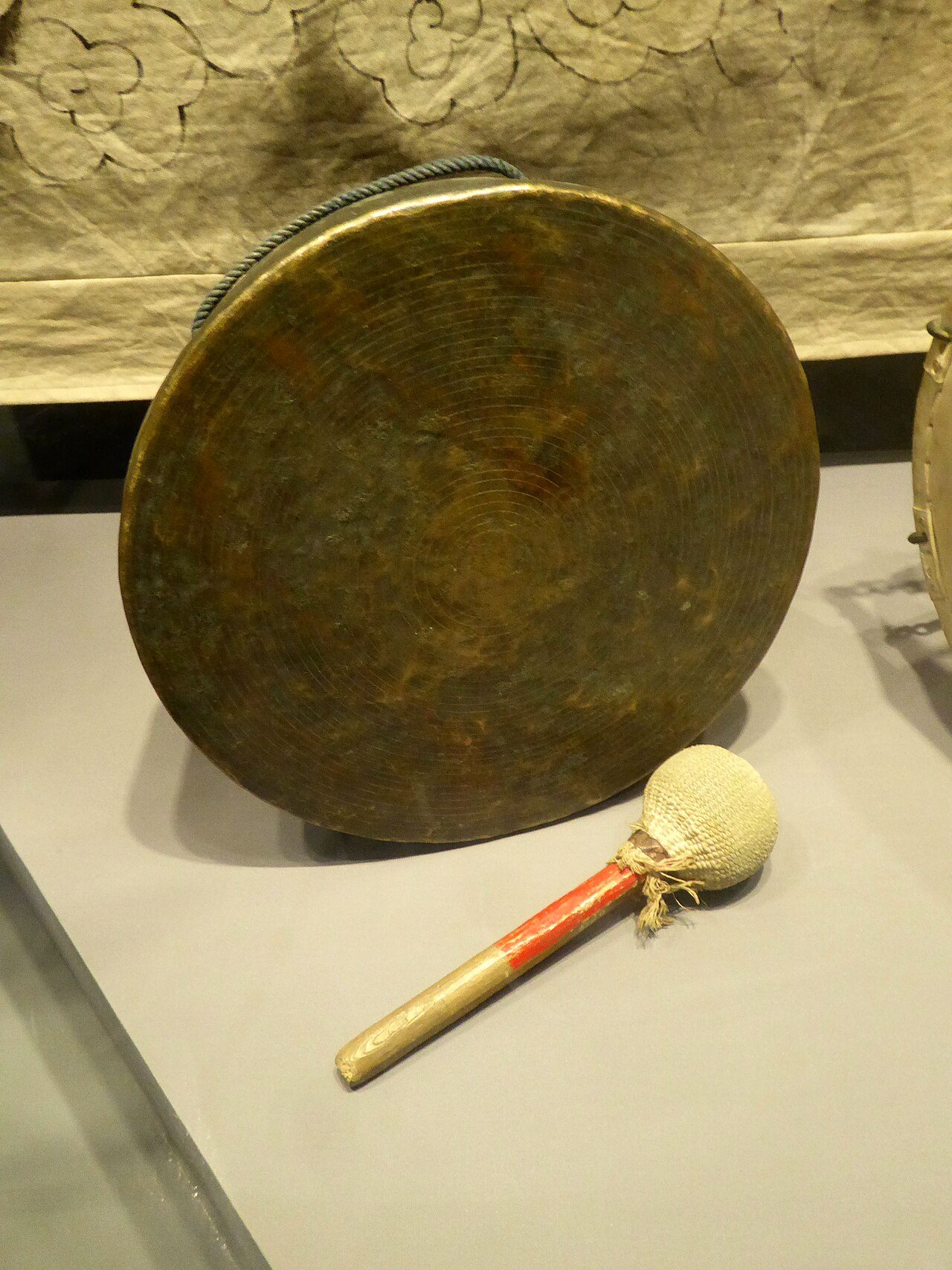
Suspended gongs are played with hammers and are of two main types: flat faced discs, either with or without a turned edge and gongs with a raised centre boss. In general, the larger the gong, the larger and softer the hammer. In Western symphonic music, the flat faced gongs are generally referred to as tam-tams to distinguish them from their bossed counterparts. Here, the term "gong" is reserved for the bossed type only. The gong has been a Chinese instrument for millennia. Its first use may have been to signal peasant workers in from the fields, because some gongs are loud enough to be heard from up to eight kilometres (five miles) away. Large flat gongs may be 'primed' by lightly hitting them before the main stroke, greatly enhancing the sound and causing the instrument to "speak" sooner, with a shorter delay for the sound to "bloom". Keeping this priming stroke inaudible calls for a great deal of skill. The smallest suspended gongs are played with bamboo sticks or even western-style drumsticks. Contemporary and avant-garde music, where different sounds are sought, will often use friction mallets (producing squeals and harmonics), bass bows (producing long tones and high overtones), and various striking implements (wood/plastic/metal) to produce the desired tones. Rock gongs are large stones struck with smaller stones to create a metallic resonating sound. 1
Chau gong (tam-tam)
By far the most familiar to most Westerners is the chau gong or bullseye gong. Large chau gongs, called tam-tams have become part of the symphony orchestra. Sometimes a chau gong is referred to as a Chinese gong, but in fact, it is only one of many types of suspended gongs that are associated with China. A chau gong is made of copper-based alloy, bronze, or brass. It is almost flat except for the rim, which is turned up to make a shallow cylinder. On a 25-centimetre (10 in) gong, for example, the rim extends about 1 cm (1⁄2 in) perpendicular to the surface. The main surface is slightly concave when viewed from the direction to which the rim is turned. The centre spot and rim of a chau gong are left coated on both sides with the black copper oxide that forms during manufacture; the rest is polished to remove this coating. Chau gongs range in size from 20 to 200 cm (7 to 80 in) in diameter. 1
History
The earliest Chau gong is from a tomb discovered at the Guixian site in the Guangxi Zhuang Autonomous Region of China. It dates from the early Western Han dynasty. Gongs are depicted in Chinese visual art as of the 6th century CE, and were known for their very intense and spiritual drumming in rituals and tribal meetings. Traditionally, chau gongs were used to clear the way for important officials and processions, much like a police siren today. Sometimes the number of strokes was used to indicate the seniority of the official. In this way, two officials meeting unexpectedly on the road would know before the meeting which of them should bow down before the other. 1
Use in symphony orchestras
The tam-tam was first introduced as an orchestral instrument by François-Joseph Gossec in 1790, and it was also taken up by Gaspare Spontini and Jean-François Le Sueur. Hector Berlioz deployed the instrument throughout his compositional career, and in his Treatise on Instrumentation he recommended its use "for scenes of mourning or for the dramatic depiction of extreme horror." Other composers who adopted the tam-tam in the opera house included Gioachino Rossini, Vincenzo Bellini, and Richard Wagner: Rossini in the final of act 3 of Armida (1817), Bellini in Norma (1831) and Wagner in Rienzi (1842). Within a few decades the tam-tam became an important member of the percussion section of a modern symphony orchestra. It figures prominently in the symphonies of Peter Ilyich Tchaikovsky, Gustav Mahler, Dmitri Shostakovich and, to a lesser extent, Sergei Rachmaninov and Sergei Prokofiev. Giacomo Puccini used gongs and tam-tams in his operas. Igor Stravinsky greatly expanded the playing techniques of the tam-tam in The Rite of Spring to include short, quickly damped notes, quick crescendos, and a triangle beater scraped across the front of the instrument. Karlheinz Stockhausen used a 60" Paiste tam-tam in his Momente. 1
Dora
A dora is one of the Japanese Percussion instruments and an idiophone. It is made of bronze, brass or iron, and is suspended onto a dora stand. It is widely used in Buddhist memorial services, hayashi performances, kabuki music, and ship departure signals. 1
The text above is adapted from the Wikipedia article “Gong”, available under the Creative Commons Attribution-ShareAlike 4.0 licence. 1
gong is percussion instrument made of metal that produces sound from the vibration of its body, according to the structured record cited below. This entry was generated automatically from that record and has not yet been reviewed by a person familiar with the tradition. 2
The source record links this tradition to 38 external registers, which can be verified through the citation. 2