The tradition & historical record
6 min read · 2 sourcesGoryeo Buddhist paintings and architecture are prominent Korean art forms that are said to have originated in the 13 and 14th centuries. Known for their intricate depiction of Buddhist icons typically in the form of large hanging scrolls, artists made use of vibrant colors and adorned the patterns with gold. As Buddhism flourished as the official religion of the Goryeo Dynasty, various Buddhist artworks were produced under royal patronage and utilized for the purposes of state-sponsored ceremonies and funerary rituals. These paintings reflect not only the beliefs, but the taste and refine of the Goryeo royalty and nobility. Illustrations and decorative architectural styles often reflected the messages of Pure Land Buddhism or Amidism featuring Buddhas and Bodhisattvas; for instance, Avalokiteśvara, amongst others, were worshipped by their devotees to achieve the goal of rebirth in the ‘Pure Land’ or paradise. As one of the consequences of years of war, the majority of the paintings are no longer found in Korea. The tradition of Goryeo paintings was forgotten for a very long time and regained significance in the recent decades when scholars started studying the techniques and attributes that are commonly seen in these artworks. Currently, numerous of these paintings are preserved by Japanese collectors, who attained them either through trade or as a result of the Japanese colonial period from 1910-1945. 1
Theme
At present, 133 Goryeo paintings have been found and preserved worldwide and a large percentage, 110 paintings to be specific, have illustrations of the Sukhāvatī (서방극락정토; Seobang Geungnak Jeongto) which roughly translates to the ‘Western Heaven’. Pure Land Buddhism is a branch of Mahayana Buddhism enjoys immense popularity in East Asian Countries as the most followed tradition. Some of the most renowned painting depicts ‘Amitābha (아미타불; Amitabul) who is believed to be the “Lord of the Western Paradise” either in alone or often accompanied by Bodhisattva Avalokiteśvara and Mahasthamaprapta which are Sanskrit names of Gwanseuum Bosal (관세음보살) and Daeseji Bosal (대세지 보살) respectively. Amitabul was also featured as surrounded by the Eight Great Bodhisattvas. Bodhisattva Ksitigarbha (지장보살; Jijang Bosal) was also worshiped and portrayed in several scroll paintings. These paintings also communicated how one can join them in paradise. 1
Materials
A study of the paintings show that these paintings have been created by trained experts who utilised premium quality paints as well metallic paint including gold and silver. These paintings are characterised by exquisite and minute aspects like facial features, embroidery on the garments and jewellery design amongst other precise details. This group of paintings commonly feature figures wearing delicate garments drawn in a manner that give the illusion of transparency. The durable condition of the surface has been attributed to the use of a thin base-coat of lead which was applied onto the bodies which was followed by the application of exquisite jewels, veils, pendants and medallions along with other materials. Not only do the use of gold details show that these paintings could only be afforded by royal commissions, but the naturalism of the clothing illustration provides evidence for refined techniques which could only be achieved with centralized support for Buddhist art via the king’s personal engagement or aristocratic support entrusting Buddhist art with the protection of the nation, thus ensuring the patronage of ritual artworks. Owing to the quality, cost of expensive art material and that these artworks were commissioned by the royals and nobles of the Goryeo society show that there is a very high probability that the masses may not have seen these paintings. Commoner exposure was likely through large-scale public means such as through temples, sculptures, or national festivals. The quality of the Goryeo paintings made it only affordable to the royal families and the aristocracy. A hierarchy is illustrated in the Transformation Tableau of the Visualization Sutra and Meditation Sutra Bianxiangtu. 1
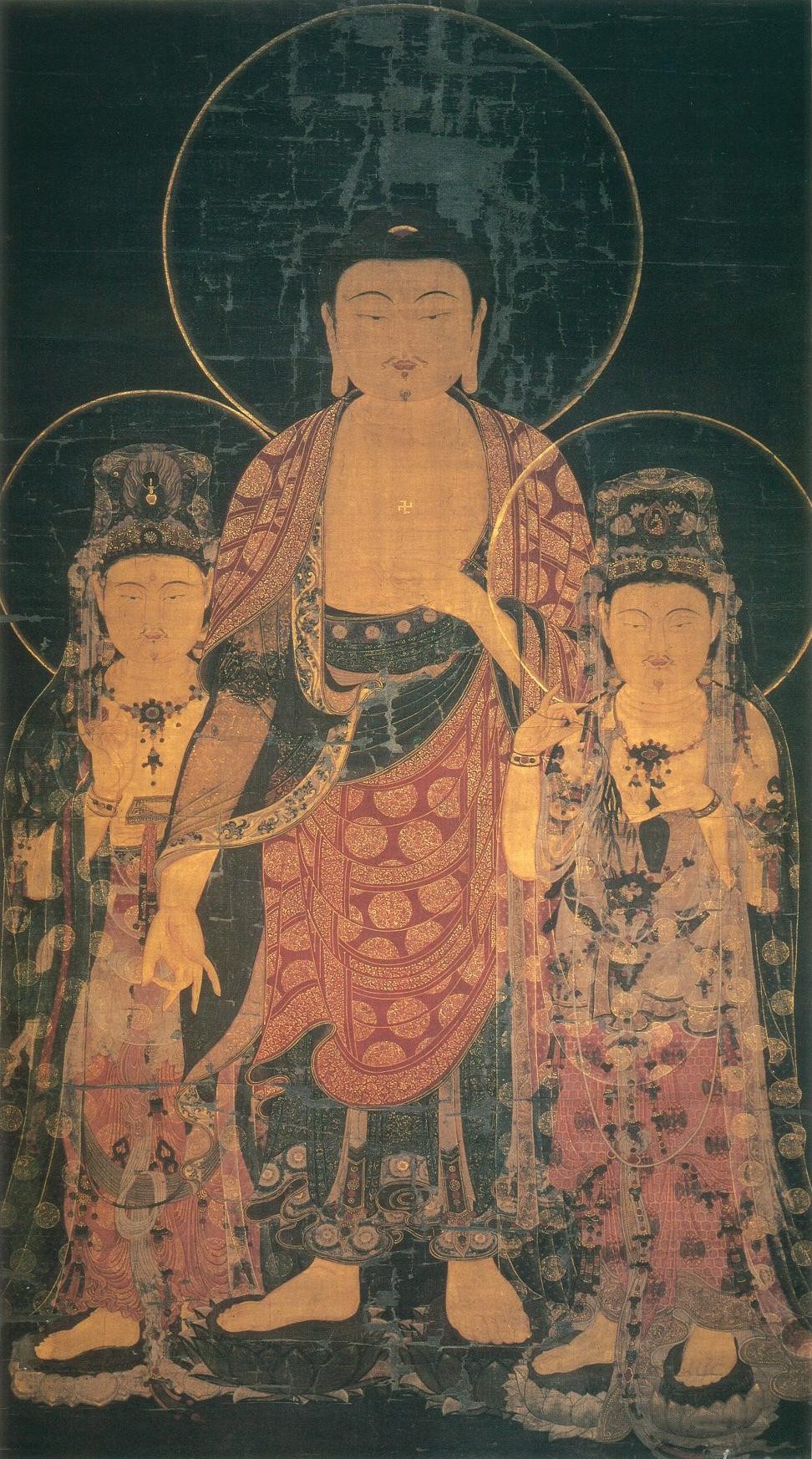
Amitabha (first half of the 14th century)
During the Unified Silla period preceding the Goryeo dynasty, there was a rise in popularity of “Pure Land Buddhism” due to anxiety and unrest over the hierarchical instability and Mongol invasions. Thus, themes of the afterlife, salvation, and enlightenment became a major focus of the art being produced. Pure Land Buddhism taught that rebirth in paradise was accessible to anyone who committed good deeds and believed in Amitabha, compared to previous forms of Buddhism where enlightenment required long periods of study that were not realistically attainable. The main deity, Buddha Amitabha, was commonly depicted in Goryeo art in an “Amitabha triad” along with the bodhisattvas Avalokiteshvara and Ksitigarbha or any other two bodhisattvas. This depiction is also known as a representation of “the Welcoming Descent”. The two works Welcoming Descent of the Amitabha Triad, currently housed in the Cleveland Museum of Art, and The Welcoming Descent of the Amitabha Triad in the Museum of Art in Atami, Japan, are both primary examples of this subgenre. Within these triads, Amitabha Buddha is in the center while flanked by a bodhisattva on either side. In The Welcoming Descent of the Amitabha Triad, all of the deities are standing in a three-quarters stance which is typical of most Goryeo Welcoming Descent art, and this is interpreted as an implied movement toward an imaginary dying believer outside of the frame and viewing the image as part of a deathbed ritual. This type of Welcoming Descent painting is hypothesized to have originated from the Ningbo area of China in the fourteenth century before being imported to Japan. 1
Kshitigarbha (first half of the 14th century)
A compassionate bodhisattva who rescues sentient beings from descending into hell or purgatory, Kshitigarbha became enormously popular during the Goryeo period. A key figure in Pure Land Buddhism, Kshitigarbha was often depicted singly and in the guise of a monk—with a shaved head, or wearing a headscarf. He is clad in a formal robe (samghāti) and is adorned with jewelry, including a necklace and wrist band or bangles, similar to other bodhisattvas. In most Goryeo Buddhist paintings, he is shown holding a cintāmani, a wish-granting crystal ball, and/or a monk’s staff. This exquisite scroll and artwork is a well-preserved example of Goryeo Buddhist painting; some of its hallmarks are the deity’s graceful facial features and slender figures, the red and green colors of the robe, and the sumptuously elegant gold decoration. Kshitigarbha appears in various compositions: as a single figure, as part of a triad, or accompanied by heavenly being and the Ten Kings of Hell. Among these, the most frequent arrangement is of the bodhisattva standing alone (as seen here), as if looking directly at the devotee. 1
Water-Moon Avalokiteśvara, first half of the 14th century
The Water-Moon Avalokiteśvara (Suwol Gwaneum) is an iconographic type that was widely popular during the Goryeo Dynasty. 1
The text above is adapted from the Wikipedia article “Goryeo Buddhist paintings”, available under the Creative Commons Attribution-ShareAlike 4.0 licence. 1
Goryeo Buddhist paintings is Korean art form, according to the structured record cited below. This entry was generated automatically from that record and has not yet been reviewed by a person familiar with the tradition. 2
The source record links this tradition to 1 external register, which can be verified through the citation. 2