The tradition & historical record
7 min read · 2 sourcesThe great Highland bagpipe (Scottish Gaelic: a' phìob mhòr pronounced [ə ˌfiːp ˈvoːɾ] lit. 'the great pipe') is a type of bagpipe native to Scotland, and the Scottish analogue to the great Irish warpipes. It has acquired widespread recognition through its usage in the British military and in pipe bands throughout the world. The bagpipe of any kind is first attested in Scotland around 1400. The earliest references to bagpipes in Scotland are in a military context, and it is in that context that the great Highland bagpipe became established in the British military and achieved the widespread prominence it enjoys today, whereas other bagpipe traditions throughout Europe, ranging from Portugal to Russia, almost universally went into decline by the late 19th and early 20th century. Though widely famous for its role in military and civilian pipe bands, the great Highland bagpipe is also used for a solo virtuosic style called pìobaireachd, ceòl mòr, or simply pibroch. Through development over the centuries, the great Highland bagpipes probably reached something like their distinctive modern form in the 18th century. 1
History
Though popular belief sets varying dates for the introduction of bagpipes to Scotland, concrete evidence is limited until approximately the 15th century. One clan still owns a remnant of a set of bagpipes said to have been carried at the Battle of Bannockburn in 1314, though the veracity of this claim is debated. There are many ancient legends and stories about bagpipes which were passed down through minstrels and oral tradition, whose origins are now lost. However, textual evidence for Scottish bagpipes is more definite in 1396, when records of the Battle of the North Inch of Perth reference "warpipes" being carried into battle. These references may be considered evidence as to the existence of particularly Scottish bagpipes, but evidence of a form peculiar to the Highlands appears in a poem written in 1598 and later published in The Complaynt of Scotland which refers to several types of pipe, including the Highland: "On hieland pipes, Scotte and Hybernicke / Let heir be shraichs of deadlie clarions." In 1746, after the forces loyal to the Hanoverian government had defeated the Jacobites in the Battle of Culloden, King George II attempted to assimilate the Highlands into Great Britain by weakening Gaelic culture and the Scottish clan system, though the oft-repeated claim that the Act of Proscription 1746 banned the Highland bagpipes is not substantiated by the text itself, nor by any record of any prosecutions under this act for playing or owning bagpipes. However, the loss of the clan chief's power and patronage and widespread emigration did contribute to its decline. It was soon realised that Highlanders made excellent troops and a number of regiments were raised from the Highlands over the second half of the eighteenth century. 1
Design
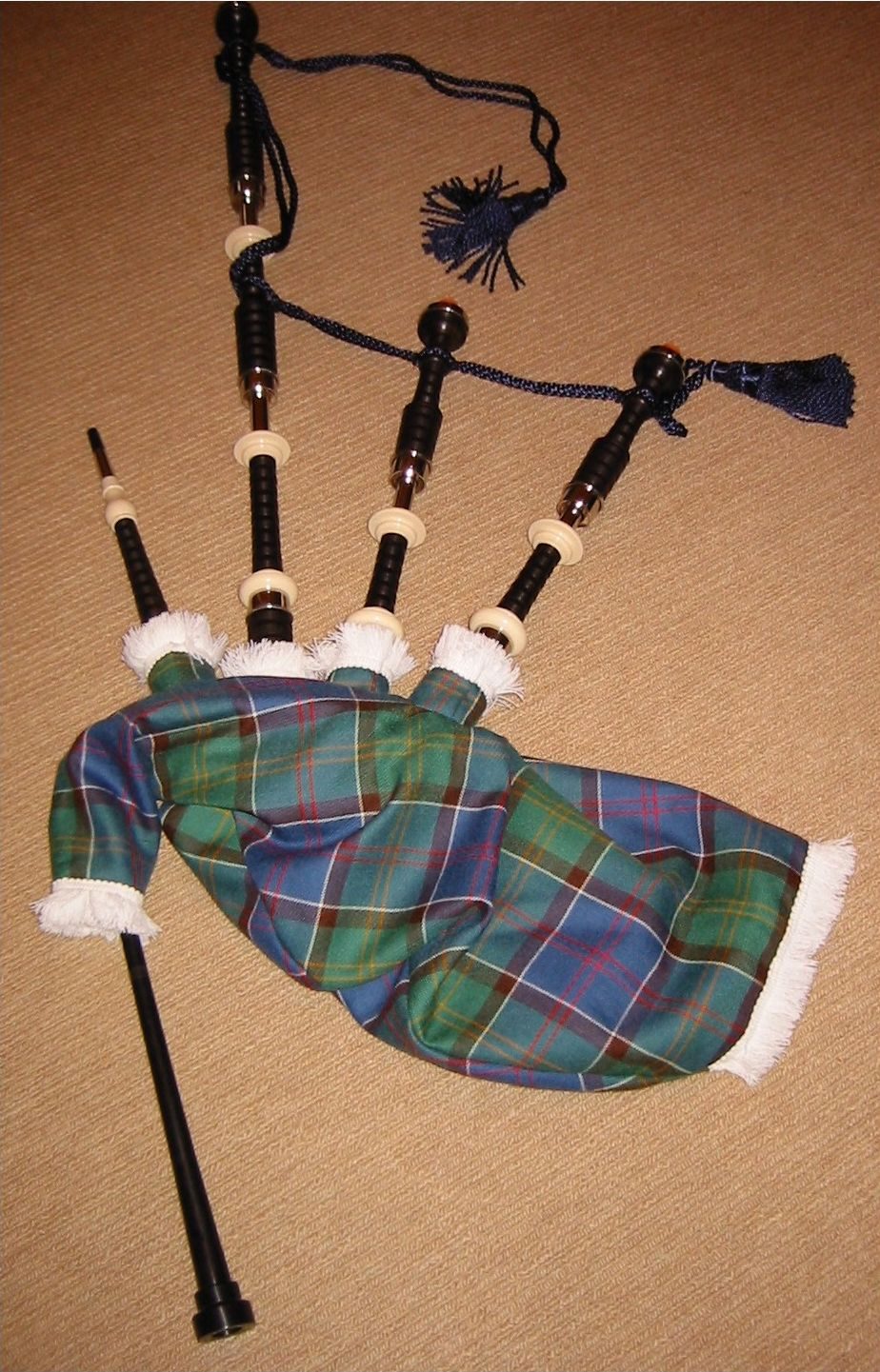
The great Highland bagpipe is classified as a woodwind instrument, like the bassoon, oboe, and clarinet. Although it is further classified as a double-reed instrument, the reeds are all closed inside the wooden "stocks", instead of being played directly by mouth as most other woodwinds are. The great Highland bagpipe actually has four reeds: the chanter reed (double), two tenor drone reeds (single), and one bass drone reed (single). A modern set has a bag, a chanter, a blowpipe, two tenor drones, and one bass drone. The scale of the chanter is approximately in the Mixolydian mode, which has a flattened seventh scale degree, though many older pipes are set to a standard Ionian mode with a half step seventh note to the high A - essentially (on the piano) this is like a C major scale with a B♭ below the middle C. It has a range from one whole tone lower than the tonic to one octave above it. The drones are tuned to this tonic note, called A (specifically A4). The nine notes of the chanter scale are "low G, low A, B, C (sounds as a C♯), D, E, F (sounds as a F♯), high G, and high A". The A pitch of most pipers and pipe bands was historically close to the present-day standard pitch where A4 = 440 Hz, but currently is tuned somewhere around 470–480 Hz, or slightly above the standard pitch B♭ (466.16 Hz) The low G and low A are tuned an octave below their high counterparts. Highland bagpipe music is written in the key of A with no key signature, or in D major, where the C and F are understood to be sharp but are not denoted as such. Traditionally, certain notes were sometimes tuned slightly off from just intonation. For example, on some old chanters the D and high G would be somewhat sharp. 1
Materials
According to popular stories Highland pipes were originally constructed of locally available woods like European holly, laburnum, and boxwood. However, evidence from collections and records contradict this instead showing that pipes were made by Lowland professional turners using imported tropical hardwoods woods such as cocuswood (from the Caribbean) due its superior resistance to splitting or chipping. In the modern day, synthetic materials, particularly Polypenco, have become quite popular, especially among pipe bands where uniformity of chanters is desirable. Ornamentation on stands of pipes can be made from: ivory, horn, nickel, German silver, silver, stainless steel, imitation ivory (often catalin or possibly bakelite depending on the year the pipes were made), or other exotic woods. 1
Music
Compared to many other musical instruments, the great Highland bagpipe is limited by its range (nine notes), lack of dynamics, and the enforced legato style, due to the continuous airflow from the bag. The great Highland bagpipe is a closed reed instrument, which means that the four reeds are completely encased within the instrument and the player cannot change the sound of the instrument via mouth position or tonguing. As a result, notes cannot be separated by simply stopping blowing or tonguing, so grace notes and combinations of grace notes, called "embellishments", are used for this purpose. These are more complicated ornaments using two or more grace notes include doublings, taorluaths, throws, grips, and birls. There are also a set of ornaments usually used for pìobaireachd, for example the dare, vedare, chedare, darado, taorluath and crunluath. Some of these embellishments have found their way into light music over the course of the 20th century. These embellishments are also used for note emphasis, for example to emphasize the beat note or other phrasing patterns. These three single grace notes (G, D, and E) are the most commonly used and are often played in succession. All grace notes are performed rapidly, by quick finger movements, giving an effect similar to tonguing or articulation on modern wind instruments. Due to the lack of rests and dynamics, all expression in great Highland bagpipe music comes from the use of embellishments and to a larger degree by varying the duration of notes. 1
Cultural role
The great Highland bagpipe plays a role as both a solo and ensemble instrumen… 1
The text above is adapted from the Wikipedia article “Great Highland bagpipe”, available under the Creative Commons Attribution-ShareAlike 4.0 licence. 1
great Highland bagpipe is type of bagpipe native to Scotland, according to the structured record cited below. This entry was generated automatically from that record and has not yet been reviewed by a person familiar with the tradition. 2
The source record links this tradition to 8 external registers, which can be verified through the citation. 2