The tradition & historical record
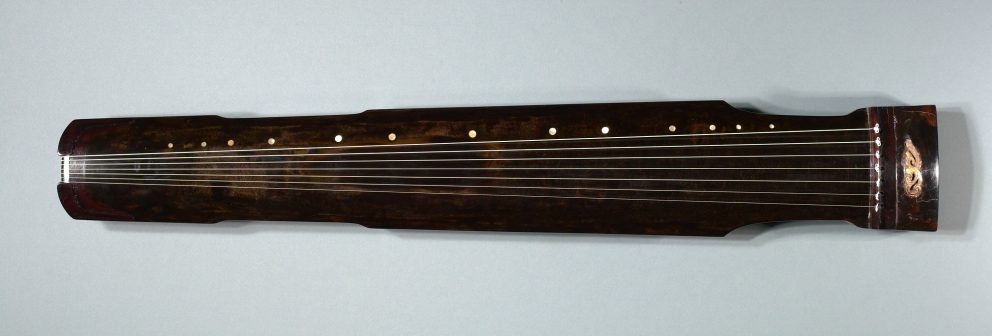
5 min read · 2 sourcesThe qin (琴 pronounced [tɕʰǐn]), or later guqin ([kùtɕʰǐn] ) after the 20th century (see terminology), is a plucked seven-string Chinese musical instrument. It has been played since ancient times, and has traditionally been favoured by scholars and literati as an instrument of great subtlety and refinement, as highlighted by the quote "a gentleman does not part with his qin or se without good reason," as well as being associated with the ancient Chinese philosopher Confucius. It is sometimes referred to by the Chinese as "the father of Chinese music" or "the instrument of the sages". The guqin is not to be confused with the guzheng, another Chinese long stringed instrument also without frets, but with moveable bridges under each string. The guqin is a very quiet instrument, with a range of about four octaves, and its open strings are tuned in the bass register. Its lowest pitch is about two octaves below middle C, or the lowest note on the cello. Sounds are produced by plucking open strings, stopped strings, and harmonics. The use of glissando—sliding tones—gives it a sound reminiscent of a pizzicato cello, fretless double bass or a slide guitar. The qin has 13 hui (徽), which represent the different position in one string. Pressing different hui produces different sound keys. The qin is also capable of many harmonics, of which 91 are most commonly used and indicated by the dotted positions. 1
Terminology
The Chinese logogram that represents the instrument 琴 by default in Chinese according to the 2nd century Shuowen Jiezi (theoretically read as *krɯm in Old Chinese) comes from its cross section side profile. By the twentieth century however, 琴 qin had encompassed a class to many other string instruments introduced to China over the ages like the hammered dulcimer (洋琴 yangqin "ocean [foreigners'] qin"), the huqin family of bowed string instruments, even extended to the Western piano (鋼琴 gangqin "steel qin") and violin (小提琴; xiaotiqin "small carriable qin"); thus the prefix gu- (古; "ancient") was later added for clarification becoming the guqin of today. It can also be called qixian-qin (七絃琴; 'seven-stringed qin'). Because Robert Hans van Gulik's book about the qin is called The Lore of the Chinese Lute, the guqin is sometimes inaccurately called a lute. 1
History
Legend has it that the qin, the most revered of all Chinese musical instruments, has a history of about 5,000 years, and that the legendary figures of China's pre-history – Fuxi; Shennong; and Huang Di, the "Yellow Emperor" – were involved in its creation. Nearly all qin books and tablature collections published prior to the twentieth century state this as the actual origins of the qin, although this is now viewed as mythology. It is mentioned in Chinese writings dating back nearly 3,000 years, and examples have been found in tombs from about 2,500 years ago. The exact origins of the qin is still a very much continuing subject of debate over the past few decades. In 1977, a recording of "Flowing Water" (Liu Shui, as performed by Guan Pinghu, one of the best qin players of the 20th century) was chosen to be included in the Voyager Golden Record, a gold-plated LP recording containing music from around the world, which was sent into outer space by NASA on the Voyager 1 and Voyager 2 spacecraft. It is the second-longest excerpt included on the disc. The reason to select a work played on this specific instrument is because the tonal structure of the instrument, its musical scale, is derived from fundamental physical laws related to vibration and overtones, representing the intellectual capacity of human beings on this subject. In 2003, guqin music was proclaimed as one of the Masterpieces of the Oral and Intangible Heritage of Humanity by UNESCO. 1
Schools, societies and players
As with any other musical tradition, there are differences in ideals and interaction between different people. Therefore, there exist different schools and societies which transmit these different ideas and artistic traditions. 1
Guqin societies
There is a difference between qin schools and qin societies. The former concerns itself with transmission of a style, the latter concerns itself with performance. The qin society will encourage meetings with fellow qin players in order to play music and maybe discuss the nature of the qin. A gathering like this is called a yaji (雅集; 'elegant gathering'), and takes place once every month or two. Sometimes, societies may go on excursions to places of natural beauty to play qin, or attend conferences. They may also participate in competitions or research. Societies do not need strict structure to adhere to; they can operate on a leisurely basis. The main purpose of qin societies is to promote and play qin music. They create opportunities to network and learn to play the instrument, to ask questions and to receive answers. 1
Players
Many individuals through the ages have played the guqin, both occupationally and avocationally; however, it is often associated with literati or gentlemen in particular. Certain melodies are also associated with famous gentlemen like Confucius, Qu Yuan, Ouyang Xiu, and Su Shi, or with poems from the Classic of Poetry (shijing 詩經). Some emperors of China also had a liking to the qin, including the Song dynasty emperor Huizong, as clearly seen in his own painting of himself playing the qin in Ting Qin Tu (聽琴圖; "Listening to the Qin") 1
The text above is adapted from the Wikipedia article “Guqin”, available under the Creative Commons Attribution-ShareAlike 4.0 licence. 1
guqin is Chinese plucked string instrument: kind of zither or lyre, typically with 5 or 7 strings, according to the structured record cited below. This entry was generated automatically from that record and has not yet been reviewed by a person familiar with the tradition. 2
The source record links this tradition to 22 external registers, which can be verified through the citation. 2