The tradition & historical record
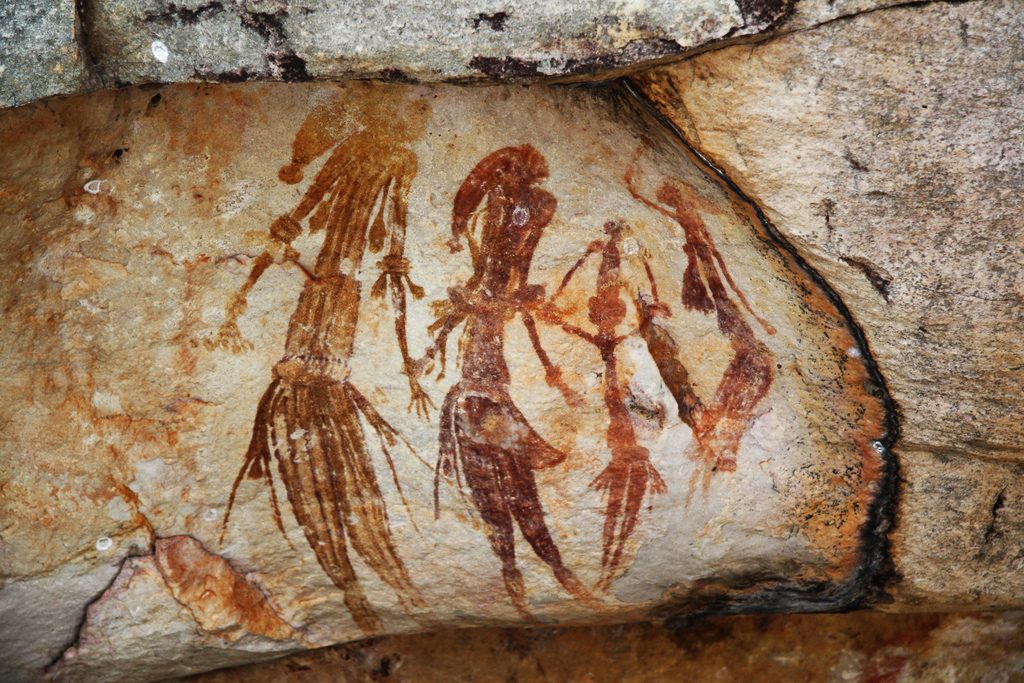
6 min read · 2 sourcesThe Gwion Gwion rock paintings, Gwion figures, Kiro Kiro or Kujon (also known as the Bradshaw rock paintings, Bradshaw rock art, Bradshaw figures and the Bradshaws) are one of the two major regional traditions of rock art found in the north-west Kimberley region of Western Australia. Key traditional owners have published their own account of the meaning of the images. However the identity of the artists and the age of the art are contested within archaeology and amongst Australian rock art researchers. A 2020 study estimates that most of the anthropomorphic figures were created 12,000 years ago, based on analysis of painted-over wasps' nests. These aspects have been debated since the works were seen, and recorded, in 1891 by pastoralist Joseph Bradshaw, after whom they were named until recent decades. As the Kimberley is home to many traditional owners, the rock art is referred to and known by many different names in the local languages, the most common of which are Gwion Gwion or Kiro Kiro/Giro Giro. The art consists primarily of human figures ornamented with accessories such as bags, tassels and headdresses. 1
Gwion Gwion art
Amateur archaeologist Grahame Walsh began work there in 1977 and returned to record and locate new sites up until his death in 2007. The results of this work produced a database of 1.5 million rock art images and recordings of 1,500 new rock art sites. He expanded his records by studying superimposition and style sequences of the paintings to establish a chronology that demonstrated that Gwion Gwion art is found early in the Kimberley rock art sequence. He proposed that the art dated to a period prior to the Pleistocene. Many of the ancient rock paintings maintain vivid colours because they have been colonised by bacteria and fungi, such as the black fungus, Chaetothyriales. The pigments originally applied may have initiated an ongoing, symbiotic relationship between black fungi and red bacteria. Based on stylistic characteristics, Walsh categorised two individual styles of Gwion paintings, which he named "Tassel" and "Sash" for dominant clothing features. He also identified two variants, which he named "Elegant Action figures" and "Clothes Peg figures". 1
Tassel figures: identified by their characteristic tassels hanging from their arms and waists, various other accessories can be recognised, such as arm bands, conical headdresses and boomerangs. This style is the earliest, most detailed and largest. Sash: while similar in appearance to the Tassel figures, the Sash body is depicted more robustly and the accoutrements depicted are slightly different: a three-pointed sash or bags attached to the figures' belts begin to be shown. Elegant Action figures: quite different from the Tassel and Sash figures, these figures are almost always shown running, kneeling or hunting with multi-barbed spears and boomerangs. 1
Dating
The Gwion Gwion are not the region's earliest paintings. The earlier art consists of crude animal drawings that are believed to be up to 40,000 years old. The Gwion Gwion have nothing in common with this earlier art and first appeared following the peak of the most recent Pleistocene glacial maximum, which is dated between 26,500 and 20,000 years ago. Since the mid-1990s, scientific dating methods have been used to determine the ages of the Gwion Gwion paintings. The methods have included accelerator mass spectrometry radiocarbon dating (AMS) and optically stimulated luminescence (OSL). This was used when mud wasp nests have been built over paintings, and it gives a minimum age rather than an actual age of the painting. The results of this have revealed some inconsistency with Walsh's chronology. Experimental OSL dates from a wasp nest overlaying a tassel Gwion Gwion figure has given a Pleistocene date of 17,500 ± 1,800 years BP. The academic community generally accepts 5,000 BP for the end of the artistic style. If the date ranges are correct, this may demonstrate that the Gwion Gwion tradition was produced for many millennia. Geoarchaeologist, Alan Watchman posits that the red paint used on a tasselled Gwion Gwion image near the Drysdale River is "likely to be only about 3,000 years old." Using the AMS results from accreted paint layers containing carbon associated with another figure, gives a date of 3,880 BP making Gwion Gwion art contemporaneous with, and no older than, Wanjina art. Around 15,000 years ago, the archaeological record shows that Aboriginals in the Kimberleys began using stone points in place of multi-barbed spears, but there is no record of this change of technology in the Gwion Gwion paintings. 1
Indigenous knowledge
Research undertaken in relation to Aboriginal knowledge has also increased. This has primarily been seen in Aboriginal names being applied to the paintings, reflecting the specific Aboriginal languages used in the areas where they are found. For example, the Ngarinyin name for the art is Gwion Gwion. Other terms include giro giro used by Aboriginal people in the Napier, Broome Bay and Prince Regent River. Australian rock art researcher David Welch notes that these words are probably different regional accents of Kujon, the name of the bird found in the creation story originally heard by Schultz in 1938. Aboriginal people are also more open in telling foreigners stories regarding the images. These stories often relate to spirits who created dances which are still performed today and feature similar apparel found in the paintings, such as headdresses, boomerangs and string. Bradshaws (Gwion Gwion) are also depicted in contemporary art works produced for sale in the Kimberley; one notable Gwion Gwion artist is Kevin Waina. 1
Colonial discovery and study
Rock art in the Kimberley region was first recorded by colonial explorer and future South Australian governor, George Grey as early as 1838. This rock art is now known as Wandjina style art. While searching for suitable pastoral land in the then remote Roe River area in 1891, pastoralist Joseph Bradshaw documented an unusual type of rock art on a sandstone escarpment. Bradshaw recognised that this style of painting was unique when compared to the Wandjina style. In a subsequent address to the Victorian branch of the Royal Geographical Society, he commented on the fine detail, the colours, such as brown, yellow and pale blue, and he compared it aesthetically to that of Ancient Egypt. American archaeologist Daniel Sutherland Davidson briefly commented on the figures while undertaking a survey of Australian rock art that he would publish in 1936. Davidson noted that Bradshaw's encounter with this art was brief and lacked any Aboriginal interpretations; furthermore, as Bradshaw's sketches of the art were at this time the only visual evidence, Davidson argued that they could be inaccurate and possibly drawn from a Eurocentric bias. The figures and their existence as an artistic tradition was questioned; articles and books on these works were not published until the 1950s. 1
Research
The fossil record of climate and vegetation at the last glacial maximum is … 1
The text above is adapted from the Wikipedia article “Gwion Gwion rock paintings”, available under the Creative Commons Attribution-ShareAlike 4.0 licence. 1
Gwion Gwion rock art is regional traditions of rock art in the Kimberley region of Western Australia, according to the structured record cited below. This entry was generated automatically from that record and has not yet been reviewed by a person familiar with the tradition. 2
The source record links this tradition to 1 external register, which can be verified through the citation. 2