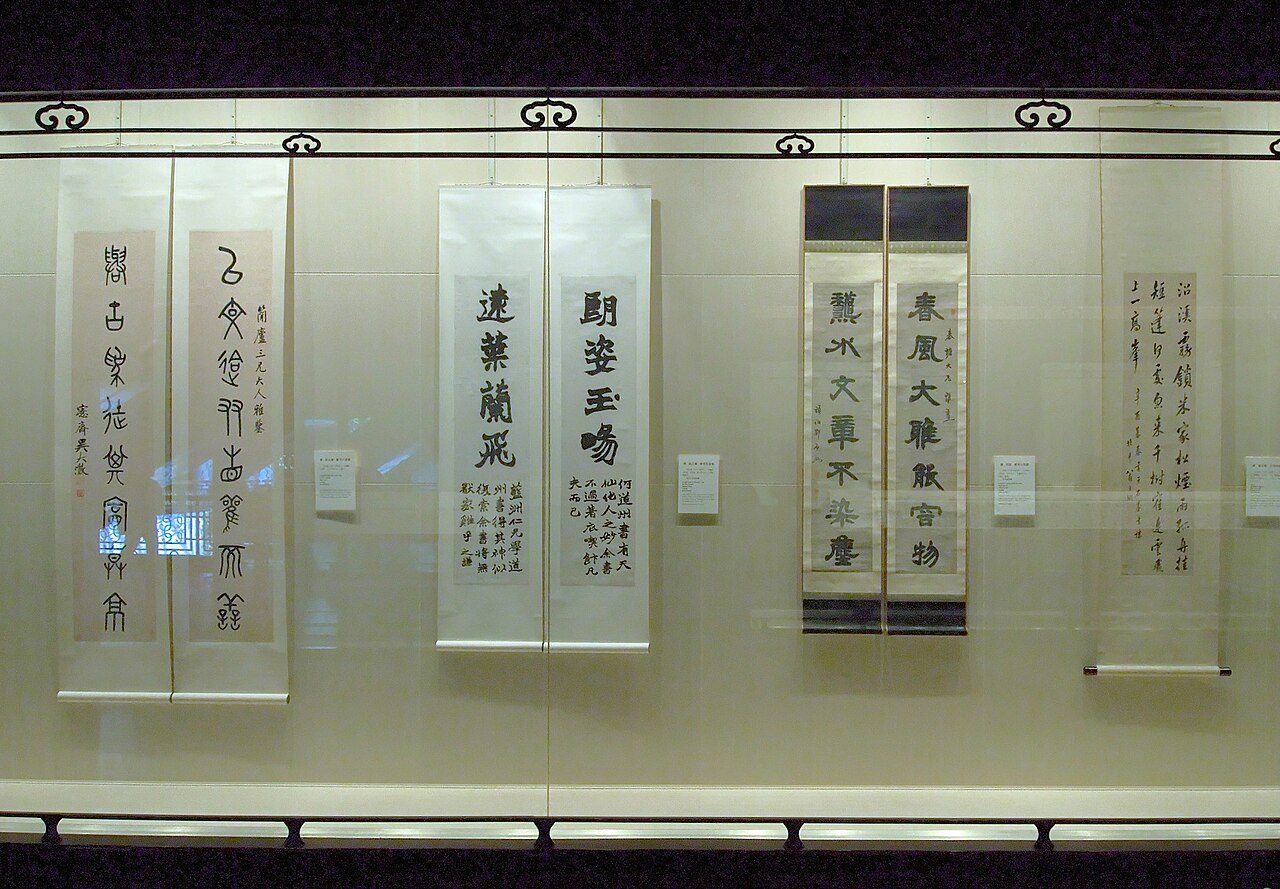
The tradition & historical record
5 min read · 2 sourcesA hanging scroll is one of the many traditional ways to display and exhibit East Asian painting and calligraphy. They are different from handscrolls, which are narrower and designed to be viewed flat on a table. Hanging scrolls are generally intended to be displayed for short periods of time, after which they are rolled up and tied for storage. They are traditionally rotated according to season or occasion, rather than be on permanent display. Their artwork could be mounted with decorative brocade silk borders. The craft of creating a hanging scroll is considered an art in itself. 1
History
Scrolls originated in their earliest form from texts written on bamboo strips and silk banners across ancient China. The earliest hanging scrolls are related to and developed from silk banners in early Chinese history. These banners were long and hung vertically on walls. Such silk banners and hanging scroll paintings were found at Mawangdui dating back to the Han dynasty (206 BCE – 220 CE). The aesthetic and structural objectives for hanging scrolls were summarized by the time of the Tang dynasty (618–907) and are still followed in the present day. During the early Song dynasty (960–1279), artists found that hanging scrolls were well suited to their art styles. Originally introduced to Japan from China as a means of spreading Buddhism, hanging scrolls found a place in Japanese culture and art and plays an important role in interior decoration. 1
Description
Hanging scrolls provide a vertical format to display art on walls. They are one of the most common types of scrolls for Chinese painting and calligraphy. They are made in many different sizes and proportions. Horizontal hanging scrolls are also a common form. Hanging scrolls are different from the handscrolls. A handscroll is a long narrow scroll for displaying a series of scenes in Chinese painting. It intended to be viewed section for section, flat on a table, during its unrolling. In contrast, a hanging scroll is appreciated in its entirety. 1
Mounting styles
There are several hanging scroll styles for mounting, known in Chinese as: 1
Yisebiao (一色裱, one color mount) Ersebiao (二色裱, two color mount) Sansebiao (三色裱, three color mount) Xuanhezhuang (宣和裝, Xuanhe style), also known as Songshibiao (宋式裱, Song dynasty mount) 1
Arrangements and formats
Besides the previous styles of hanging scroll mountings, there are a few additional ways to format the hanging scroll. 1
Hall painting (中堂畫) A hall painting is intended to be the centerpiece in a main hall. It is usually large, serves as a focal point in an interior, and often has a complicated subject. Four hanging scrolls (四條屏) These hanging scrolls were developed from screen paintings. They comprise several narrow and long hanging scrolls usually hung next to each other on a wall, but they can also be hung separately. Their subjects have related themes, such as the Four Gentlemen (orchid, bamboo, chrysanthemum, plum blossom) or the Four Beauties (ladies renowned for their beauty). Panoramic screen (通景屏) The panoramic screen consists of several hanging scrolls that have continuous images, in which the subject continues further in another scroll. These hanging scrolls cover large areas of a wall and usually do not have a border in between. Couplet (對聯) A couplet is two hanging scrolls placed side by side or accompanying a scroll in the middle. They have calligraphy in vertical writing. This style became popular during the Ming dynasty (1368–1644). Thin strip painting (條幅畫) Narrow strip paintings intended for smaller rooms and spaces. 1
Features and materials
Chinese mounting and conservation techniques are considered a traditional craft and are believed to have developed around 2,000 years ago. This craft is considered an art unto itself. Careful attention was and still is paid to ensure the quality and variety of the silk and paper to protect and properly fit the artwork onto the mounting, as it gives form to the art. The art is fixed onto a four-sided inlay, made from paper or silk, thus providing a border. The artwork in the middle of the scroll is called huaxin (畫心; literally "painted heart"). There is sometimes a section above the artwork called a shitang (詩塘; literally "poetic pool"), which is usually reserved for inscriptions onto the work of art, ranging from a short verse to poems and other inscriptions. These inscriptions are often done by people other than the artist. Although inscriptions can also be placed onto the material of the artwork itself. The upper part of the scroll is called tiantou (天頭; symbolizing "Heaven") and the lower part is called ditou (地頭; symbolizing "Earth"). At the top of the scroll is a thin wooden bar, called tiangan (天杆), on which a cord is attached for hanging the scroll. Two decorative strips, called jingyan (惊燕; literally "frighten swallows"), are sometimes attached to the top of the scroll. At the bottom of the scroll is a wooden cylindrical bar, called digan (地杆), attached to give the scroll the necessary weight to hang properly onto a wall, but it also serves to roll up a scroll for storage when the artwork is not in display. The two knobs at the far ends of the lower wooden bar are called zhoutou (軸頭) and help to ease the rolling of the scroll. These could be ornamented with a variety of materials, such as jade, ivory, or horn. 1
The text above is adapted from the Wikipedia article “Hanging scroll”, available under the Creative Commons Attribution-ShareAlike 4.0 licence. 1
hanging scroll is type of scroll painting, according to the structured record cited below. This entry was generated automatically from that record and has not yet been reviewed by a person familiar with the tradition. 2
The source record links this tradition to 4 external registers, which can be verified through the citation. 2