The tradition & historical record
5 min read · 2 sourcesThe Hara School was a Kyoto-based Japanese painting atelier established in the late Edo era, which continued as a family-controlled enterprise through the early 20th century. The Hara artists were imperial court painters and exerted great influence within Kyoto art circles. They contributed paintings to various temples and shrines, as well as to the Kyoto Imperial Palace. 1
Late Edo period painting schools
Artistic production in Edo period Japan was dominated by schools, which were professional workshops organized along patriarchal lines. They had the twinned goals of training painters to faithfully continue school techniques, and of producing art to satisfy patrons. Art was largely the domain of private patrons and connoisseurs, its manufacture being commission-driven by nobles, daimyōs, temples and shrines. Only late in the nineteenth-century did art become accessible to the public, with the 1872 opening of Japan's first museum. Schools were characterized by an extended family structure based on heredity through birth or adoption, and were modeled on the medieval guild system. Workshops also took inspiration from the edokoro, government-run painting offices. The late Edo atelier system had four features: the primacy of blood line, the hereditary transmission of skill from male to male, the positioning of the oldest male as single head, and alliances with other workshops through contract or marriage. Artistic ability was defined as a combination of shitsuga (質画) and gakuga (学画): innate and learned painting skill. Pupils entered workshops as children, based not primarily on talent, but on status. Some studios strictly policed students' leisure activities, such as drinking and socializing, which was facilitated by the fact that pupils traditionally lived-in as uchi deshi. Study was a serious, time-consuming endeavor: "the successful student spent years in training, a time during which he developed physical stamina, self-discipline, perseverance, the ability to earn for himself, facility in technical skills, and a good understanding of the aesthetics and spiritual considerations required of a dedicated painter". 1
Biography
Hara Zaichū was born Hara Chien (致遠) in 1750 in Kyoto, where he lived throughout his life. Although his family were sake brewers, Zaichū followed his passion for art. He studied the painting techniques of the then dominant Kanō School under master painter Ishida Yutei (石田幽汀) (1721–86) and was instructed in Buddhist painting by Yamamoto Tan'en (山本探淵) (d. 1816). Zaichū also took advantage of access to Ming period Chinese paintings in the collections of some Kyoto shrines and temples. Zaichū studied alongside Maruyama Ōkyo (円山応挙) (1733–95), who was to become one of the most influential artists of the Edo period and start his own painting school. There is some question as to whether Zaichū was Maruyama's pupil. Following Maruyama's death, Zaichū claimed not to have been, but this was disputed by Maruyama School members, most notably Zaichū's rival Kishi Ganku. Many modern biographies describe Zaichū as the "student" and Maruyama as his "teacher". Regardless, Zaichū was strongly influenced by Maruyama, as well as by the Kanō and the Tosa school styles. From these varied influences, Zaichū founded the Hara School in the mid-1770s. 1
Zaichū was a prominent figure in the Kyoto art world, and an official court artist. So strong was his court affiliation that he earned the moniker Kyūtei-ha (宮廷派), reflecting his status as a court representative. His name appeared in all five editions of the Heian jinbutsushi, a "Who's Who" of Kyoto, from 1775 through 1830. All four of his sons went on to become professional painters. The three eldest, Zaisei (原在正), Zaimei (原在明) and Zaizen (原在善), joined the Hara atelier. His youngest, Zaishin, was adopted into the Umeto family and worked under the name Umeto Zaishin (梅戸在親). 1
Style
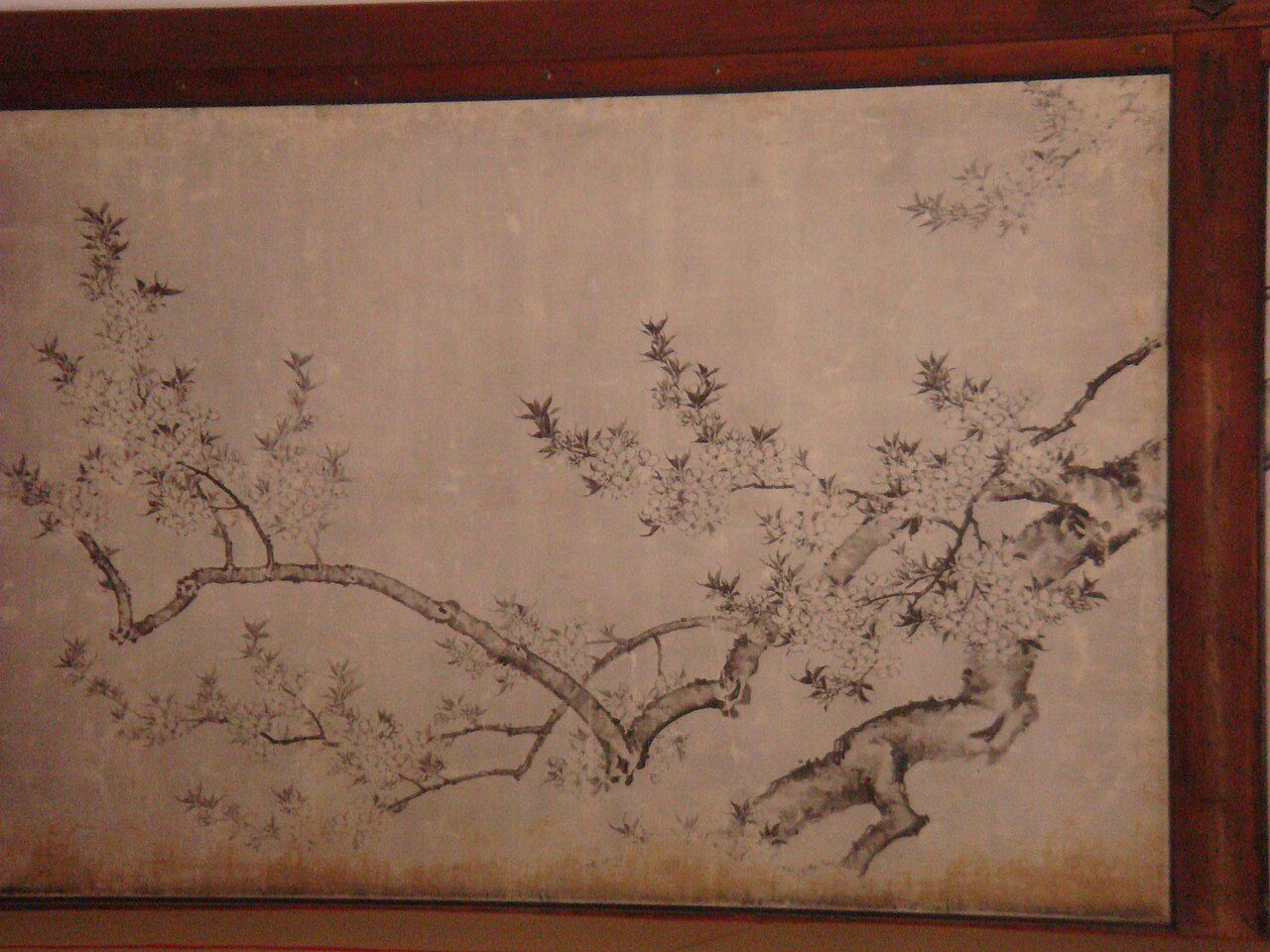
Thematically, his repertoire was diverse, including landscapes, portraits, plants and flowers, animals, Buddhist scenes (仏画), and gods (神像). He was considered particularly expert at court scenes, as well as landscapes and nature scenes. When construction began on Kyoto's Imperial Palace in 1790, Zaichū joined artists from the Tosa and Kanō schools to contribute several paintings. He also produced fusuma-e (sliding door paintings) for Kyoto temples such as Ninnaji (仁和寺), Kenninji (建仁寺), Shōgoin ( 聖護院) and Shōkokuji (相國寺). He worked in various scales and media, from small emaki (絵巻) handscrolls, kakemono (掛け物) hanging scrolls, and ema (絵馬) wooden prayer boards, to large fusuma-e (襖絵). The Hara style tends to be described relative to other styles, for example as "lying somewhere between the orthodox Kanō, Chinese literati and Maruyama styles". Critics identify his work as delicate and decorative, as well as precise, balanced and elegant. In comparison with many of his contemporaries, he was less inclined toward realism and drama. As a result, his works are considered "rather quiet and low key", or even characterized by "stiffness", yet "admirably suited to the needs of the court". 1
Critical assessment
Many of Zaichū's paintings were stored in prominent Kyoto temples frequented mainly by the nobility. As a result, his works were not available to the public, which some argue has negatively affected his reputation. In addition to despairing of Zaichū's works' "blandness", some modern critics have challenged his status as an important artist, arguing that his works are essentially imitations of older Chinese and Japanese paintings rather than original, creative pieces. Others acknowledge his use of prototypes, but suggest that his works demonstrate a "characteristic Japanese dynamism". Zaichū, for the record, acknowledged his indebtedness to existing works: on some paintings, instead of signing his name, he wrote captions identifying the pieces as "copies" or as being "after" a given artist. 1
Works
In addition to those on display in the Kyoto Imperial Palace, paintings by Zaichū can be seen at the Kyoto National Museum (京都国立博物館), Shizuoka Museum (静岡県立美術館), Iida City Museum (飯田市美術博物館), Daitokuji Temple, Ikkyūji Temple (一休寺), and Shōkokuji Temple (相国寺). Outside Japan, the British Museum holds one of his paintings. 1
The text above is adapted from the Wikipedia article “Hara school of painters”, available under the Creative Commons Attribution-ShareAlike 4.0 licence. 1
Hara school of painters is Japanese painting atelier, according to the structured record cited below. This entry was generated automatically from that record and has not yet been reviewed by a person familiar with the tradition. 2
The source record links this tradition to 1 external register, which can be verified through the citation. 2