The tradition & historical record
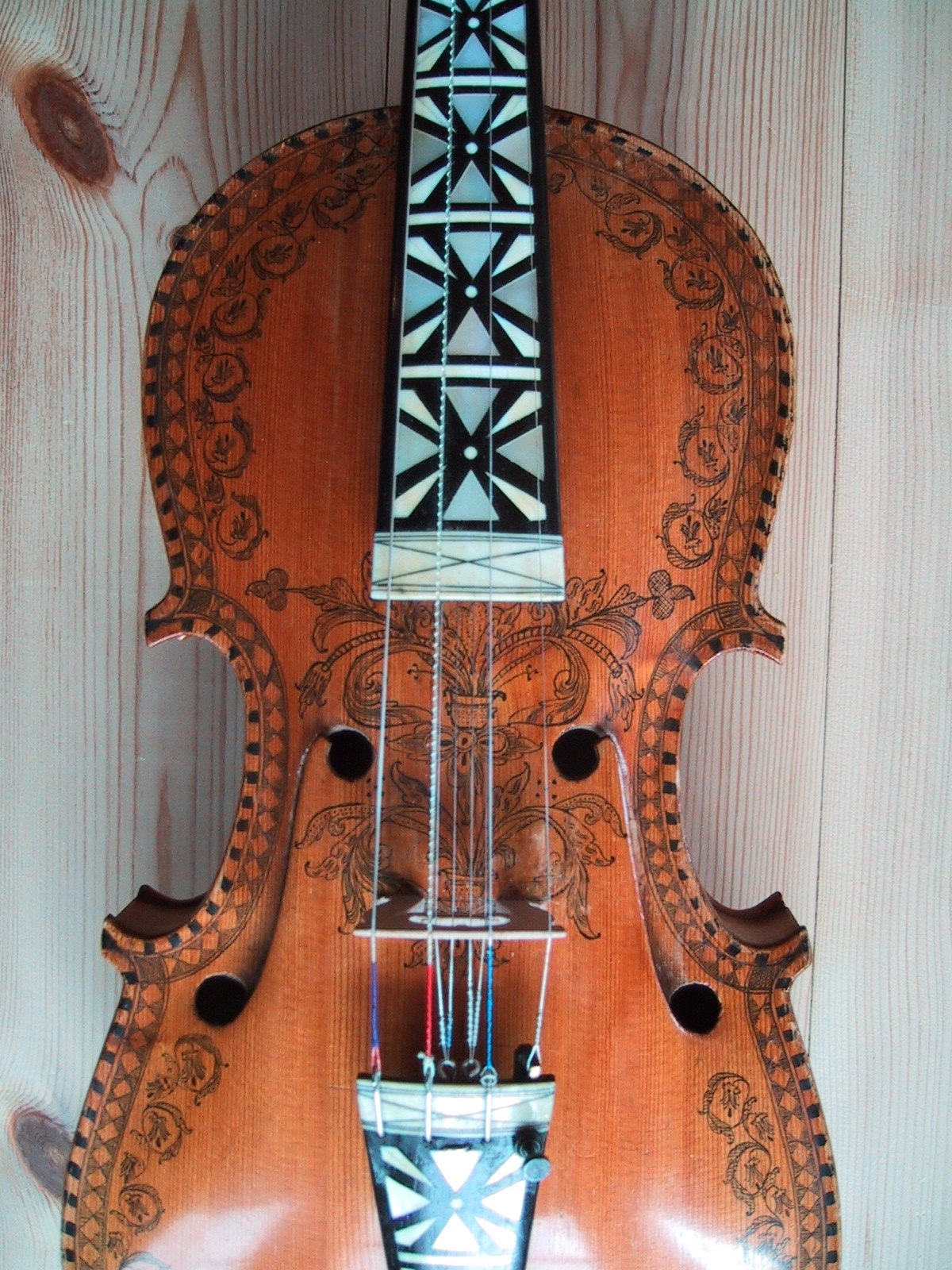
7 min read · 2 sourcesA hardanger fiddle (Norwegian: hardingfele) is a traditional stringed instrument considered the national instrument of Norway. In modern designs, this type of fiddle is very similar to the violin, though with eight or nine strings (rather than four as on a standard violin) and thinner wood. The earliest known example of the hardingfele is from 1651, made by Ole Jonsen Jaastad in Hardanger, Norway. Originally, the instrument had a rounder, narrower body. Around the year 1850, the modern layout with a body much like the violin became the norm. The F-holes of the hardanger fiddle are distinctive, oftentimes with a more "sunken" appearance, and generally straighter edges (unlike the frilly, swirly F-holes of a violin). Four of the strings are strung and played like a violin, while the rest, named understrings or sympathetic strings, resonate under the influence of the other four. These additional strings are tuned and secured with extra pegs at the top of the scroll, effectively doubling the length of a Hardingfele scroll when compared to a violin. The sympathetic strings, once fastened to their pegs, are funneled through a "hollow" constructed fingerboard, which is built differently than a violin's, being slightly higher and thicker to allow for these extra strings. The resonant strings lie on the center of the special bridge, attached to extra hooks (or fine-tuners) on the tailpiece. 1
Tunings
Unlike the violin, the hardingfele is a transposing instrument, meaning sheet music for the hardingfele is written in a key other than the one where the instrument sounds when it plays that music. Specifically, the hardingfele is a D instrument, meaning that the hardingfele's written C corresponds to D on a non-transposing instrument, such as the piano. The notes given below for tunings are therefore relative to the hardingfele's written A, not to a concert A. 1
The understrings are tuned to vibrate according to the main tuning. For example, when the main strings are tuned A-D-A-E, the understrings are tuned B-D-E-F♯-A. The tuning largely depends on the region in which the instrument is being played, or the requirements of a particular tune. In Norway, more than 20 different tunings are recorded. Most hardanger tunes are played in a common tuning (A-D-A-E). The hardanger fiddle can also be played in "low bass", the word "bass" referring to the lowest string, (G-D-A-E), the normal violin tuning. In certain regions, the "Gorrlaus" (F-D-A-E) tuning is sometimes used. Many well-known players (such as Annbjørg Lien) frequently employ E-scale tunings; i.e., instead of A-D-A-E, with tunes being mainly played in a D-scale, the instrument will be tuned to B-E-B-F#, so the tunes are mostly in an E-scale. Going higher still, the player Knut Buen recorded several albums in an F-scale tuning, C-F-C-G. This is possible only on a smaller-bodied instrument (such as a hardanger fiddle), being rarely attempted on a standard full-sized violin. As a substitute, many fiddlers who play standard violins will simply tune their G string to A, using the A-D-A-E tuning, enabling them to play the same style of music. Another tuning is called "troll tuning" (A-E-A-C♯). 1
Technique
The technique of bowing a hardingfele also differs from that used with a violin. It's a smoother, bouncier style of bowing, with a lighter touch. The player usually bows on two of the upper strings at a time, and sometimes three. This is made easy by the relative flatness of the bridge, unlike the more curved bridge on a violin. The objective is to create a continuous sound of two (or more due to the sympathetic understrings) pitches. The strings of the fiddle are slimmer than those of the violin, resembling the strings of violins from the baroque period. Many classically trained violinists use a baroque bow when playing the hardingfele in order to counteract the extra weight that classical violinists naturally place on the string. Here is an example of technique shown by Rose Logan with an instrument held at St Cecilia's Hall. 1
The hardanger fiddle and religion
The hardingfele has had a long history with the Christian church. Well known early fiddle maker Isak Botnen is said to have learned some of his craft from church lay leader and school master Lars Klark, along with the methods for varnishing from pastor Dedrik Muus. In many folktales, the devil is associated with the hardingfele; in fact many good players were said to have been taught to play by the devil, if not by the nix. During religious revivals in the 19th century, many fiddles (regular and hardanger) were destroyed or hidden both by fiddlers and laypeople who thought "that it would be best for the soul that the fiddles be burned", as it was viewed as a "sinful instrument that encouraged wild dances, drinking and fights." This happened in Norway, as well as other parts of Europe, and until the 20th century playing a hardanger fiddle in a church building was forbidden. Some fiddlers, however, played on, in spite of all condemnation, and thus valuable traditions remained intact. The first folk musicians to perform in a church were the fiddlers Johannes Dahle from Tinn Municipality, and Gjermund Haugen from Notodden Municipality. Dahle performed in the 1920s. Known modern fiddler Annbjørg Lien has played with church organist Iver Kleive, but even she has experienced prejudice before performance from the religious side. Also, the oldest known fiddles still in existence can be heard accompanied by the oldest playable church pipe organ in Norway (originally built for an 18th-century church) on the album "Rosa i Botnen" by Knut Hamre and Benedicte Maurseth. While the use of a hardingfele in church in Norway may still be a bit sensitive for some, fiddlers in other parts of the world have no problems playing in churches for all types of occasions, including weddings. 1
Influences
Edvard Grieg adapted many hardanger folk tunes into his compositions, and composed tunes for the hardanger as part of his score for Ibsen's Peer Gynt Suite No. 1. The opening phrase of "Morning" from Grieg's Peer Gynt music is derived from the tuning of the sympathetic strings of the hardanger fiddle: A F♯ E D E F♯ and so on. In recent years, the instrument has gained recognition in the rest of the world. Japan has been one of the countries that has found an interest in the hardingfele and Japanese musicians travel to Norway just to learn to play this instrument. In 1997, the Australian classical composer Liza Lim wrote the piece Philtre for a solo hardanger fiddle, and she also includes the instrument in her work Winding Bodies: 3 Knots (2013–14). Her string quartet The Weaver's Knot (2013–14) is inspired by the sound and performance techniques of hardanger fiddle playing. Another recent work is "mobius II" for hardanger fiddle and electronics by the British composer Rose Dodd (2011, premiered at the Huddersfield Contemporary Music Festival by Britt Pernille Froholm). 1
Players
Notable hardingfele players include Lillebjørn Nilsen, Knut Buen, Hauk Buen, Olav Jørgen Hegge, Annbjørg Lien, S… 1
The text above is adapted from the Wikipedia article “Hardanger fiddle”, available under the Creative Commons Attribution-ShareAlike 4.0 licence. 1
Hardanger fiddle is traditional Norwegian stringed instrument, according to the structured record cited below. This entry was generated automatically from that record and has not yet been reviewed by a person familiar with the tradition. 2
The source record links this tradition to 19 external registers, which can be verified through the citation. 2